
Virtual Synchronous Generator Control Platform Market Report Scope and Overview:
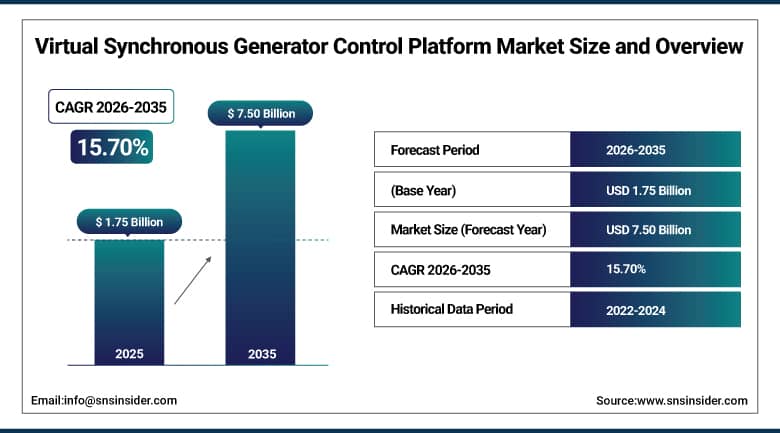
The Virtual Synchronous Generator Control Platform Market was valued at USD 1.75 Billion in 2025 and is projected to reach USD 7.50 Billion by 2035, registering a CAGR of 15.70% from 2026 to 2035.
The Virtual Synchronous Generator Control Platform Market is an indispensable technology layer as power systems incorporate more renewable energy sources, offering grid-tied inverters with the functionality of inertia, damping, and dynamic frequency response of traditional synchronous generators. In a context where power systems experience a transition from coal, gas, and nuclear facilities toward renewable energy sources, this technology ensures that grids become stabilized through inertia, frequency response, and voltage regulation, which can be achieved in the absence of conventional synchronous generators.
To Get More Information Of This Market - Request Free Sample Report
Virtual Synchronous Generator Control Platform Market Trends
-
Rising retirement of conventional synchronous generation continues accelerating demand for synthetic inertia control platforms.
-
Growing grid-code mandates for fast frequency response continue expanding utility procurement of VSG control algorithms.
-
Expanding microgrid and distributed energy resource deployment is broadening demand for islanding and resynchronization control functions.
-
Increasing integration of AI and machine learning continues improving adaptive tuning of virtual inertia and damping parameters.
-
Growing preference for software-based, firmware-upgradable control continues reducing incremental hardware deployment costs.
U.S. Virtual Synchronous Generator Control Platform Market Outlook
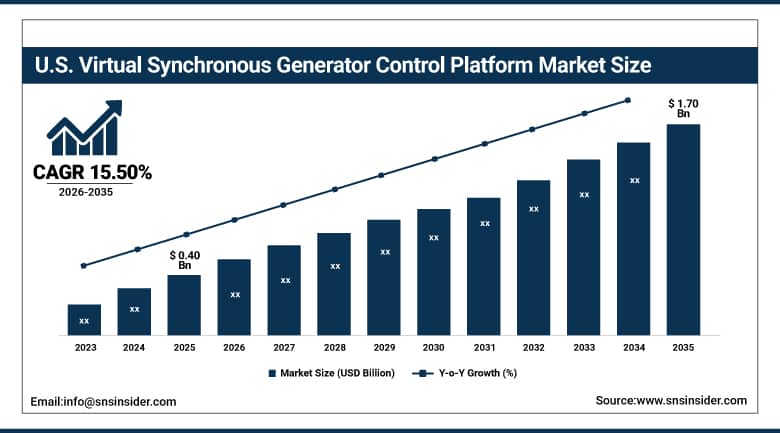
The U.S. Virtual Synchronous Generator Control Platform Market was valued at approximately USD 0.40 Billion in 2025 and is projected to reach approximately USD 1.70 Billion by 2035, registering a CAGR of approximately 15.50% from 2026 to 2035.
In the U.S., the demand has been generated by the rapid retiring of synchronous generation powered by coal and natural gas plants, growing mandates for fast frequency response and inertia contribution from inverters by FERC and NERC grid codes, and rising adoption of grid-forming inverters' control software at utility-scale photovoltaic plants, wind farms, and energy storage systems. Increasing investment into microgrid resiliency programs by commercial, industrial, and critical infrastructure owners became an additional driver of demand from utilities and IPPs for the VSG control platform.
Adaptive control algorithms for virtual inertia and damping tuning based on artificial intelligence was crucial for maintaining the leadership of the U.S. market for the virtual synchronous generator control platform. Also, increasing adoption of cloud-based monitoring and diagnostic software for distributed renewable and energy storage assets became an additional source of demand for the solution.
Virtual Synchronous Generator Control Platform Market Segment Analysis
-
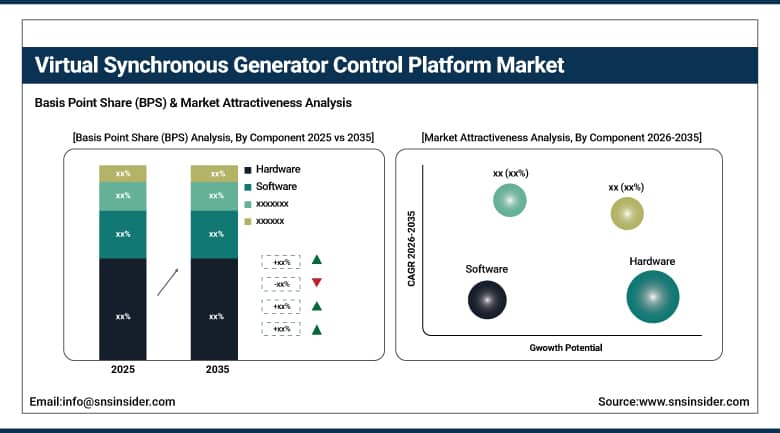
By Component, Hardware segment dominated the Market in 2025 with 42.50% share; Software segment is the fastest growing segment, registering a CAGR of approximately 19.30%.
-
By Application, Renewable Energy Integration segment dominated the market in 2025 with 34.60% share; Microgrids segment is the fastest growing segment, registering a CAGR of approximately 19.80%.
-
By Deployment Mode, On-Premises segment dominated the market in 2025 with 61.40% share; Cloud-Based segment is the fastest growing segment, registering a CAGR of approximately 21.50%.
-
By End User, Utilities segment dominated the market in 2025 with 54.70% share; Industrial segment is the fastest growing segment, registering a CAGR of approximately 18.60%.
By Component, Hardware Dominates While Software Accelerates Fastest
The Hardware held the highest market share of the Virtual Synchronous Generator Control Platform Market in 2025, accounting for about 42.50% on account of sustained demand for control systems, sensors, and grid-forming inverters, which form the physical basis for the realization of virtual inertia control technology. The launch of the easYgen control system from Woodward is an example of how control software and hardware acquisitions by utilities and integrators remain high on their agendas.
Software is expected to register a CAGR of about 19.30%, the highest of all segments within the Component category, due to increasing adoption of firmware-upgradeable control algorithms by suppliers that enable grid forming capability through the addition of minimal incremental cost for existing inverter hardware. The increased adoption of AI-driven adaptive tuning, cloud analytics, and remote diagnostics capabilities fuels this growth trend.
By Application, Renewable Energy Integration Dominates While Microgrids Grow Fastest
Renewable Energy Integration held the largest application share in 2025 at approximately 34.60%, since it continues to be the main force driving the VSG platform adoption by utilities and IPPs in order to counterbalance the negative effects of the intermittent production of solar and wind energy sources on the stability of the electric grid. The increasing implementation of virtual inertia and frequency support capabilities along with renewable integration projects makes this application the natural choice when adopting VSG platforms.
Microgrids are expected to grow at a CAGR of about 19.80% during the forecast period, making it the fastest-growing segment within applications categories, as commercial, industrial, and rural operators deploy VSG-based islanding and re-synchronization solutions in order to become independent and resilient to grid outages. An example of a VSG platform in this case is the grid-forming inverter control solution developed by Sungrow.
By Deployment Mode, On-Premises Leads While Cloud-Based Grows Fastest
On-premises deployment was estimated to hold the largest share in 2025, accounting for about 61.40% of the total market share due to high inclination towards in-house control system integration, zero latency, and highly secure data management in case of mission critical frequency control applications among utilities and large industries. Growing investment by utilities toward upgrading their control system infrastructure for implementing VSG technology has contributed to dominance of this deployment model.
Cloud-based deployment is expected to be the fastest growing mode with CAGR of about 21.50% during forecast period owing to growing inclination of commercial organizations and utilities toward cloud platform due to no upfront capital requirements and other benefits such as remote monitoring capability, real time analytics, and easy software upgrades. The vendors are continuously working on enhancing the security of their cloud infrastructure.
By End User, Utilities Lead While Industrial Users Gain Fastest Traction
Utilities emerged as the leading end-user segment in 2025, accounting for approximately 54.70% of total revenue, due to their responsibility in ensuring grid stability, renewable energy integration, and conformity to grid code regulations. The growing use of VSG control systems in utilities within North America, Europe, and Asia Pacific is attributed to the retiring of synchronous generators and the backlog in renewable energy integration due to the direct investments in grid forming technologies.
Among the end-users, the industrial end users' growth is expected to be the fastest, recording about 18.60% CAGR because of the growing use of VSG control systems in manufacturing, mining, and data center facilities that require reliable energy supply and low sensitivity to disturbance using on-site renewable energy. It has become easy for mid-sized industrial facilities to install grid forming solutions because of the availability of modular and scalable control packages.
Regional Analysis:
|
Region |
Major Country |
Share within Region, 2025 (%) |
|---|---|---|
|
Asia Pacific |
China |
38.40% |
|
North America |
United States |
80.00% |
|
Europe |
Germany |
28.20% |
|
Middle East and Africa |
Saudi Arabia |
26.50% |
|
Latin America |
Brazil |
34.20% |
Asia Pacific Virtual Synchronous Generator Control Platform Market Insights
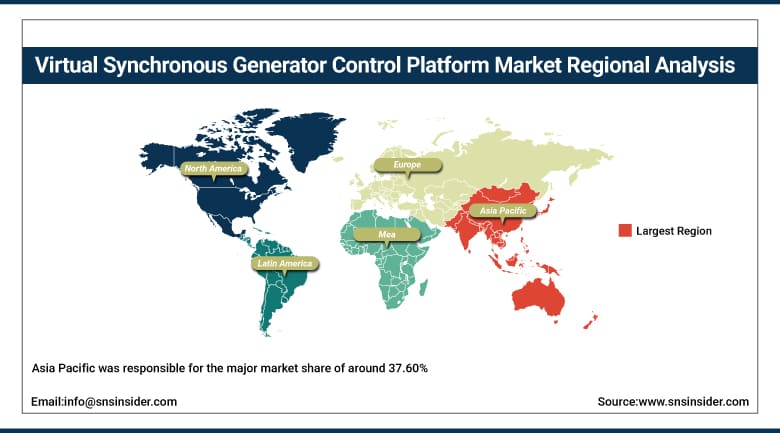
Asia Pacific was responsible for the major market share of around 37.60% of the Virtual Synchronous Generator Control Platform Market in 2025 and is also expected to continue as the leading region in terms of fastest growth rate, growing with an approximate CAGR of 20.80% between 2026 and 2035. This dominant position has been fueled by factors such as high levels of industrialization, renewable energy ambitions, and large-scale grid modernization initiatives in countries such as China, India, Japan, and South Korea.
The country that contributed the maximum share of the Asia Pacific revenue pool was China at around 38.40%, owing to consistent investments made by the government of the country in renewable capacity development as well as increased local production capabilities of grid forming inverter control technology. In India, rapid interconnections of renewable sources along with national level grid code reform initiatives to generate synthetic inertia have been the primary driving forces behind the growth in the region.
Get Customized Report as Per Your Business Requirement - Enquiry Now
North America Virtual Synchronous Generator Control Platform Market Insights
North America held a substantial share of the Virtual Synchronous Generator Control Platform Market in 2025, due to the mature power system, the high level of renewable energy adoption, and the emphasis placed on improving resilience within the power grids against the backdrop of early retirements of traditional synchronous generators. The United States and Canada have been leading in the installation of virtual synchronous generator control platforms as a result of the overall need to update the existing aging power grid infrastructure and transition to an inverter-based power system.
The United States alone captured about 80.00% of the total revenue share of the North American market mainly due to the fast frequency response requirement set by the FERC and NERC as well as the investment in grid-forming inverter technologies by utilities that are developing wind, solar, and energy storage projects.
Europe Virtual Synchronous Generator Control Platform Market Insights
The European region had a considerable market share for the VSG Control Platform Market on account of stringent grid codes, decarbonization goals, and high renewable penetration in the member countries. Countries like Germany, the UK, France, and the Nordics are actively adopting VSG platforms to tackle the issues related to grid stability amid growing installations of renewable capacities and retirements of traditional power plants.
Germany was the revenue leader in the European market on the back of massive renewable capacity installation in line with its energy transition initiative and rising need for grid forming inverters in light of increasing volatility of the power grid. The UK also maintained its relevance as a regional demand driver due to its plans of installing offshore wind capacities and grid code changes that require synthetic inertia from renewables.
MEA and Latin America Virtual Synchronous Generator Control Platform Market Insights
The European region had a considerable market share for the VSG Control Platform Market on account of stringent grid codes, decarbonization goals, and high renewable penetration in the member countries. Countries like Germany, the UK, France, and the Nordics are actively adopting VSG platforms to tackle the issues related to grid stability amid growing installations of renewable capacities and retirements of traditional power plants.
Germany was the revenue leader in the European market on the back of massive renewable capacity installation in line with its energy transition initiative and rising need for grid forming inverters in light of increasing volatility of the power grid. The UK also maintained its relevance as a regional demand driver due to its plans of installing offshore wind capacities and grid code changes that require synthetic inertia from renewables.
Market Dynamics:
Growth Drivers: Accelerating Synchronous Generator Retirement and Renewable Integration
The market will continue to develop in response to an increasing rate of retirement of coal, gas, and nuclear synchronous generation; increasing investments made by utilities in grid-forming inverter control technology; increasing integration of renewable energy sources that require synthetic inertia and frequency support; and increased microgrid and DER deployments that require advanced islanding and resynchronization controls. In view of the increasing number of grid code updates calling for inertia provided by inverter-controlled generators, demand for VSG control solutions is anticipated to remain robust along the entire value chain for the forecast period.
Also indicative of the growing demand are increasingly close relationships between vendors of control software and inverters, along with government-sponsored programs for grid modernization and renewable energy integration in several geographies. Maintaining grid stability without replacing traditional generating assets will continue to be a priority globally during the forecast period.
Restraints: High Deployment Complexity and Integration Costs
The comparatively higher cost and technical challenges of implementing such VSG control systems represent a barrier to quicker adoption in the market, especially for smaller utility companies and businesses lacking in technical know-how. The technical challenges associated with connecting VSG systems to existing grid systems represent considerable obstacles, especially in terms of the amount of investment required to get these projects up and running.
Another concern that must be taken into account is that of cybersecurity, data protection, and regulatory compliance, issues which vary from one region to another and can represent additional hurdles for both vendors and end-users. Compatibility issues between existing SCADA systems and VSG systems present additional obstacles for utilities managing grids using multi-vendor equipment.
Opportunities: Digital Transformation and Grid Security Enhancement
The evolving digital revolution in the energy industry offers an excellent opportunity for vendors that can integrate artificial intelligence, machine learning, and IoT technology in VSG control platforms for predictive maintenance and performance optimization. Siemens AG and Hitachi Energy platform services that include AI-enabled grid analytics as well as grid forming control functionalities are good examples of how vendors take advantage of this emerging workflow opportunity.
In addition, the global shift towards a net zero energy system offers enormous opportunities for vendors who have scalable, interoperable and cost-effective VSG products that can meet future demands for inverter dominated power systems. Vendors who can demonstrate improvement in grid stability and curtailment due to their grid forming technology offer a great chance for continued investments from utility and industrial customers.
Recent Developments:
-
2025: Woodward, Inc. upgraded its easYgen control platform with expanded synchronization and protection features for distributed generation and microgrid applications.
-
2025: SMA Solar Technology introduced grid-forming firmware upgrades for its Sunny Tripower inverter line, enabling synthetic inertia support without additional hardware investment.
-
2026: NR Electric launched an upgraded wide-area grid-forming control platform supporting coordinated virtual inertia dispatch across multi-site renewable portfolios.
-
2026: GE Vernova expanded its grid automation software portfolio with new adaptive control algorithms for grid-forming inverter tuning across utility-scale renewable projects.
Virtual Synchronous Generator Control Platform Market key players are:
-
ABB Ltd.
-
Siemens AG
-
GE Vernova Inc.
-
Schneider Electric SE
-
Huawei Technologies Co., Ltd.
-
SMA Solar Technology AG
-
Sungrow Power Supply Co., Ltd.
-
Hitachi Energy Ltd.
-
Emerson Electric Co.
-
Eaton Corporation plc
-
Delta Electronics, Inc.
-
NR Electric Co., Ltd.
-
Rockwell Automation, Inc.
-
Woodward, Inc.
-
Mitsubishi Electric Corporation
-
Ingeteam S.A.
-
Nidec Corporation
-
TMEIC (Toshiba Mitsubishi-Electric Industrial Systems Corporation)
-
KACO new energy GmbH
-
ComAp a.s.
Virtual Synchronous Generator Control Platform Market:
| Report Attributes | Details |
|---|---|
| Market Size in 2025 | USD 1.75 Billion |
| Market Size by 2035 | USD 7.50 Billion |
| CAGR | 15.70% from 2026 to 2035 |
| Base Year | 2025 |
| Forecast Period | 2026-2035 |
| Historical Data | 2022-2024 |
| Report Scope & Coverage | Market Size, Segments Analysis, Competitive Landscape, Regional Analysis, DROC & SWOT Analysis, Forecast Outlook |
| Key Segments | •By Component, Hardware segment dominated the Market in 2025 with 42.50% share; Software segment is the fastest growing segment, registering a CAGR of approximately 19.30%. •By Application, Renewable Energy Integration segment dominated the market in 2025 with 34.60% share; Microgrids segment is the fastest growing segment, registering a CAGR of approximately 19.80%. •By Deployment Mode, On-Premises segment dominated the market in 2025 with 61.40% share; Cloud-Based segment is the fastest growing segment, registering a CAGR of approximately 21.50%. •By End User, Utilities segment dominated the market in 2025 with 54.70% share; Industrial segment is the fastest growing segment, registering a CAGR of approximately 18.60%. |
| Regional Analysis/Coverage | North America (US, Canada), Europe (Germany, UK, France, Italy, Spain, Russia, Poland, Rest of Europe), Asia Pacific (China, India, Japan, South Korea, Australia, ASEAN Countries, Rest of Asia Pacific), Middle East & Africa (UAE, Saudi Arabia, Qatar, South Africa, Rest of Middle East & Africa), Latin America (Brazil, Argentina, Mexico, Colombia, Rest of Latin America). |
| Company Profiles | ABB Ltd., Siemens AG, GE Vernova Inc., Schneider Electric SE, Huawei Technologies Co., Ltd., SMA Solar Technology AG, Sungrow Power Supply Co., Ltd., Hitachi Energy Ltd., Emerson Electric Co., Eaton Corporation plc, Delta Electronics, Inc., NR Electric Co., Ltd., Rockwell Automation, Inc., Woodward, Inc., Mitsubishi Electric Corporation, Ingeteam S.A., Nidec Corporation, TMEIC (Toshiba Mitsubishi-Electric Industrial Systems Corporation), KACO new energy GmbH, ComAp a.s. |

Frequently Asked Questions
Key players in the Virtual Synchronous Generator Control Platform Market include ABB Ltd., Siemens AG, GE Vernova Inc., Schneider Electric SE, and Hitachi Energy Ltd., among others.
Key opportunities in the Virtual Synchronous Generator Control Platform Market include expansion of AI-driven adaptive control and digital twin capabilities, alongside growing demand for grid-forming technology to support the global transition toward net-zero, inverter-dominated power systems.
The market is driven by accelerating retirement of conventional synchronous generation, rising renewable energy interconnection requiring synthetic inertia and frequency support, and expanding grid-code mandates requiring inertia contribution from inverter-based resources.
The Hardware segment dominated the Virtual Synchronous Generator Control Platform Market, accounting for approximately 42.50% market share.
The Asia Pacific region dominated the Virtual Synchronous Generator Control Platform Market in 2025 with a 37.60% share, driven by rapid industrialization and large-scale renewable energy investment across China and India.
