
Vitamins & Minerals Market Report Scope & Overview:
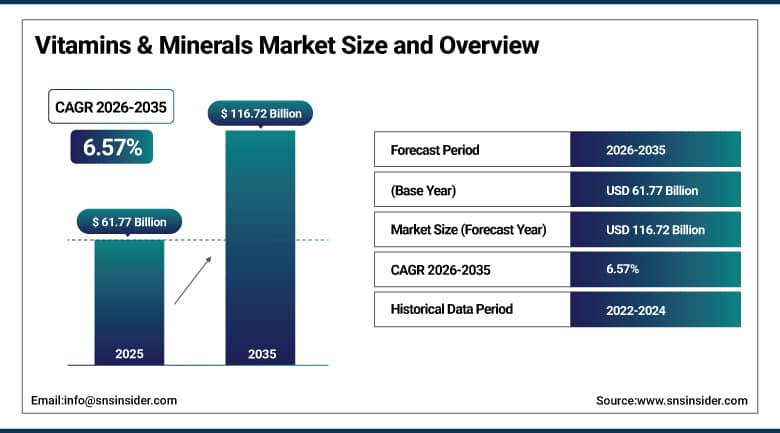
The Vitamins & Minerals Market was valued at USD 61.77 Billion in 2025 and is expected to reach USD 116.72 Billion by 2035, growing at a CAGR of 6.57% from 2026 to 2035.
Vitamins and minerals occupy a strange spot in the broader supplement world, they are the least glamorous category, no adaptogens or nootropic buzzwords attached, yet they remain the financial backbone the rest of the industry is built on. Widespread micronutrient deficiencies, even in wealthy countries with abundant food supply, keep demand steady in a way flashier wellness trends cannot always match, and public health messaging around vitamin D and B12 in particular has done more to normalize daily supplementation than any marketing campaign could. What is shifting the category now is delivery format, gummies and other more palatable formats are pulling share away from traditional tablets, particularly among consumers who found pill-swallowing enough of a barrier to skip supplementation altogether.
In December 2025, Church & Dwight Co., Inc. announced plans to divest its Vitafusion and L'il Critters vitamin gummy businesses following a strategic review of its vitamins, minerals, and supplements segment.
To Get More Information On Vitamins & Minerals Market - Request Free Sample Report
Vitamins & Minerals Market Trends
-
Gummy and chewable formats are gaining share over traditional tablets as consumers prioritize palatability and ease of use.
-
Condition-specific mineral formulations, magnesium, zinc, iron, are expanding faster than generic multivitamin products.
-
Private-label vitamin and mineral products are gaining shelf space as retailers build out their own supplement lines.
-
Clean-label and allergen-free formulations are becoming standard expectations rather than premium differentiators.
-
Online subscription models are reshaping repeat-purchase behavior for daily vitamin and mineral regimens.
U.S. Vitamins & Minerals Market Outlook
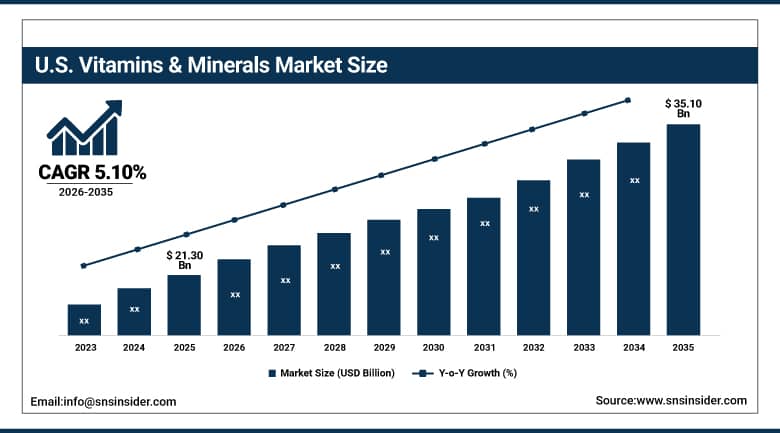
The U.S. Vitamins & Minerals Market was valued at USD 21.30 Billion in 2025 and is projected to reach USD 35.10 Billion by 2035, growing at a CAGR of 5.10% during 2026-2035.
Regional demand patterns within the U.S. vary more than the national averages suggest, with the West and South consistently posting the strongest growth as wellness-oriented consumer culture and warmer-climate outdoor lifestyles both correlate with higher supplement uptake. Vitamins continue to outsell minerals by a wide margin nationally, though mineral-specific products, magnesium in particular, have seen a genuine surge in consumer interest tied to sleep and stress-related wellness trends circulating heavily on social media. Tablets remain the leading format by a comfortable margin, but the gap with gummies and other alternative formats continues narrowing each year. Regulatory attention on supplement labeling accuracy has also intensified, prompting several major brands to reformulate or relabel products to ensure claims match third-party testing results more precisely.
In February 2025, Bayer AG initiated a comprehensive strategic review of its consumer health vitamin and supplement portfolio, including its adult vitamin gummy product lines.
Vitamins & Minerals Market Segment Analysis
-
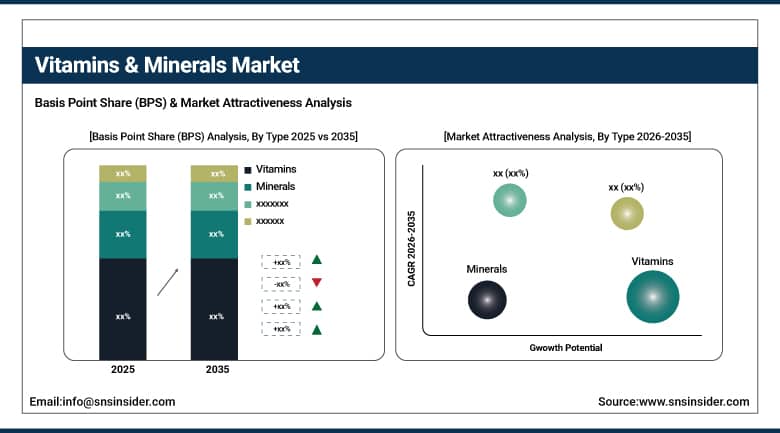
By Type, Vitamins segment dominated the Vitamins & Minerals Market in 2025 with 58% share; Minerals segment is the fastest-growing segment, registering a CAGR of 7.80% from 2026 to 2035.
-
By Form, Tablets segment dominated the market in 2025 with 35% share; Gummies segment is the fastest-growing segment, registering a CAGR of 9.20% from 2026 to 2035.
-
By End User, Adults segment dominated the market in 2025 with 78.20% share; Geriatric segment is the fastest-growing segment, registering a CAGR of 8.60% from 2026 to 2035.
-
By Distribution Channel, Pharmacies & Drugstores segment dominated the market in 2025 with 42% share; Online segment is the fastest-growing segment, registering a CAGR of 9.60% from 2026 to 2035.
By Type, Vitamins Lead the Vitamins & Minerals Market While Minerals Gain Ground Fastest
Vitamins hold 58% of the Vitamins & Minerals Market, and that lead has been remarkably durable for a category that does not get much marketing spotlight compared to trendier wellness ingredients. Vitamin D, B-complex, and vitamin C remain the three pillars of most consumers' supplement routines, backed by decades of public health messaging and enough consumer familiarity that brands rarely need to explain what the product does or why someone might want it.
Minerals are growing at a 7.80% CAGR, the fastest pace between the two types, driven largely by magnesium's rapid rise as a sleep and stress-support ingredient circulating heavily through social media and wellness content. Zinc and iron have also seen renewed interest tied to immune health and, particularly among younger women, awareness campaigns around iron deficiency, giving minerals a broader growth base than any single trending ingredient alone could sustain.
By Form, Tablets Dominate While Gummies Emerge as the Fastest-Growing Format
Tablets account for 35% of the market by form, remaining the most economical option for manufacturers and the most familiar format for long-time supplement users who have taken the same pill for years without much reason to switch. Lower manufacturing costs and longer shelf stability keep tablets the default choice for basic, high-volume multivitamin products where price sensitivity matters more than format novelty.
Gummies are growing fastest, at a 9.20% CAGR, as manufacturers increasingly target both children and adults who find swallowing pills unpleasant or difficult, a barrier that has quietly kept a meaningful share of consumers from supplementing consistently at all. The format's dessert-like appeal has also expanded its audience well beyond convenience alone, turning what used to be viewed as strictly a kids' product into a genuinely popular adult category.
By End User, Adults Dominate While Geriatric Registers the Fastest Growth
Adults account for 78.20% of end-user demand, the overwhelming majority, reflecting both the sheer size of the adult population relative to children and the fact that adult health awareness campaigns have driven far more consistent daily supplementation habits than marketing aimed at pediatric or geriatric-specific products. Working-age adults juggling demanding schedules and imperfect diets remain the category's most consistent and price-insensitive customer base.
Geriatric end users are growing fastest, at an 8.60% CAGR, as the world's aging population drives rising demand for condition-specific formulations addressing bone density, cognitive support, and cardiovascular health, needs that become more pressing and more clinically visible with age. Physicians increasingly recommend targeted vitamin and mineral regimens for older patients managing specific deficiencies, which is reinforcing this segment's above-average growth alongside pure demographic expansion.
By Distribution Channel, Pharmacies & Drugstores Dominates While Online Registers the Fastest Growth
Pharmacies & Drugstores hold 42% of distribution channel demand, benefiting from consumer trust in pharmacist recommendations and the format's convenient bundling with prescription pickups and other health-related errands. This channel's dominance also reflects how many consumers still associate vitamin and mineral purchases with a broader health-maintenance routine rather than a purely discretionary retail purchase.
Online distribution is growing fastest, at a 9.60% CAGR, as subscription-based reorder models remove the friction of remembering to repurchase a daily supplement and direct-to-consumer brands increasingly build their entire go-to-market strategy around digital-first distribution. Personalized formulation services in particular depend almost entirely on online channels, since their business model requires an upfront data-collection step that simply does not work at a physical retail shelf.
Regional Insights
|
Region |
Country |
Share (2025) |
|
North America |
United States |
87.50% |
|
Asia Pacific |
China |
34.60% |
|
Europe |
Germany |
24.80% |
|
Middle East & Africa |
UAE |
17.30% |
|
Latin America |
Brazil |
27.90% |
North America Vitamins & Minerals Market Insights
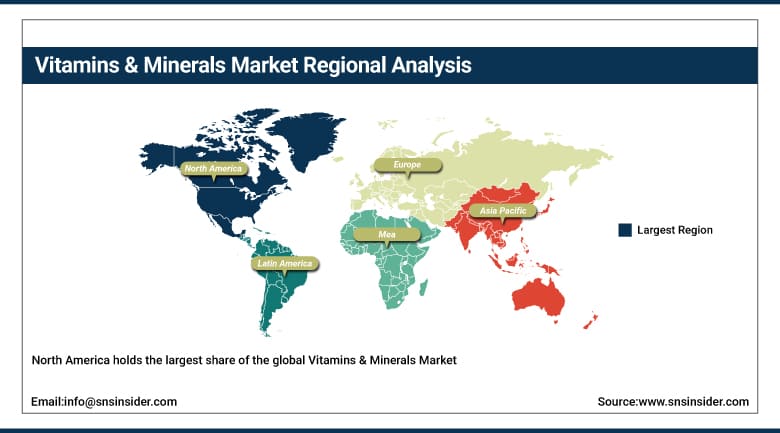
North America holds the largest share of the global Vitamins & Minerals Market, supported by decades of established supplement retail infrastructure and consumer habits that treat daily vitamin intake as close to routine rather than discretionary. Sustainability and clean-label expectations have become particularly pronounced here, with consumers increasingly scrutinizing ingredient sourcing and third-party testing credentials before committing to a brand.
The United States accounts for approximately 87.50% of the North American market, reflecting its deeply established supplement retail and pharmacy distribution ecosystem. Canada contributes a smaller but steady share, supported by its own health-conscious consumer base and comparable retail infrastructure.
Get Customized Report as Per Your Business Requirement - Enquiry Now
Asia Pacific Vitamins & Minerals Market Insights
Asia Pacific is growing faster than any other region in this market, driven by rapidly rising health awareness, expanding middle-class disposable incomes, and delivery-system innovation that is making supplements more appealing to first-time buyers across the region. Technological advancements in encapsulation and bioavailability, often pioneered or rapidly adopted by manufacturers serving this region, are helping products stand out in an increasingly crowded and fast-growing retail environment.
China holds roughly 34.60% of the regional market, supported by its massive consumer base, rising disposable incomes, and expanding cross-border e-commerce access to imported supplement brands. India and Southeast Asian markets are growing quickly as health awareness expands beyond major urban centers, while Japan and South Korea contribute through their established, quality-focused nutraceutical industries.
Europe Vitamins & Minerals Market Insights
Europe's vitamins and minerals market is mature and steady, shaped by comparatively strict regulatory frameworks around health claims and ingredient approval that, while slowing new product launches, have reinforced strong consumer trust in supplement safety and quality across the region. EU compound feed and food fortification programs also create consistent institutional demand for vitamin and mineral premixes alongside consumer retail products.
Germany leads the European market with a 24.80% share, supported by its large pharmacy retail network and high per-capita supplement penetration. France and the United Kingdom follow, with demand in both countries tied to well-established preventive health and wellness consumption habits.
Middle East & Africa and Latin America Vitamins & Minerals Market Insights
Middle East & Africa is experiencing gradual growth owing to increasing awareness and disposable income among the Gulf countries. Similarly, the Latin American region’s growth trends are due to increasing disposable income levels and awareness regarding health among people in major cities of Brazil and Mexico.
In Middle East & Africa region, UAE has a market share of 17.30%, which is due to the reason that it acts as a distribution center for the region. Brazil accounts for 27.90% of the Latin American market due to the reason that it is having a large consumer base and an emerging health and wellness trend in the country.
Growth Drivers: Micronutrient Deficiency Awareness and Aging Populations Fueling Market Growth
The growing knowledge about deficiencies of essential vitamins and minerals has been reinforced by campaigns on vitamin D and iron supplements. This is helping to normalize the consumption of daily supplements among a larger section of people than the old perception associated with this category suggests. Another important growth driver that can be observed is the aging population of the world. This is because aging consumers tend to use more supplements than younger individuals and also require formulation for certain conditions other than the usual multivitamins.
Growing incomes of people in the emerging countries have helped to increase the number of people who consume vitamins and minerals as their incomes allow them to afford these products.
Restraints: Regulatory Complexity and Ingredient Cost Volatility Limiting Market Expansion
Regulatory requirements around health claims and labeling accuracy vary significantly across markets, creating genuine compliance complexity for brands trying to sell the same product internationally without running afoul of differing national standards. Raw material costs for certain vitamins and specialty minerals have also been volatile, tied to global supply concentration in a relatively small number of manufacturing regions.
Consumer skepticism toward supplement efficacy claims, periodically reinforced by high-profile studies questioning whether certain vitamins deliver meaningful health benefits for the general population, remains a persistent headwind that brands with strong clinical backing are generally better positioned to weather.
Opportunities: Condition-Specific Formulations and Format Innovation Creating New Growth Avenues
Formulations that address specific conditions and focus on sleep, stress, and cognition are evident areas of potential, especially as consumer awareness and appreciation for magnesium and such ingredients grows through the continued promotion of these through social media and wellness content.
Innovations in format, besides the popular gummy format, provide a second avenue to tap into consumers who have yet to find a suitable format from which to get their supplement intake. Examples of innovations include effervescent tablets, powder packs, and other formats.
Recent Developments
-
December 2025: Church & Dwight Co., Inc. announced plans to divest its Vitafusion and L'il Critters vitamin gummy businesses following a strategic review of its vitamins, minerals, and supplements segment.
-
February 2025: Bayer AG initiated a comprehensive strategic review of its consumer health vitamin and supplement portfolio, including its adult vitamin gummy product lines.
-
2025: Amapharm GmbH continued expanding its private-label and turnkey nutraceutical gummy manufacturing capacity to support brand partners entering the adult vitamin and mineral supplement market.
-
2025: Pharmavite LLC's Nature Made brand continued expanding its vitamin and mineral product lineup in response to rising demand for condition-specific and gummy supplement formats.
Vitamins & Minerals Companies are:
-
Amway Corporation
-
Herbalife Nutrition Ltd.
-
Bayer AG
-
Pfizer Inc.
-
Glanbia plc
-
Nestlé Health Science
-
Pharmavite LLC
-
Haleon plc
-
NOW Health Group, Inc.
-
DSM-Firmenich AG
-
BASF SE
-
Otsuka Pharmaceutical Co., Ltd.
-
Reckitt Benckiser Group plc
-
Perrigo Company plc
-
Opella Healthcare
-
Nutraceutical International Corporation
-
Suntory Wellness Ltd.
-
Blackmores Limited
Vitamins & Minerals Market Report Scope:
| Report Attributes | Details |
|---|---|
| Market Size in 2025 | USD 61.77 Billion |
| Market Size by 2035 | USD 116.72 Billion |
| CAGR | CAGR of 6.57% From 2026 to 2035 |
| Base Year | 2025 |
| Forecast Period | 2026-2035 |
| Historical Data | 2022-2024 |
| Report Scope & Coverage | Market Size, Segments Analysis, Competitive Landscape, Regional Analysis, DROC & SWOT Analysis, Forecast Outlook |
| Key Segments | • By Type (Vitamins, Minerals) • By Form (Tablets, Capsules, Gummies, Powder) • By End User (Adults, Children, Geriatric) • By Distribution Channel (Pharmacies & Drugstores, Supermarkets & Hypermarkets, Online) |
| Regional Analysis/Coverage | North America (US, Canada), Europe (Germany, UK, France, Italy, Spain, Russia, Poland, Rest of Europe), Asia Pacific (China, India, Japan, South Korea, Australia, ASEAN Countries, Rest of Asia Pacific), Middle East & Africa (UAE, Saudi Arabia, Qatar, South Africa, Rest of Middle East & Africa), Latin America (Brazil, Argentina, Mexico, Colombia, Rest of Latin America). |
| Company Profiles | Amway Corporation, Herbalife Nutrition Ltd., Bayer AG, Pfizer Inc., Abbott Laboratories, Glanbia plc, Nestlé Health Science, Pharmavite LLC, Haleon plc, NOW Health Group, Inc., DSM-Firmenich AG, BASF SE, Otsuka Pharmaceutical Co., Ltd., GNC Holdings, LLC, Reckitt Benckiser Group plc, Perrigo Company plc, Opella Healthcare, Nutraceutical International Corporation, Suntory Wellness Ltd., Blackmores Limited |

Frequently Asked Questions
Key players include Amway Corporation, Herbalife Nutrition Ltd., Bayer AG, Pfizer Inc., Abbott Laboratories, Glanbia plc, Nestlé Health Science, and Pharmavite LLC, alongside other established vitamin and mineral supplement manufacturers.
Key opportunities include condition-specific mineral formulations for sleep and stress support, format innovation beyond gummies and tablets, and expanding online subscription-based distribution models.
The market is driven by widespread micronutrient deficiency awareness, an aging global population, and rising disposable incomes across emerging markets.
The Vitamins segment dominated the Vitamins & Minerals Market in 2025.
The North America region dominated the Vitamins & Minerals Market in 2025, accounting for approximately 39% of global market share.
