
Workplace Safety Market Report Scope & Overview:
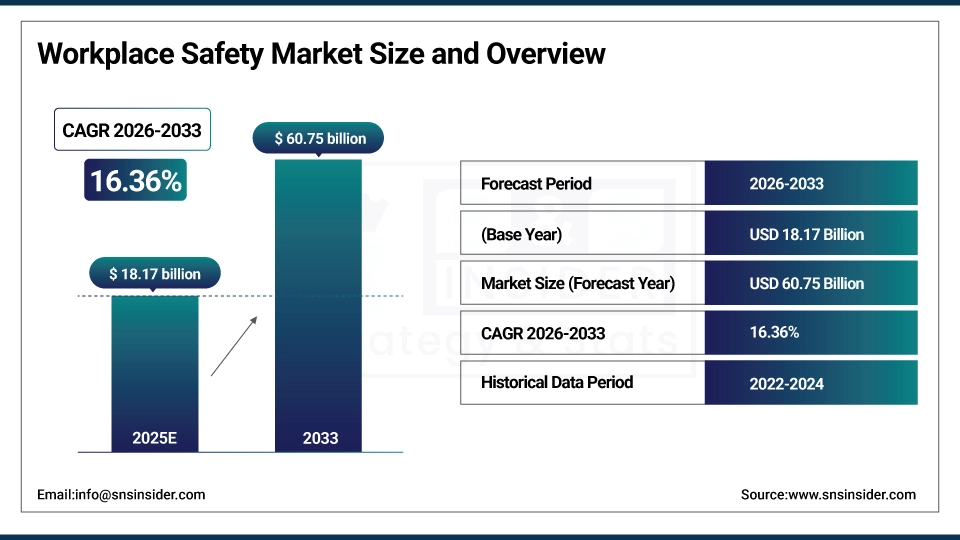
The Workplace Safety Market is valued at USD 18.17 billion in 2025E and is expected to reach USD 60.75 billion by 2033, growing at a CAGR of 16.36% from 2026-2033.
The Workplace Safety Market is expanding rapidly due to stricter regulatory standards, rising employer liability concerns, and a growing emphasis on creating safer, technology-enabled work environments. Increased adoption of advanced safety solutions such as IoT sensors, AI-based monitoring, connected PPE, and real-time hazard detection systems is driving strong demand. Additionally, rising workplace accidents, expansion of industrial sectors, and the shift toward predictive safety analytics further support long-term market growth.
In 2025, workplace safety technology adoption surged by 16% globally, as 75% of manufacturers and construction firms implemented connected PPE and real-time hazard detection cutting severe incidents by 32% and driving ROI through improved compliance, productivity, and worker retention.
Workplace Safety Market Size and Forecast
-
Market Size in 2025E: USD 18.17 Billion
-
Market Size by 2033: USD 60.75 Billion
-
CAGR: 16.36% from 2026 to 2033
-
Base Year: 2025E
-
Forecast Period: 2026–2033
-
Historical Data: 2022–2024
To Get more information on Workplace Safety Market - Request Free Sample Report
Workplace Safety Market Trends
-
Growing adoption of AI-driven safety analytics to predict hazards and reduce workplace accidents proactively
-
Increasing use of wearables and smart PPE to monitor worker health, fatigue, and environmental exposure in real time
-
Expansion of IoT-enabled safety systems enabling continuous equipment monitoring and automated alerts for hazardous conditions
-
Rising demand for cloud-based safety management platforms offering centralized compliance tracking and incident reporting
-
Integration of AR and VR training solutions to enhance worker skills, emergency preparedness, and hazard awareness
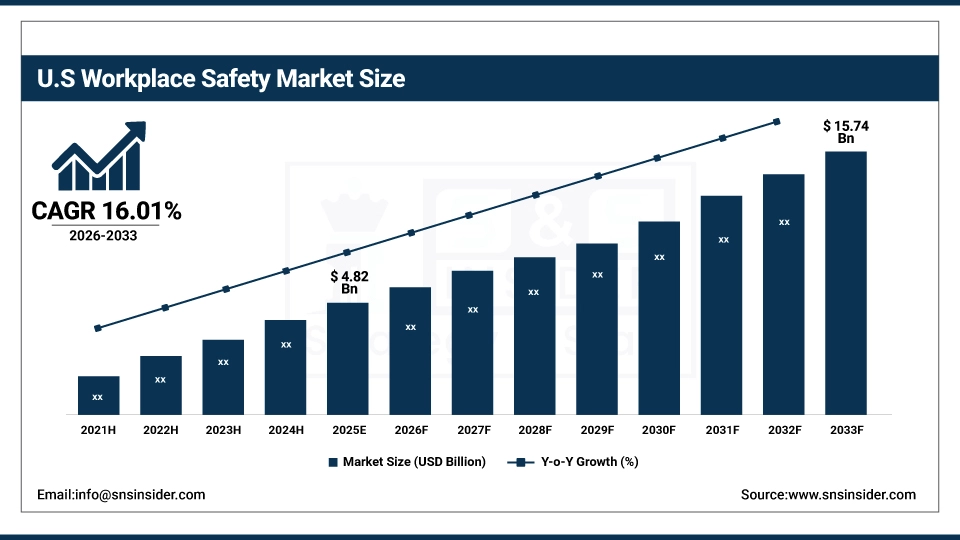
U.S. Workplace Safety Market is valued at USD 4.82 billion in 2025E and is expected to reach USD 15.74 billion by 2033, growing at a CAGR of 16.01% from 2026-2033.
Growth in the U.S. Workplace Safety Market is driven by stricter occupational safety regulations, rising workplace accidents, and growing adoption of IoT-enabled safety devices, AI-based monitoring, and predictive analytics. Increasing focus on employee well-being and risk mitigation is further accelerating market demand across industries.
Workplace Safety Market Growth Drivers:
-
Increasing workplace accidents and rising regulatory enforcement are driving higher adoption of safety systems, protective equipment, and monitoring technologies across industrial, construction, and manufacturing sectors.
Growing cases of occupational injuries and fatalities are compelling organizations to prioritize worker safety through advanced protective equipment and automated monitoring systems. Governments worldwide are enforcing stricter safety regulations, mandating compliance across hazardous industries, which boosts demand for smart safety systems. Companies are increasingly integrating real-time monitoring technologies, safety sensors, and preventive equipment to reduce liability, enhance operational continuity, and safeguard employee well-being. Rising awareness about workplace hazards and the financial impact of accidents further accelerates investment in comprehensive safety programs and technology-enabled safety solutions globally.
In 2025, workplace accidents rose by 12% globally, prompting 68% of industrial, construction, and manufacturing firms to accelerate adoption of safety systems—boosting demand for smart PPE, real-time monitoring, and AI-driven compliance tools by over 35%.
-
Growing focus on employee well-being and organizational safety culture encourages companies to invest in advanced workplace safety solutions to enhance productivity and reduce operational risks.
Organizations recognize that a strong safety culture not only protects workers but also improves productivity, reduces downtime, and strengthens brand reputation. As employee health and wellness become strategic priorities, firms are adopting advanced workplace safety technologies, including digital safety platforms, ergonomic equipment, and automated hazard detection systems. The shift toward preventive risk management, coupled with rising ESG compliance requirements, drives companies to upgrade safety processes. Growing emphasis on mental well-being, ergonomic workspaces, and proactive hazard mitigation encourages continual investment in modern safety infrastructure, creating long-term growth opportunities for workplace safety solutions.
In 2025, 72% of global enterprises increased investment in advanced workplace safety solutions, linking strong safety cultures to a 30% drop in incidents and a 25% gain in productivity, particularly in manufacturing, logistics, and energy sectors.
Workplace Safety Market Restraints:
-
High initial investment costs for advanced safety systems and training programs limit adoption among small and medium enterprises with budget constraints in developing regions.
Implementing comprehensive workplace safety solutions often requires substantial capital for equipment, training, technology integration, and ongoing maintenance. SMEs, particularly in developing regions, struggle to afford modern safety systems due to limited budgets and competing expenditure priorities. Advanced solutions like IoT-based monitoring, wearable sensors, and automated compliance platforms remain financially inaccessible for many small businesses. Additionally, the cost of continuous safety training and certification programs adds operational burden. These financial barriers slow safety adoption, leading many enterprises to rely on traditional, less effective safety practices that do not meet modern regulatory standards.
In 2025, over 65% of SMEs in developing regions cited high upfront costs—often exceeding USD50,000 per site—for advanced safety systems and training as the primary barrier, significantly limiting deployment despite rising regulatory and operational safety demands.
-
Lack of skilled professionals to operate modern safety technologies and limited awareness in low-income regions hinder effective implementation of workplace safety programs.
As workplace safety technologies become more advanced, companies increasingly require skilled safety officers who can manage digital systems, interpret analytics, and ensure compliance. However, many regions face a shortage of trained safety professionals, limiting the effectiveness of safety initiatives. Furthermore, low awareness about workplace hazards and limited understanding of the benefits of safety programs reduce adoption levels. In developing economies, cultural factors, insufficient training resources, and inadequate government support worsen the situation. These gaps weaken safety implementation, restrict modernization, and prevent industries from fully leveraging intelligent safety systems.
In 2025, 60% of organizations in low-income regions reported inadequate adoption of modern safety technologies due to a shortage of trained personnel and low awareness, delaying implementation and leaving 45% of high-risk workplaces without adequate digital safety measures.
Workplace Safety Market Opportunities:
-
Rising adoption of IoT, AI, wearables, and smart sensors create opportunities for intelligent workplace safety platforms enabling real-time hazard detection and predictive risk analytics.
Technological advancements are transforming workplace safety by enabling proactive risk mitigation and continuous monitoring. IoT-connected sensors provide real-time alerts for hazardous conditions, while AI-driven analytics predict potential risks before accidents occur. Wearable devices offer continuous tracking of worker movement, fatigue levels, and exposure to harmful environments, improving preventive safety management. These technologies enhance visibility, reduce human error, and enable data-driven decision-making. As industries aim to modernize operations, demand for integrated safety ecosystems grows. This technological shift presents significant opportunities for solutions providers to deliver intelligent, scalable safety platforms across global industries.
In 2025, 70% of industrial firms integrated IoT, AI, and smart wearables into safety platforms, enabling real-time hazard alerts and predictive risk analytics—reducing workplace incidents by 35% and improving response times by over 40% globally.
-
Increasing digital transformation initiatives in high-risk industries offer opportunities for cloud-based safety management systems, automated compliance tools, and remote monitoring solutions.
Industries such as manufacturing, oil & gas, mining, and construction are accelerating digital transformation to improve operational efficiency and regulatory compliance. This shift is creating strong demand for cloud-based safety management platforms that streamline incident reporting, compliance tracking, and workflow automation. Remote monitoring technologies allow supervisors to oversee operations from anywhere, improving oversight in hazardous environments. Automated compliance tools reduce administrative burden and minimize violations. As organizations seek centralized, data-driven safety solutions, providers offering digital platforms, analytics dashboards, and integrated compliance systems are well-positioned to capture new opportunities in the evolving workplace safety landscape.
In 2025, 68% of high-risk industries such as oil & gas, construction, and mining—adopted cloud-based safety management systems, driving a 40% increase in remote monitoring and automated compliance solutions to support digital transformation and reduce workplace incidents.
Workplace Safety Market Segment Highlights
-
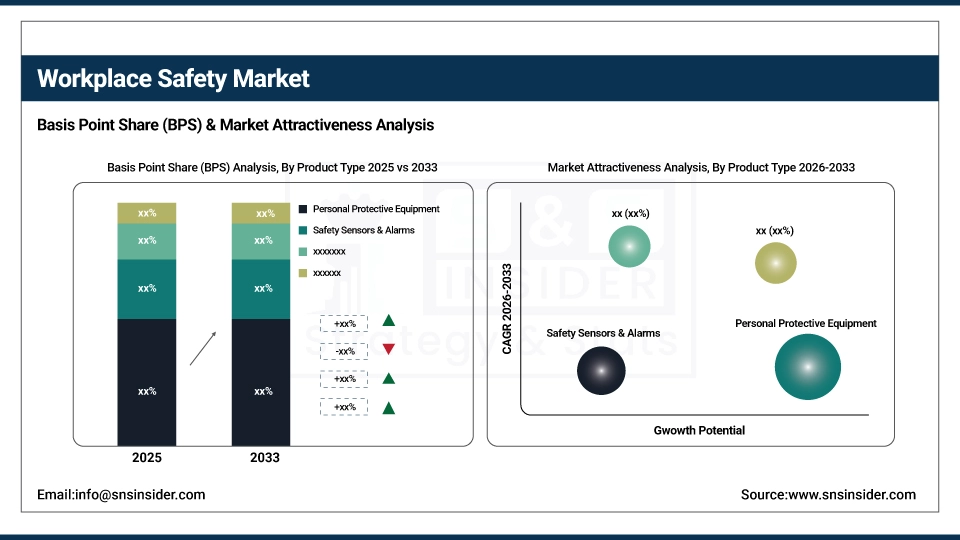
By Product Type: Personal Protective Equipment led with 41.8% share, while Workplace Safety Software is the fastest-growing segment with a CAGR of 20.6%.
-
By Deployment Mode: On-Premises Solutions led with 57.3% share, while Cloud-Based Solutions are the fastest-growing with a CAGR of 22.4%.
-
By Safety Type: Fire & Explosion Safety led with 29.4% share, while Ergonomics & Human Factor Safety is the fastest-growing with a CAGR of 19.9%.
-
By End-User Industry: Manufacturing & Industrial led with 32.6% share, while Healthcare is the fastest-growing with a CAGR of 21.1%.
Workplace Safety Market Segment Analysis
By Product Type: PPE led, while Workplace Safety Software is the fastest-growing segment.
PPE dominates the product landscape due to its essential role in protecting workers across construction, manufacturing, oil & gas, and healthcare environments. Mandatory regulatory compliance, rising workplace injury awareness, and greater employer responsibility drive consistent demand. Items such as helmets, gloves, masks, and protective clothing remain indispensable in high-risk settings. Increased global industrialization, stricter safety frameworks, and adoption of advanced protective materials further strengthen the dominance of PPE across diverse industries.
Workplace Safety Software is the fastest-growing segment as organizations accelerate digital transformation to improve compliance, monitoring, and incident management. Cloud-enabled platforms allow real-time reporting, predictive analytics, automated audits, and workforce training, significantly enhancing safety outcomes. The shift toward proactive risk prevention, remote workforce management, and integrated EHS solutions fuels rapid adoption. Regulatory pressure and the need for centralized digital safety dashboards contribute to the strong upward trajectory of safety software.
By Deployment Mode: On-Premises Solutions led, while Cloud-Based Solutions are the fastest-growing segment.
On-Premises Solutions dominate due to their ability to provide full data control, secure storage, and integration with specialized in-house safety systems. Large enterprises and high-risk sectors such as manufacturing, energy, and logistics prefer on-site deployments to meet stringent compliance requirements and safeguard sensitive operational data. Established IT infrastructure, customization needs, and long-standing reliance on traditional systems maintain the strong preference for on-premises workplace safety management across critical industries.
Cloud-Based Solutions grow fastest as companies prioritize scalability, accessibility, and lower IT maintenance costs. Cloud platforms allow seamless updates, real-time analytics, and remote workforce monitoring, making them ideal for distributed operations. Increasing adoption of mobile safety applications, automation tools, and digital compliance features accelerates cloud transition. Small and mid-size enterprises, in particular, benefit from flexible subscription models, while global firms adopt cloud safety systems to unify cross-location safety operations efficiently.
By Safety Type: Fire & Explosion Safety led, while Ergonomics & Human Factor Safety is the fastest-growing segment.
Fire & Explosion Safety leads the segment due to strict regulations, high-risk industrial operations, and mandatory implementation of fire detection, suppression, and emergency response systems. Industries such as oil & gas, chemicals, mining, and manufacturing rely heavily on these solutions to prevent catastrophic losses. Investments in advanced flame detectors, automated sprinklers, and integrated alarm systems support continued dominance. Frequent industrial hazards and enforcement of international safety standards sustain the strong demand for this category.
Ergonomics & Human Factor Safety is the fastest-growing segment as employers increasingly focus on reducing musculoskeletal disorders, fatigue, and human-error-driven incidents. Rising awareness of worker well-being, productivity enhancement, and occupational health improvement drives adoption of ergonomic tools, training systems, and human-centric safety solutions. Technology advancements such as wearable sensors, posture monitoring, and AI-driven assessments further propel growth. Remote and hybrid workforces also contribute to demand for better ergonomic risk management.
By End-User Industry: Manufacturing & Industrial led, while Healthcare is the fastest-growing segment.
Manufacturing & Industrial sectors dominate the market due to high exposure to machinery hazards, chemical risks, and operational accidents. Employers invest heavily in personal protective equipment, incident management platforms, fire suppression systems, and training programs to ensure regulatory compliance and reduce downtime. The scale of operations, diverse risk zones, and involvement of heavy equipment further necessitate comprehensive safety systems. Continuous industrial expansion and modernization strengthen this segment’s leadership in workplace safety adoption.
Healthcare is the fastest-growing segment as hospitals, clinics, and laboratories intensify focus on staff safety, infection control, and patient-handling ergonomics. Rising biological hazards, chemical exposure, and pandemic-driven safety demands accelerate adoption of PPE, digital compliance platforms, and monitoring systems. Increased regulatory oversight, investment in worker protection, and implementation of health-risk management tools fuel growth. The expansion of healthcare infrastructure and workforce safety initiatives continues to push this segment’s rapid upward momentum.
Workplace Safety Market Regional Analysis
North America Workplace Safety Market Insights:
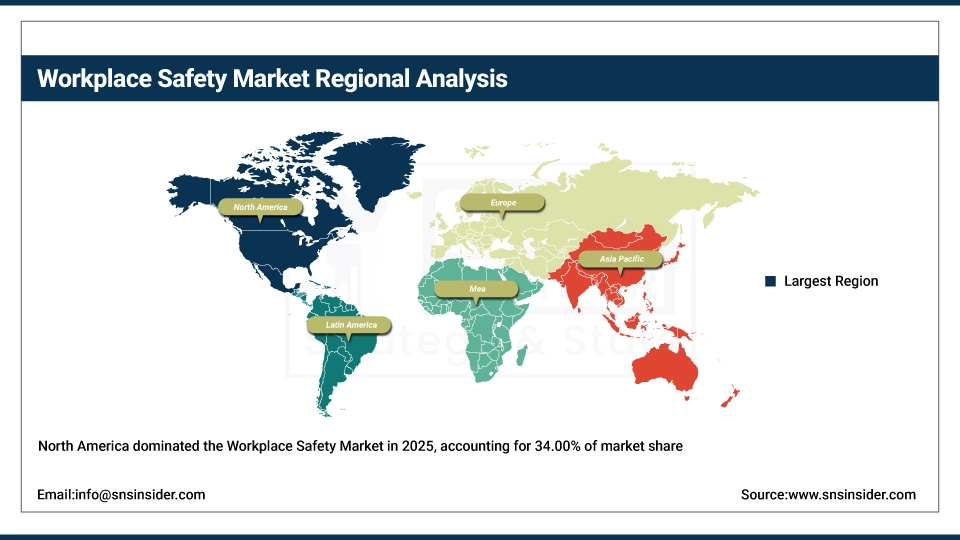
North America dominated the Workplace Safety Market in 2025 with a 34.00% share due to stringent regulatory frameworks, high compliance enforcement, and widespread adoption of advanced safety technologies across manufacturing, construction, and oil & gas sectors. Strong employer liability laws, mature industrial infrastructure, and continuous investment in automation and monitoring systems further strengthened its market leadership.
Get Customized Report as per Your Business Requirement - Enquiry Now
Asia Pacific Workplace Safety Market Insights
Asia Pacific is projected to grow at the fastest CAGR of 18.05% from 2026–2033, driven by rapid industrialization, expanding manufacturing bases, and increasing government focus on worker safety. Rising awareness of occupational hazards, growth in construction activities, and accelerated adoption of digital safety tools and IoT-enabled systems are boosting the region’s long-term market expansion.
Europe Workplace Safety Market Insights
Europe held a strong position in the Workplace Safety Market in 2025 due to strict occupational safety regulations, mature industrial operations, and early adoption of advanced safety systems across manufacturing, chemicals, and logistics sectors. Extensive union-driven worker protection norms, robust compliance mechanisms, and rapid integration of digital monitoring tools further strengthened regional demand.
Middle East & Africa and Latin America Workplace Safety Market Insights
Middle East & Africa and Latin America together showed steady growth in the Workplace Safety Market, driven by expanding oil & gas operations, infrastructure development, and rising workplace risk awareness. Governments are increasingly adopting safety regulations, while industries invest in training, protective equipment, and basic automation. Growing multinational presence and improving regulatory frameworks are gradually enhancing market adoption across both regions.
Workplace Safety Market Competitive Landscape:
Honeywell International Inc.
Honeywell International Inc. is a global leader in workplace safety technologies, delivering advanced solutions across personal protective equipment, industrial automation, and connected safety systems. The company provides gas detection devices, smart wearables, respiratory protection, and facility safety software designed to enhance worker protection and compliance. Honeywell integrates IoT, analytics, and automation to minimize workplace risks and improve operational efficiency. Its products are widely used in manufacturing, oil & gas, aerospace, construction, and various high-risk industrial environments.
-
2024, Honeywell launched its Forge Connected Worker Safety Suite, an integrated platform combining wearables, AI video analytics, and real-time location systems (RTLS) to prevent accidents in industrial environments (oil & gas, manufacturing, utilities).
IBM Corporation
IBM Corporation plays a significant role in the workplace safety market by leveraging advanced technologies such as artificial intelligence, data analytics, cloud computing, and IoT. IBM’s safety platforms help organizations monitor hazards, predict risks, and automate compliance management. Through intelligent insights and real-time data processing, IBM enables enterprises to improve incident reporting, mitigate operational risks, and enhance workforce well-being. IBM’s AI-driven solutions are widely adopted across industries including manufacturing, logistics, utilities, and large industrial operations.
-
2023, IBM expanded its Environmental Intelligence Suite to include workplace safety risk forecasting, leveraging weather, climate, and IoT data to protect outdoor and remote workers.
Microsoft Corporation
Microsoft Corporation contributes to the workplace safety market through its cloud-based platforms, AI capabilities, and digital transformation tools. Microsoft solutions, such as Azure IoT, Microsoft 365, and Dynamics 365, help organizations improve safety monitoring, streamline compliance, and enhance communication during critical events. By integrating sensors, analytics, and real-time data insights, Microsoft enables proactive risk detection and safer operational environments. Its technologies support sectors like manufacturing, construction, energy, and healthcare, driving smarter and more efficient safety management systems.
-
2025, Microsoft introduced the Workplace Safety Accelerator as part of Microsoft Cloud for Sustainability, enabling organizations to unify EHS (Environment, Health, Safety) data in Microsoft Fabric and act via Power Platform and Teams.
Workplace Safety Market Key Players
Some of the Workplace Safety Market Companies
-
3M Company
-
Honeywell International Inc.
-
IBM Corporation
-
Microsoft Corporation
-
Hexagon AB
-
Robert Bosch GmbH
-
DuPont de Nemours
-
MSA Safety Incorporated
-
Ansell Limited
-
Drägerwerk AG & Co. KGaA
-
ABB Ltd.
-
Ecolab Inc.
-
Cority Software Ltd.
-
Wolters Kluwer N.V.
-
Intelex Technologies Inc.
-
EcoOnline AS
-
HCL Technologies Ltd.
-
Johnson Controls International plc
-
Cintas Corporation
-
Guardhat Inc.
| Report Attributes | Details |
|---|---|
| Market Size in 2025E | USD 18.17 Billion |
| Market Size by 2033 | USD 60.75 Billion |
| CAGR | CAGR of 16.36% From 2026 to 2033 |
| Base Year | 2025 |
| Forecast Period | 2026-2033 |
| Historical Data | 2022-2024 |
| Report Scope & Coverage | Market Size, Segments Analysis, Competitive Landscape, Regional Analysis, DROC & SWOT Analysis, Forecast Outlook |
| Key Segments | • By Product Type (Personal Protective Equipment, Safety Sensors & Alarms, Fire Safety Equipment, Workplace Safety Software, Safety Signage & Communication Systems) • By Deployment Mode (On-Premises / On-Site Solutions, Cloud-Based / Digital Solutions) • By Safety Type (Occupational Health & Hygiene, Fire & Explosion Safety, Fall Protection & Mechanical Safety, Electrical Safety, Ergonomics & Human Factor Safety) • By End-User Industry (Construction, Manufacturing & Industrial, Oil & Gas, Healthcare, Transportation & Logistics) |
| Regional Analysis/Coverage | North America (US, Canada), Europe (Germany, UK, France, Italy, Spain, Russia, Poland, Rest of Europe), Asia Pacific (China, India, Japan, South Korea, Australia, ASEAN Countries, Rest of Asia Pacific), Middle East & Africa (UAE, Saudi Arabia, Qatar, South Africa, Rest of Middle East & Africa), Latin America (Brazil, Argentina, Mexico, Colombia, Rest of Latin America). |
| Company Profiles | 3M Company, Honeywell International Inc., IBM Corporation, Microsoft Corporation, Hexagon AB, Robert Bosch GmbH, DuPont de Nemours, MSA Safety Incorporated, Ansell Limited, Drägerwerk AG & Co. KGaA, ABB Ltd., Ecolab Inc., Cority Software Ltd., Wolters Kluwer N.V., Intelex Technologies Inc., EcoOnline AS, HCL Technologies Ltd., Johnson Controls International plc, Cintas Corporation, Guardhat Inc. |
Frequently Asked Questions
North America dominated with 34.00% share in 2025, owing to stringent regulations, advanced safety technology adoption, and mature industrial and construction sectors.
Personal Protective Equipment (PPE) dominated the market with 41.8% share due to mandatory compliance, high industrial usage, and critical role in worker protection.
Growth is driven by stricter safety regulations, rising workplace accidents, adoption of IoT and AI-enabled monitoring, and increasing employer focus on worker well-being.
The Workplace Safety Market was valued at USD 18.17 Billion in 2025, supported by rising workplace accidents and increasing adoption of advanced safety solutions.
The Workplace Safety Market is expected to grow at a CAGR of 16.36% from 2026–2033, driven by regulatory enforcement and digital safety adoption globally.
