Aramid fiber has moved well beyond its early role in body armor. Today it sits inside fiber optic cables, aircraft panels, tires, industrial filters and electrical insulation. Buyers choose it because it is strong, light and resistant to heat. As more industries face tighter safety and weight limits, aramid becomes a practical answer rather than a premium option. This shift widens the customer base for producers.
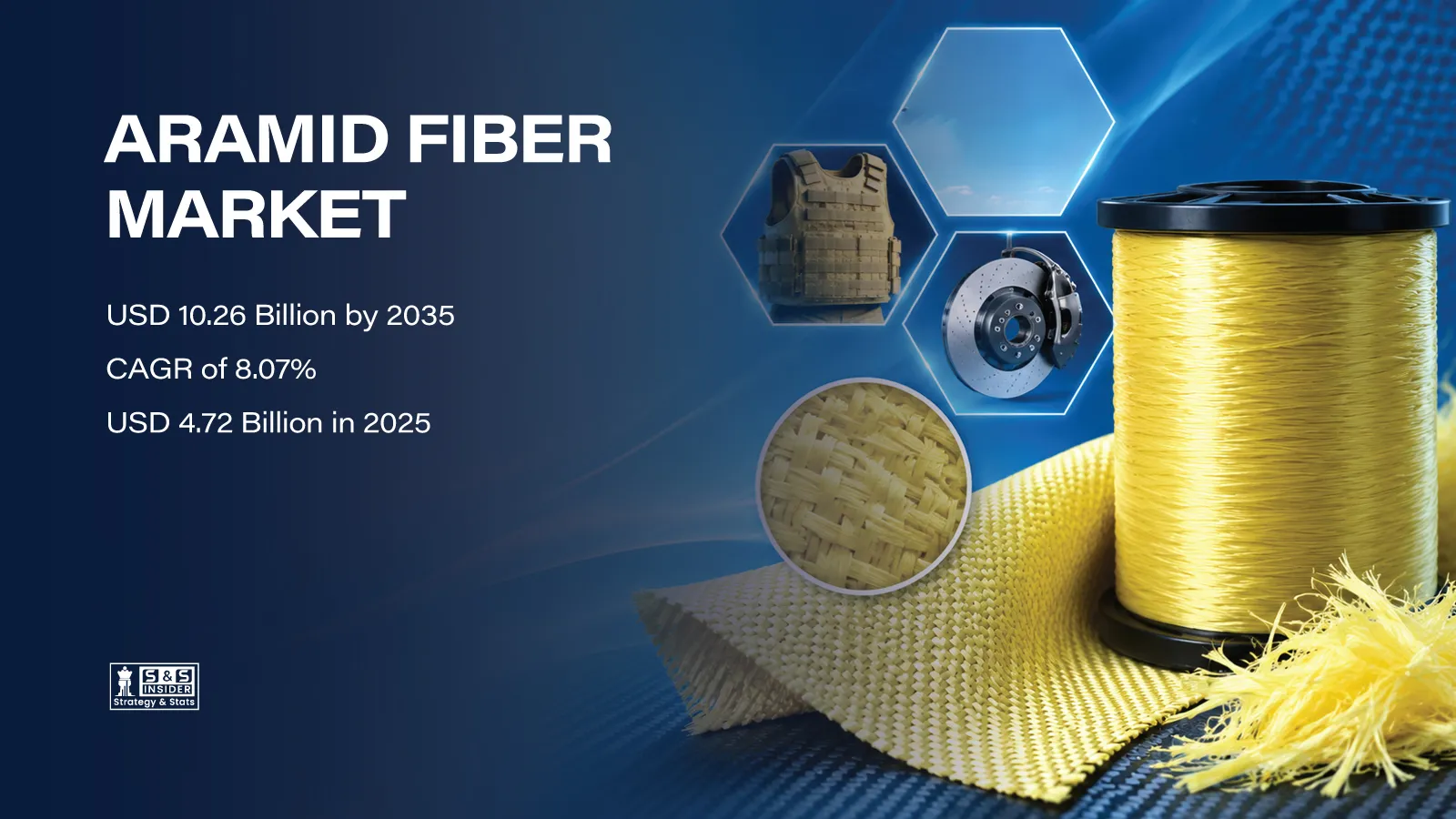
According to a recent study by SNS Insider, the global Aramid Fiber Market size was valued at USD 4.72 Billion in 2025 and is anticipated to reach USD 10.26 Billion by 2035, registering a CAGR of 8.07% over the forecast period 2026–2035. The market is estimated at USD 5.10 Billion in 2026.
Gain Actionable Intelligence on the Aramid Fiber Market - Request a Sample Report
Supply Security Becomes a Buying Priority
Only a small number of companies can make aramid fiber at scale. Production needs special chemistry, high capital spending and years of process know-how. For buyers, this means a short list of suppliers and a real risk of shortages.
Defense agencies and cable makers are responding by signing longer contracts and qualifying a second source. Many prefer suppliers with plants in more than one region, so a single outage does not stop their own lines.
For producers, this creates room to win multi-year agreements. Companies that can show steady quality, clear delivery records and local stock are in a strong position to lock in demand.
Data Infrastructure Opens a New Demand Channel
Fiber optic cables use aramid yarn as a strength member. It protects the glass fibers when cables are pulled through ducts or strung between poles. As telecom operators extend broadband and data center operators link new sites, cable output rises.
Large data center campuses need dense, high-count cables, which use more reinforcement per kilometer. This is a steady, volume-driven market, different from the contract-driven defense segment.
Suppliers that offer fine yarns, consistent tensile strength and coating options suited to cable makers can grow here without depending on defense budgets.
Aramid Fiber Market Segmentation Highlights
By Type: Para-aramid held 68.12% of the market in 2025, supported by its use in armor, cables and tires. Meta-aramid is expected to grow fastest at a CAGR of 9.04%, as demand for flame-resistant clothing and electrical insulation rises.
By Application: Security and protection led with a 33.47% share in 2025. Optical fiber and cable reinforcement is the fastest-growing application at a CAGR of 9.86%, which gives producers a reason to build dedicated cable-grade product lines.
By End Use: Defense and security accounted for 36.41% of the market in 2025. Electrical and electronics is set to expand fastest at a CAGR of 9.46%, driven by insulation needs in motors, transformers and electronic devices.
Europe Leads with 31.72% Market Share as Asia Pacific Advances at 10.27% CAGR
Europe held the largest share at 31.72% in 2025. The region has established production, strong aerospace and automotive buyers, and strict workplace safety rules that support protective clothing demand.
North America followed with a 30.15% share. The U.S. market was valued at USD 1.16 Billion in 2025 and is projected to grow at a CAGR of 7.84%, supported by defense programs and broadband buildout.
Asia Pacific held 27.83% and is the fastest-growing region at a CAGR of 10.27%. Production capacity in Japan, South Korea and China, together with rising demand in India and Southeast Asia, makes the region the main source of new volume. The Middle East & Africa held 6.43% and Latin America 3.87%, with demand linked to defense, oil and gas, and industrial safety.
Application-Specific Grades Could Unlock Higher Margins
General-purpose aramid competes mainly on price. Grades designed for one use, such as cable reinforcement, filtration or battery components, can earn better margins because they solve a specific problem.
Working closely with cable makers, tire producers and clothing brands helps suppliers design these grades. It also makes customers less likely to switch, since a new supplier would need to pass the same tests again.
Producers that pair materials with technical support and testing services can move from selling a commodity to selling a solution.
Competitive Outlook: Ownership Changes and Capacity Shape the Field
The market is concentrated, and recent ownership changes are reshaping it. In April 2026, DuPont completed the sale of its aramids business, including Kevlar and Nomex, to Arclin. This puts well-known brands under a new owner focused on materials.
Asian producers continue to add capacity and target cable and industrial buyers. Competition will center on reliable supply, consistent quality and the ability to serve fast-growing applications in each region.
Aramid Fiber Market Outlook Through 2035
The aramid fiber market is set to more than double by 2035. Defense will stay the largest buyer, but cables, electronics and industrial uses will add most of the new demand. Suppliers that secure long-term contracts, build regional supply and develop application-specific grades will be best placed to capture this growth.