
The Automation-as-a-Service Market is growing as companies look for faster, cheaper and more flexible ways to automate routine work across IT, finance, HR and customer service. Cloud-based delivery lets firms use automation tools without large upfront spending on software or infrastructure. Rising use of AI agents, the need to cut manual errors and pressure to improve productivity are leading businesses of all sizes to adopt subscription-based automation, which will support market growth.
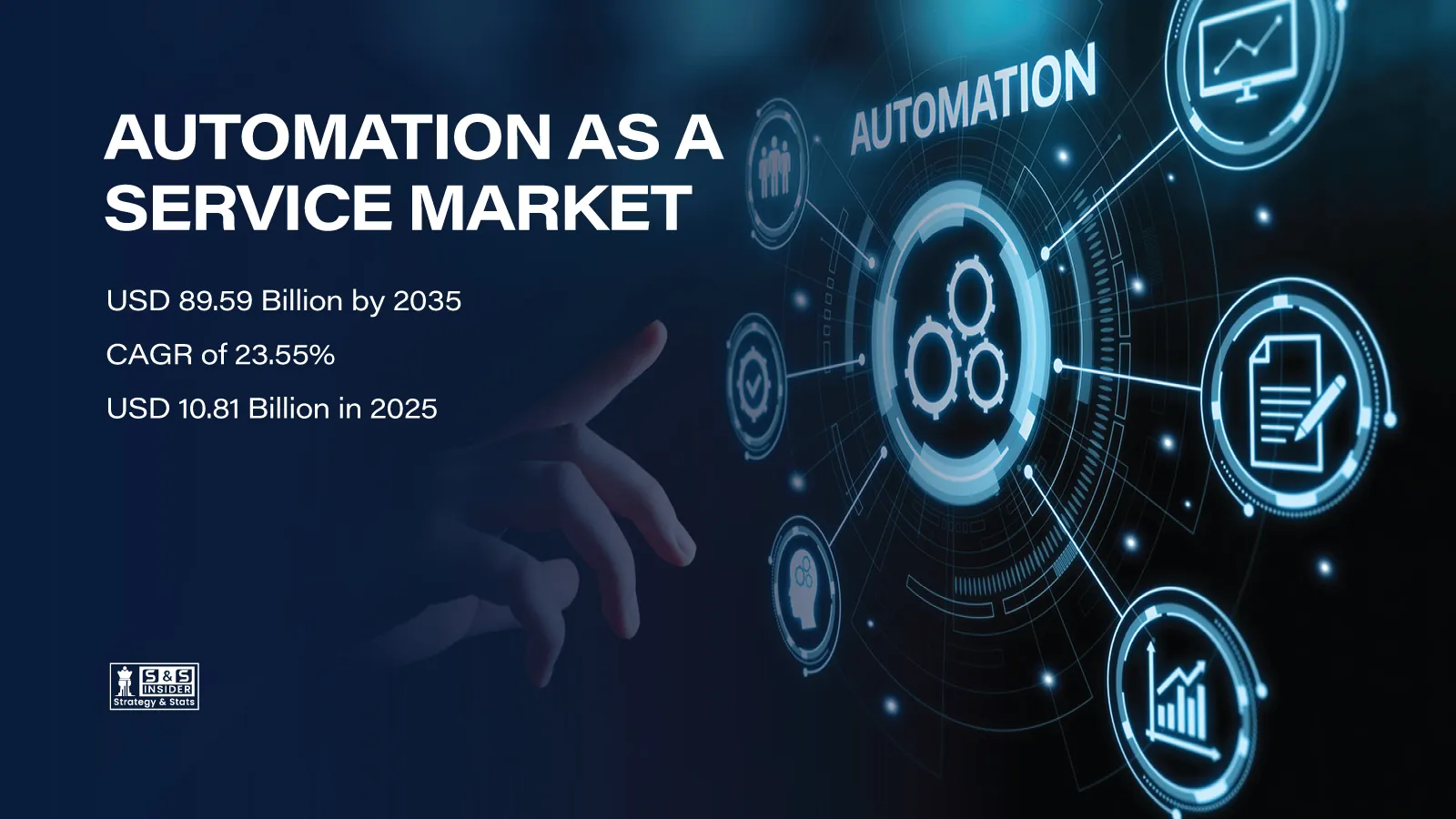
The Automation-as-a-Service Market value stood at USD 10.81 billion in 2025 and is anticipated to grow to USD 89.59 billion by 2035, growing at a CAGR of 23.55% in the forecast period of 2026-2035. Solutions accounted for around 66.85% of the market by component, while public cloud held 56.38% by deployment model in 2025.
Unlock exclusive market insights download the brochure to explore global Automation-as-a-Service Market trends, emerging opportunities, competitive developments, and forecasts through 2035.
Regional Analysis of the Automation-as-a-Service Market
The Automation-as-a-Service market is expanding across North America, Europe, Asia-Pacific, Latin America and Middle East & Africa. North America dominated the market with around 38.96% share in 2025 owing to the strong presence of automation software vendors, early adoption of cloud and AI tools and high technology spending by enterprises. North America is led by the US, which had a market valuation of USD 3.68 billion in 2025 and is forecasted to grow at a CAGR of 23.93%. Europe accounted for around 26.76% and Germany, the UK and France were leading in enterprise automation adoption.
Asia-Pacific will register the highest CAGR of 24.61% due to rapid digital transformation, growing cloud adoption among SMEs and rising investment in IT services and the leading countries in Asia-Pacific include China, India and Japan. Latin America and Middle East & Africa are witnessing stable growth due to wider cloud access, government digitization programs and growing demand from banking and telecom firms.
Top 10 Trends in the Automation-as-a-Service Market
- Rising use of AI agents that can plan and complete multi-step business tasks.
- Strong demand for automation services, the fastest-growing component at a CAGR of 24.81%.
- Growing preference for hybrid cloud deployment to balance flexibility and data control.
- Faster adoption among SMEs looking for low-cost, subscription-based tools.
- Continued leadership of BFSI as the largest end user of automation services.
- Rapid growth in IT & telecom, the fastest-growing end-user segment.
- Increased focus on governance and security controls for AI-driven automation.
- Expansion of low-code platforms that let business users build workflows.
- Rising partnerships between automation vendors and AI model providers.
- Shift toward flexible, outcome-based pricing models.
Automation-as-a-Service Market Growth Drivers and Opportunities
Growth prospects for the market are due to rising pressure on companies to lower operating costs, speed up processes and reduce manual errors. Cloud-based delivery removes the need for heavy infrastructure spending and makes automation easier to scale. Vendors are adding AI agents to handle more complex tasks. For example, in September 2026, UiPath made its coding agents generally available and added governance controls and an on-premises automation suite.
The growing potential is evident among SMEs, hybrid cloud users and IT & telecom firms looking for ready-to-use automation tools. For example, in January 2026, Automation Anywhere introduced AI-native agentic solutions built with OpenAI for finance, HR, IT and customer service. Data security concerns, integration with legacy systems, skill gaps and high switching costs are some challenges in this market.
Top 10 Companies in the Automation-as-a-Service Market
The Automation-as-a-Service industry is made up of automation software vendors, cloud platform providers and enterprise technology companies. The competitive advantage for these companies lies in AI capabilities, platform integration, strong security features and long-term relationships with enterprise customers.
- UiPath Inc.
- Pegasystems Inc.
- IBM Corporation
- Microsoft Corporation
- Appian Corporation
- ServiceNow, Inc.
- Automation Anywhere, Inc.
- NICE Ltd.
- SS&C Blue Prism
- Salesforce, Inc.
- UiPath Inc.
UiPath Inc. is a U.S.-based automation software company known for its robotic process automation platform. The company offers cloud and on-premises tools that combine software robots, AI and agents. In September 2026, UiPath made its coding agents generally available and added new governance controls.
- Pegasystems Inc.
Pegasystems Inc. is a U.S. software company focused on workflow automation and customer engagement. Its Pega platform helps enterprises automate case management and business processes. In July 2026, the company made Pega Infinity 26 generally available, with flat per-case pricing for governed AI agents.
- IBM Corporation
IBM Corporation is a global technology company offering cloud, AI and consulting services. Its automation portfolio helps businesses manage workflows and AI agents across systems. In May 2026, IBM announced the next generation of watsonx Orchestrate as a control plane for agents from any source.
- Microsoft Corporation
Microsoft Corporation is a global technology company providing cloud, productivity and business software. Its Power Platform and Copilot Studio let users build automated workflows and AI agents. In May 2026, Microsoft updated Copilot Studio with computer-using agents and redesigned workflows.
- Appian Corporation
Appian Corporation is a U.S.-based low-code platform provider for process automation. The company helps enterprises build applications and automate workflows with built-in AI. In April 2026, Appian added Model Context Protocol support for its agents and announced a technology partnership with Snowflake.
Company Profile
A detailed company profile can cover:
- Business overview and company snapshot
- Product portfolio and deployment coverage
- Market position and competitive analysis
- Financial performance, where available
- Recent developments, partnerships and acquisitions
- SWOT analysis
The remaining companies can be assessed using the same framework in a comprehensive market research report.
Future Outlook of the Automation-as-a-Service Market
Growth in the Automation-as-a-Service industry is set to continue as businesses move more routine work to cloud-based automation tools. Wider use of AI agents, hybrid cloud and low-code platforms will expand the range of tasks that can be automated. North America will remain a key market, while Asia-Pacific will add strong new demand. Companies that offer secure, easy-to-integrate and flexibly priced solutions may gain a stronger competitive position over the forecast period.



