
Factories, warehouses and process plants are spending more on the parts that make machines run on their own. Controllers, drives, sensors and network modules have become core business assets rather than background equipment. Every new production line, robot cell or automated warehouse adds orders for these parts. Every aging plant that needs updating adds more.
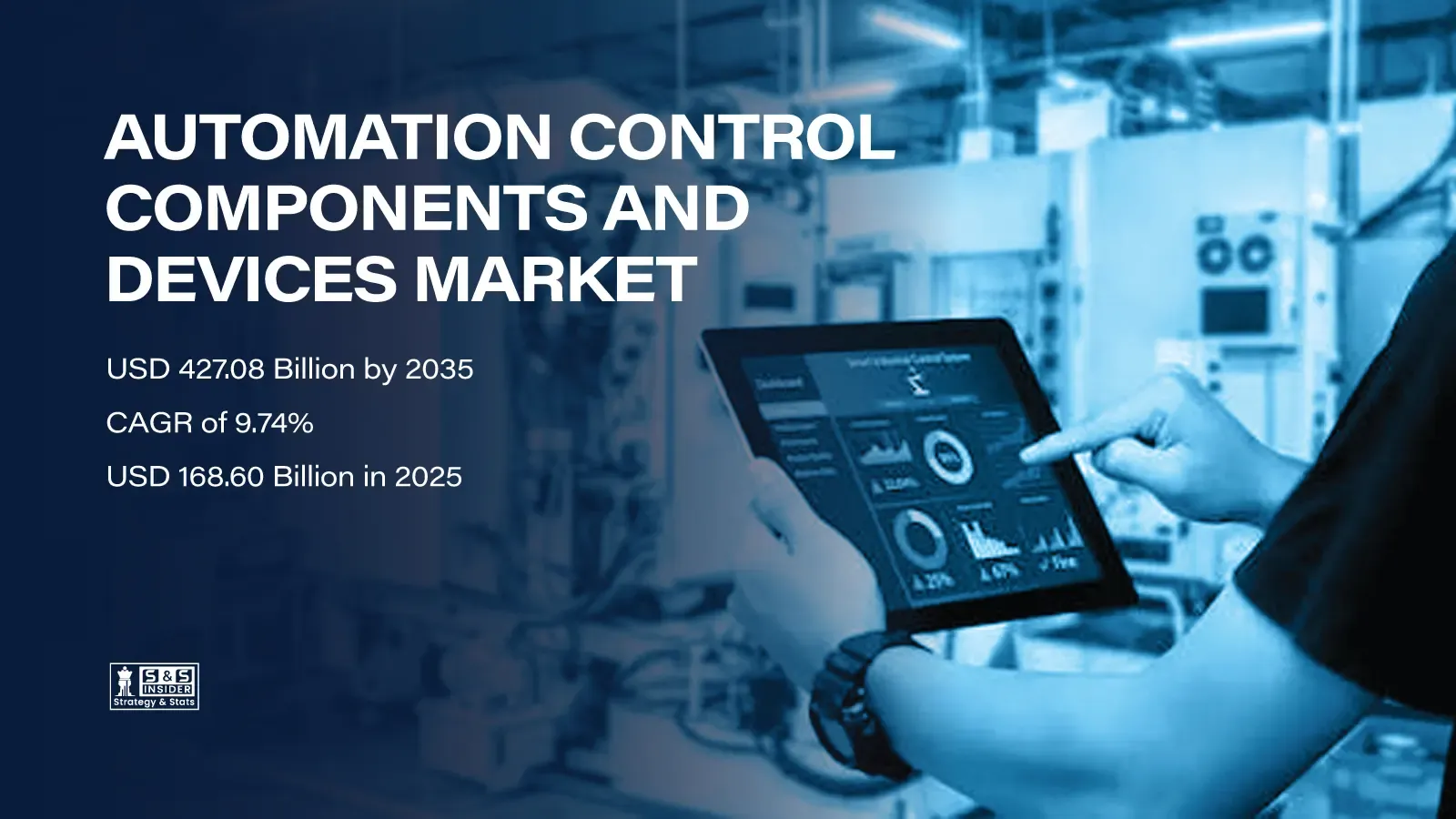
According to a recent study by SNS Insider, the global Automation Control Components and Devices Market was valued at USD 168.60 Billion in 2025 and is expected to reach USD 427.08 Billion by 2035, growing at a CAGR of 9.74% over 2026–2035. The market is estimated at USD 185.02 Billion in 2026.
Gain Actionable Intelligence on the Automation Control Components and Devices Market - Request a Sample Report
Labor Gaps Turn Automation into a Basic Business Need
Many manufacturers find it hard to hire and keep skilled workers. Automation lets them keep output steady with smaller teams, so control systems are now part of workforce planning, not only engineering budgets.
This changes how buyers spend. Instead of one large purchase, many companies automate one step at a time, starting where labor is shortest or errors cost the most. Suppliers can build long relationships by supporting each stage of that journey.
Smaller and mid-sized manufacturers are a growing group of buyers. They need simple systems that are easy to install, program and expand. Products and services designed for this group open a large and underserved part of the market.
Old Plants Create a Steady Stream of Replacement Demand
A large share of the world's installed controllers and sensors was put in place many years ago. Spare parts become harder to find, software support ends, and older devices often cannot connect to modern networks. Plant owners eventually have to replace them.
Replacement projects are often easier to approve than new plants because they protect output that already exists. This gives suppliers a reliable source of revenue even in years when spending on new factories slows.
Upgrades also bring more devices into the network. As a result, a single modernization project can lead to further orders for communication modules, safety parts and software.
Automation Control Components and Devices Market Segmentation Highlights
By Component: Servo motors, drives and motion components held 23.40% of the market in 2025. Industrial communication and I/O is the fastest-growing component, at an 11.72% CAGR, as plants connect more machines.
By Technology: Conventional programmable automation accounted for 36.20% in 2025. AI-enabled automation is growing fastest, at a 14.86% CAGR, which opens room for higher-value systems.
By End Use: Automotive and EV held 21.60% in 2025. Logistics and warehousing is expanding fastest, at a 12.38% CAGR, as fulfillment centers automate.
Asia Pacific Leads with 37.80% Market Share and Advances at 11.28% CAGR
Asia Pacific held 37.80% of the market in 2025 and is also the fastest-growing region, at an 11.28% CAGR. China, Japan, South Korea, India and Taiwan drive demand through factory expansion and robot use.
North America held 29.60% in 2025. The U.S. was valued at USD 40.92 Billion and is growing at a 9.12% CAGR, supported by reshoring and warehouse automation.
Europe held 25.40%, Latin America 4.00% and the Middle East & Africa 3.20%. Plant modernization in Europe and new industrial projects in Brazil and Saudi Arabia support steady demand.
Automation-as-a-Service Could Unlock New Commercial Opportunities
Many manufacturers want automation but do not want to tie up capital in equipment. Paying a monthly fee for robots, controls and support lowers the barrier to entry and moves the risk of performance to the supplier.
This model suits warehouses and contract manufacturers whose volumes change with customer demand. They can add or remove capacity without large purchases. Suppliers gain regular income and closer contact with how their equipment is used.
Remote monitoring makes the model practical. Suppliers can track device health, plan maintenance before failures and offer upgrades at the right time, turning a one-time sale into an ongoing service.
Competitive Outlook: Connected, Secure and Easy-to-Use Systems
Competition is moving from single devices to complete systems that work together. Buyers prefer suppliers that offer controllers, drives, sensors and software that connect easily and come with one support contract.
Security is becoming part of the buying decision. Attacks on connected controllers and stricter rules in Europe push buyers toward products with built-in protection. Trade actions and tariffs also reward suppliers with local production and flexible supply chains.
Automation Control Components and Devices Market Outlook Through 2035
The market is set to grow from USD 168.60 Billion in 2025 to USD 427.08 Billion by 2035. Labor gaps, plant upgrades and new warehouse automation will drive that growth. Suppliers that pair reliable hardware with connected software, strong security and flexible service models are best placed to win it.



