The latest SNS Insider Battery Coating Market report says the global market is growing quickly. Battery makers are adding cell capacity for electric vehicles and energy storage systems. Coatings on electrodes, separators, and packs help cells last longer and run safely, so demand for them grows with every new production line.
The global battery coating market was valued at USD 551.37 Million in 2025. It is estimated at USD 636.12 Million in 2026 and is expected to reach USD 2.30 Billion by 2035, a CAGR of 15.37% during 2026–2035.
Cell makers want higher energy density and better thermal safety. Both goals require more coating per cell. Separator coatings that use ceramic layers are becoming more common because they help prevent short circuits at high temperatures.
New safety and traceability rules are also shaping demand. China's GB 38031-2025 standard sets stricter safety tests for traction batteries. The EU digital battery passport becomes mandatory in February 2027, so suppliers must document materials and processes more carefully.
Asia Pacific is both the largest and the fastest-growing regional market. Europe and North America are expanding as local cell production increases.
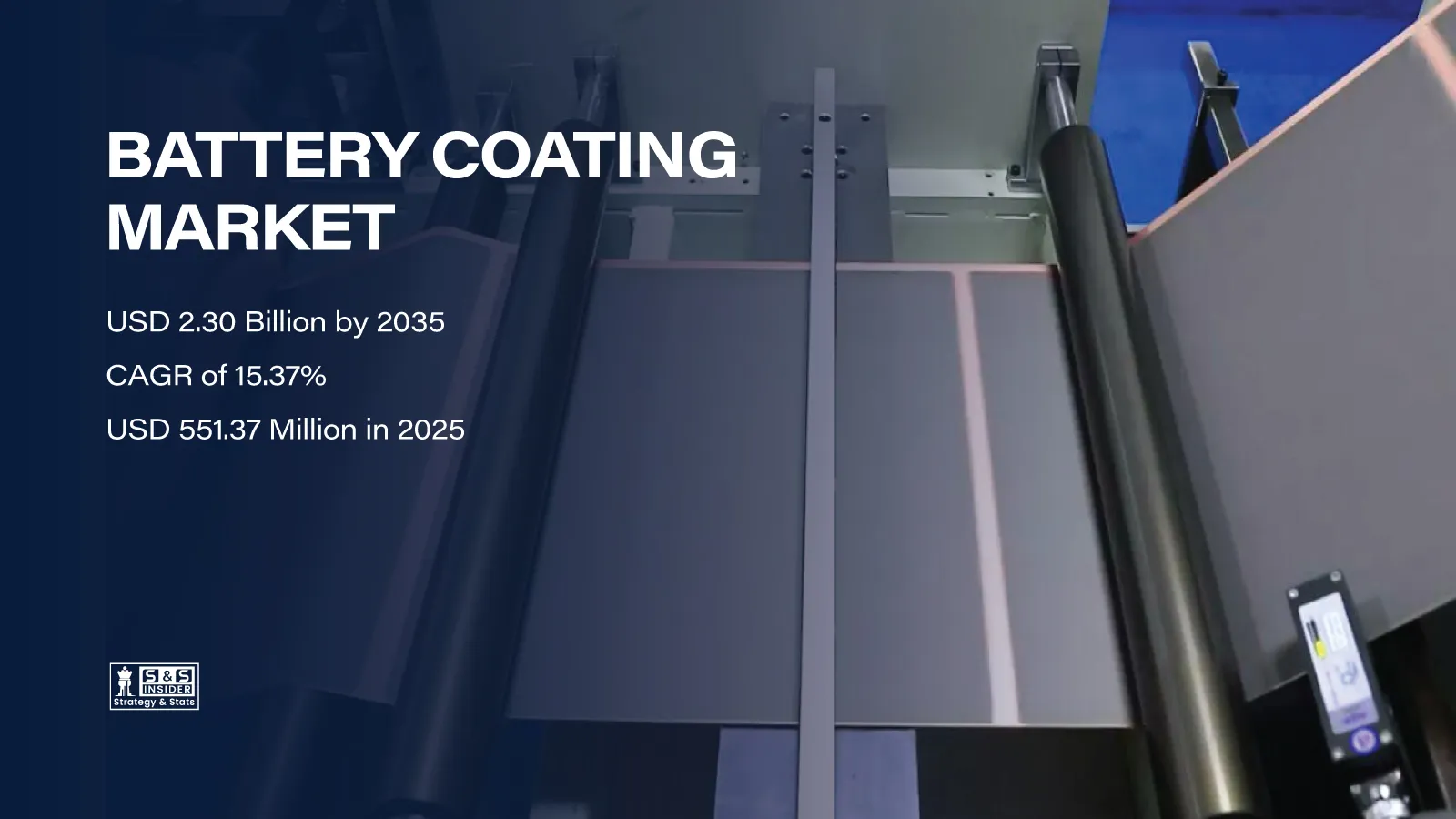
Market Size and Forecast
|
Market Indicator |
Value |
|
Market Size, 2025 |
USD 551.37 Million |
|
Market Size, 2026 |
USD 636.12 Million |
|
Market Forecast, 2035 |
USD 2.30 Billion |
|
CAGR, 2026–2035 |
15.37% |
|
Leading Region, 2025 |
Asia Pacific (62.37%) |
|
Fastest-Growing Region |
Asia Pacific (17.21% CAGR) |
Demand Drivers and Constraints
Primary Demand Drivers
-
Electric vehicle production: New cell capacity for electric cars, buses, and trucks increases the volume of coated electrodes and separators.
-
Higher energy density and safety: Cells with more energy in less space need thinner, more uniform coatings to stay stable.
-
Stricter safety standards: Rules such as China's GB 38031-2025 push makers to use heat-resistant separator and pack coatings.
-
Battery passport requirements: EU traceability rules favor suppliers who can document coating materials and processes clearly.
-
Stationary energy storage: Growth in grid and commercial storage, especially lithium iron phosphate systems, adds steady demand.
Potential Growth Constraints
-
Trade restrictions and price swings in fluoropolymers, ceramics, and graphite.
-
Long product qualification cycles, often two years or more.
-
Price pressure from large cell manufacturers.
-
High cost of pilot lines and testing for smaller suppliers.
-
Process changes needed to move from solvent-based to water-based coating.
Demand Structure by Component
Electrode Coating (2025 Market Share: 46.38%)
Electrode coating accounted for 46.38% of the global battery coating market in 2025. Every lithium-ion cell needs coated anodes and cathodes, so this segment grows directly with cell output. The coating controls how evenly active material sits on the foil, and that affects capacity, charging speed, and cycle life. Cell makers are moving to thicker electrodes and higher nickel cathodes, which need precise binders and surface layers. As gigafactories add lines in Asia, Europe, and North America, electrode coating will remain the largest component segment.
Current trend: Wider use of high-precision coating for thicker, high-energy electrodes.
Major trends: Water-based binders, dry electrode processing, cathode surface coatings, and inline thickness control.
Separator Coating (Forecast CAGR: 17.64%)
Separator coating is projected to grow at the fastest rate, with a CAGR of 17.64% during 2026–2035. Coated separators keep their shape at high temperatures and lower the risk of internal short circuits. Stricter safety rules and larger cell formats are making ceramic-coated separators standard in many electric vehicle programs. Suppliers are adding coating lines close to cell plants to shorten delivery times. Demand will rise further as solid-state and semi-solid designs need new separator and interface layers.
Current trend: Rising adoption of ceramic-coated separators in electric vehicle cells.
Major trends: Thin ceramic layers, polymer-ceramic blends, wet-process coating lines, and localized separator supply.
Demand Structure by Material
PVDF (2025 Market Share: 33.72%)
PVDF held a 33.72% share of the market in 2025. The material is widely used as a binder for cathodes and as a separator coating because it is chemically stable inside the cell. Cell makers trust its long track record, and switching to a new binder means long qualification work. Producers are expanding capacity to meet demand from new cathode lines. PVDF is expected to stay the leading material even as water-based alternatives gain ground.
Current trend: Capacity expansions by PVDF producers to serve new cathode plants.
Major trends: Battery-grade PVDF, lower-solvent processing, regional supply chains, and improved binder purity.
Ceramic (Forecast CAGR: 17.28%)
Ceramic coatings are expected to expand at a CAGR of 17.28% through 2035. Alumina and boehmite layers help separators resist heat and shrinkage, which improves cell safety. These materials are central to meeting new thermal runaway tests in China and other markets. Ceramic coatings also support the move toward solid-state cells, where stable interfaces are essential. Growing safety demands will keep ceramic materials the fastest-growing material category.
Current trend: Wider use of alumina and boehmite coatings on separators.
Major trends: Ultra-thin ceramic layers, heat-resistant separators, solid-state interface coatings, and particle size control.
Demand Structure by Battery Type
Lithium-Ion (2025 Market Share: 72.41%)
Lithium-ion batteries represented 72.41% of the battery coating market in 2025. They power most electric vehicles, consumer electronics, and grid storage systems, so they use the largest share of coatings. Both nickel-based and lithium iron phosphate chemistries need electrode and separator coatings. Large cell makers buy at high volume and set strict quality targets. Continued growth in vehicle and storage production will keep lithium-ion the main source of demand.
Current trend: Steady capacity growth in lithium-ion cell production worldwide.
Major trends: High-nickel cathodes, lithium iron phosphate expansion, silicon anode coatings, and cell-to-pack designs.
Solid-State (Forecast CAGR: 21.83%)
Solid-state batteries are projected to grow at a CAGR of 21.83% during 2026–2035. These cells replace liquid electrolytes with solid layers, and coatings are needed to keep the contact between layers stable. Automakers and cell makers are running pilot lines and testing early designs. Coating suppliers that can deliver precise interface layers are working closely with these programs. As pilot production moves toward commercial output, coating demand for this battery type will rise quickly.
Current trend: Pilot-scale development of coatings for solid-state cell interfaces.
Major trends: Interface protection layers, sulfide and oxide electrolyte compatibility, thin-film coating, and pilot line partnerships.
Key Market Participants
The battery coating market includes chemical companies, separator producers, and specialty coating suppliers.
Key participants include Arkema, Solvay, Asahi Kasei, UBE Corporation, Toray Industries, SK IE Technology, Sumitomo Chemical, Mitsubishi Paper Mills, Tanaka Chemical, PPG Industries, Axalta Coating Systems, and Targray.
Competition centers on material purity, coating consistency, local supply, and support during cell qualification. Recent moves show this focus. In August 2026, Asahi Kasei opened a wet-process separator coating line in Charlotte, North Carolina. In June 2026, Arkema completed a 15% PVDF capacity expansion at Calvert City, Kentucky.
Regional Market Dynamics
Asia Pacific (2025 Market Share: 62.37%)
Asia Pacific led the global battery coating market with a 62.37% share in 2025 and is expected to grow fastest, at a CAGR of 17.21% through 2035. China has the largest base of cell, cathode, and separator production. Japan and South Korea supply advanced materials and coating technology to cell makers around the world. New safety rules in China are raising the use of ceramic separator coatings. The region's large production scale will keep it ahead throughout the forecast period.
Direction: Continued leadership and fastest growth, supported by cell production scale and stricter safety rules.
Europe (2025 Market Share: 15.46%)
Europe held a 15.46% share in 2025 and is the second-largest regional market. New gigafactories in Germany, Hungary, Poland, and the Nordic countries are adding local demand for coatings. The EU battery passport, mandatory from February 2027, requires clear records of materials and processes. This favors suppliers that can document their supply chains and run local production. Growth will follow the pace of new cell plants in the region.
Direction: Steady expansion driven by local cell production and traceability rules.
North America (2025 Market Share: 14.92%)
North America accounted for 14.92% of the market in 2025. The United States leads regional demand, with a market value of USD 73.52 Million in 2025 and a projected CAGR of 15.46%. New cell plants and incentives for local battery supply are drawing coating producers to the region. Suppliers are building plants near their customers to reduce shipping time and trade risk. Canada adds demand through battery material and cell projects.
Direction: Solid growth supported by new domestic cell plants and local material supply.
Middle East & Africa
The Middle East and Africa held a 4.41% share in 2025. Demand is still small but growing through grid storage projects tied to solar power. Gulf countries are investing in energy storage as part of national energy plans. Most coated materials are imported, so local demand depends on storage project volumes.
Direction: Emerging opportunities driven by renewable energy storage projects.
Latin America
Latin America held a 2.84% share in 2025. The region has large lithium reserves in Chile and Argentina, but cell production is still limited. Brazil and Mexico are seeing early interest in vehicle and storage battery assembly. Demand for coatings will grow as local battery manufacturing develops.
Direction: Gradual growth supported by lithium resources and early battery assembly projects.
Market Outlook (2026–2035)
The global battery coating market is forecast to reach USD 2.30 Billion by 2035 as cell production continues to expand.
Electric vehicles, energy storage, and stricter safety rules will remain the main growth drivers. Separator and ceramic coatings are expected to gain share as safety demands rise.
Solid-state batteries and water-based processing will open new uses for coatings beyond today's lithium-ion lines.
Asia Pacific will keep its lead, while Europe and North America grow as local cell production increases.
Overall, the battery coating market is set for strong growth through 2035, and success will depend on material quality, safety performance, local supply, and close work with cell makers.