
According to the latest SNS Insider Precision Planting Market report, farmers are adopting precision planting systems to place each seed at the right depth and spacing. Seed, fertilizer and fuel cost more every season, so growers want each pass across the field to count. Better seed placement helps them raise yields while spending less on inputs.
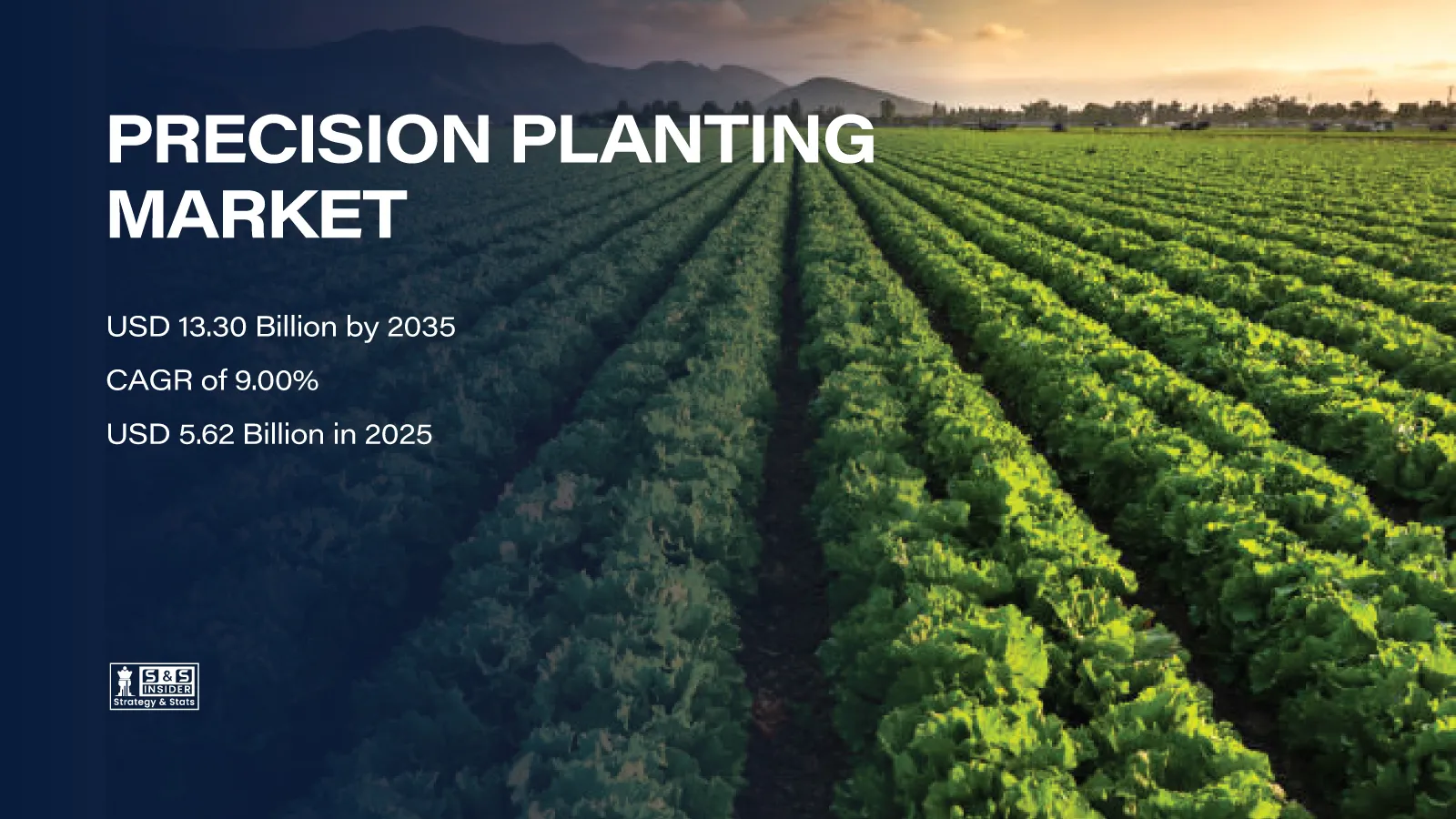
The global precision planting market was valued at USD 5.62 Billion in 2025 and is estimated at USD 6.13 Billion in 2026. It is projected to reach USD 13.30 Billion by 2035, growing at a CAGR of 9.00% during 2026–2035.
Electric drive systems now lead the market because they give finer control over seed rate and depth than older hydraulic designs. Equipment makers are fitting precision technology at the factory, and retrofit kits are bringing the same features to older planters.
Labor shortages are pushing farms toward automation, and connected machinery links planters to farm management software. Services, software subscriptions and autonomous seeding are growing quickly, so the market is no longer only about hardware.
North America holds the largest share of the market, and Asia Pacific is the fastest-growing region.
Market Size and Forecast
|
Market Indicator |
Value |
|
Market Size, 2025 |
USD 5.62 Billion |
|
Market Size, 2026 |
USD 6.13 Billion |
|
Market Forecast, 2035 |
USD 13.30 Billion |
|
CAGR, 2026–2035 |
9.00% |
|
Leading Region, 2025 |
North America (39.80%) |
|
Fastest-Growing Region |
Asia Pacific (11.80% CAGR) |
Demand Drivers and Constraints
Primary Demand Drivers
-
Yield pressure and input costs: Growers use precision planting to raise yields and avoid wasting expensive seed and fertilizer.
-
Labor shortages: Fewer skilled operators are available, so farms are investing in automated planting equipment.
-
Connected machinery: Planters linked to farm management software let growers record, review and adjust each field's planting plan.
-
Field trial evidence: Results from on-farm trials and operator training give buyers the confidence to invest.
-
Retrofit demand: A large base of older planters can be upgraded with precision kits at a lower cost than new machines.
Potential Growth Constraints
-
High upfront costs for small and mid-sized farms.
-
Repair access disputes and complex onboard electronics.
-
Uncertainty over tariffs on imported agricultural equipment.
-
Swings in crop prices and tight rural credit.
-
Slower mechanization in parts of emerging markets.
Demand Structure by Offering
Hardware (2025 Market Share: 46.20%)
Hardware accounted for 46.20% of the precision planting market in 2025. This segment covers row units, seed meters, sensors, displays and electric drives, and every precision system depends on them. Farmers usually start with hardware, either by buying a new planter or by fitting precision components to one they already own. Each purchase sets up later spending on software and services. Steady replacement of aging equipment and strong retrofit activity are expected to keep hardware the largest offering through 2035.
Current trend: Rising sales of retrofit kits for older planters.
Major trends: Electric seed meters, downforce control, high-resolution sensors and in-cab displays.
Services (Forecast CAGR: 11.60%)
Services are projected to grow at the fastest CAGR of 11.60% during 2026–2035. As planters become more complex, growers need help with installation, calibration, agronomy and data use. Dealers and equipment makers now sell service packages and subscriptions alongside the machine. These offers help farmers get full value from their equipment and give suppliers steady income after the sale. Wider use of planting data in crop planning is expected to keep services growing quickly.
Current trend: Growth in agronomic support and subscription-based service plans.
Major trends: Managed data services, remote diagnostics, operator training and seasonal calibration programs.
Demand Structure by Drive Type
Electric Drive (2025 Market Share: 55.20%)
Electric drive held 55.20% of the market in 2025 and is projected to grow at a CAGR of 11.50% through 2035. Electric motors control each row separately, which allows precise seed rates and variable-rate planting across a field. They also reduce the hydraulic load on the tractor and need fewer moving parts. These benefits make electric drive the default choice on many new planters. Hydraulic drive is still used on older and simpler machines, but its share is gradually shifting to electric designs.
Current trend: Factory fitment of electric drives on new planter models.
Major trends: Row-by-row control, electric depth adjustment, variable-rate seeding and reduced tractor hydraulic demand.
Demand Structure by System Type
High-Speed Precision Planting Systems (2025 Market Share: 38.40%)
High-speed precision planting systems represented 38.40% of the market in 2025. These systems let farmers plant at higher speeds without losing accuracy in seed spacing or depth. Each day of the planting season matters, so planting faster helps growers finish on time and protect yields. Large row-crop farms in North America and South America are the main buyers. Ongoing upgrades to seed delivery and meter design are expected to support steady demand.
Current trend: Wider adoption of high-speed planting on large row-crop farms.
Major trends: Belt-driven seed delivery, faster seed meters, accurate spacing at speed and shorter planting windows.
Drones and Autonomous Seeding (Forecast CAGR: 13.20%)
Drones and autonomous seeding are projected to grow at the fastest CAGR of 13.20% during 2026–2035. These systems reduce the need for operators and can work on wet fields, slopes and small plots where tractors struggle. They are also used for cover crops and reseeding gaps in a field. Costs are falling and regulations are becoming clearer, so more farms are testing them. Labor shortages are expected to speed up their adoption.
Current trend: Growing field trials of autonomous and drone-based seeding.
Major trends: Cover crop seeding, autonomous planting platforms, remote operation and small-plot applications.
Demand Structure by Farm Size
Below 400 Hectares (2025 Market Share: 54.60%)
Farms below 400 hectares accounted for 54.60% of the market in 2025. This group is very large across all regions, so its total spending is high, even though each farm buys less. Many of these farms are upgrading older planters with retrofit kits instead of buying new machines. Dealer financing and shared equipment programs also make precision tools easier to afford. Lower-cost systems are expected to support adoption in this group.
Current trend: Rising use of affordable retrofit kits on small and mid-sized farms.
Major trends: Entry-level precision kits, dealer financing, equipment sharing and simple display systems.
Above 400 Hectares (Forecast CAGR: 10.60%)
Farms above 400 hectares are projected to grow at a CAGR of 10.60% through 2035. Large operations plant big areas in short windows, so speed, accuracy and automation give them a clear return. They are also more likely to buy fully connected planters and software subscriptions. Labor shortages hit these farms hard, which increases interest in autonomous options. Farm consolidation is expected to add to demand in this segment.
Current trend: Investment in fully connected, high-capacity planting fleets.
Major trends: Wide planters, fleet data management, autonomous operation and variable-rate seeding.
Key Market Participants
The precision planting market includes large agricultural equipment makers, specialist planter manufacturers and precision technology providers.
Key participants include Deere & Company, AGCO Corporation (Precision Planting, PTx), CNH Industrial N.V., Kinze Manufacturing, Inc., Kubota Corporation, AG Leader Technology, Väderstad AB, Horsch Maschinen GmbH, Amazone H. Dreyer SE & Co. KG, Lemken GmbH & Co. KG, Kuhn Group and Bourgault Industries Ltd.
Competition centers on planting accuracy, electric drive control, software connection and dealer support. Suppliers that offer factory-fitted technology, retrofit options and useful data services are well placed to win both new and existing customers.
Regional Market Dynamics
North America (2025 Market Share: 39.80%)
North America led the global precision planting market with a 39.80% share in 2025. The United States is the leading country, with a market value of USD 2.04 Billion in 2025 and a projected CAGR of 8.70%. Large corn and soybean farms, high labor costs and strong dealer networks support early adoption. A large base of older planters also creates strong demand for retrofit kits. Tariff uncertainty and tight farm credit may slow some purchases, but the region is expected to remain the largest market.
Direction: Continued leadership supported by retrofit demand and connected row-crop farming.
Europe (Second-Largest Regional Market)
Europe held 26.40% of the market in 2025. Farmers in the region work with strict rules on fertilizer and chemical use, so precise seed and input placement brings clear benefits. Local manufacturers such as Väderstad, Horsch, Amazone, Lemken and Kuhn offer a wide range of precision seed drills and planters. Smaller field sizes in many countries favor flexible, mounted machines. Demand is expected to grow steadily as farms replace older equipment.
Direction: Steady growth driven by input-use rules and equipment renewal.
Asia Pacific (Forecast CAGR: 11.80%)
Asia Pacific held 23.20% of the market in 2025 and is projected to grow at the fastest CAGR of 11.80% through 2035. Rising food demand, shrinking farm labor and government support for mechanization are speeding up adoption. Many farms in the region are small, which creates room for low-cost systems, shared services and drone seeding. Large grain-growing areas are also adding high-capacity planters. Growing local manufacturing is expected to make precision equipment more affordable.
Direction: Fastest regional growth supported by mechanization and labor shortages.
Middle East & Africa
The Middle East and Africa held 2.60% of the market in 2025. Water shortages and the need for food security are encouraging more careful use of seed and inputs. Large commercial farms and government food programs are the main early buyers. High equipment costs and limited dealer coverage still restrict wider use. Rental models and support programs are expected to help adoption over time.
Direction: Early-stage growth supported by food security programs and commercial farming.
Latin America
Latin America held 8.00% of the market in 2025. Large soybean and corn farms in the region benefit from fast and accurate planting over wide areas. Growers are investing in precision equipment to protect yields and control input costs. Currency swings and crop price changes can delay purchases. Financing programs and retrofit options are expected to support steady demand.
Direction: Gradual growth supported by large-scale row-crop farming.
Market Outlook (2026–2035)
The global precision planting market is forecast to reach USD 13.30 Billion by 2035, as growers invest in tools that make every seed count.
Input cost control, labor shortages and connected machinery will remain the main growth drivers. Electric drive systems are expected to keep gaining ground over hydraulic designs.
Services, software and autonomous seeding will widen the market beyond hardware sales. Retrofit kits will help bring precision planting to farms that cannot buy new machines.
North America will keep its leading position, while Asia Pacific is expected to offer the strongest growth.
Overall, the precision planting market is set for steady growth through 2035, with success depending on planting accuracy, affordable upgrade paths, useful farm data and reliable dealer support.



