
The latest SNS Insider Wireless Audio Device Market report shows a market that keeps growing as people replace older earbuds, headphones and speakers with newer models. Better batteries, stronger noise cancellation and more features give buyers a clear reason to upgrade. Wireless sound is now a normal part of phones, homes and cars.
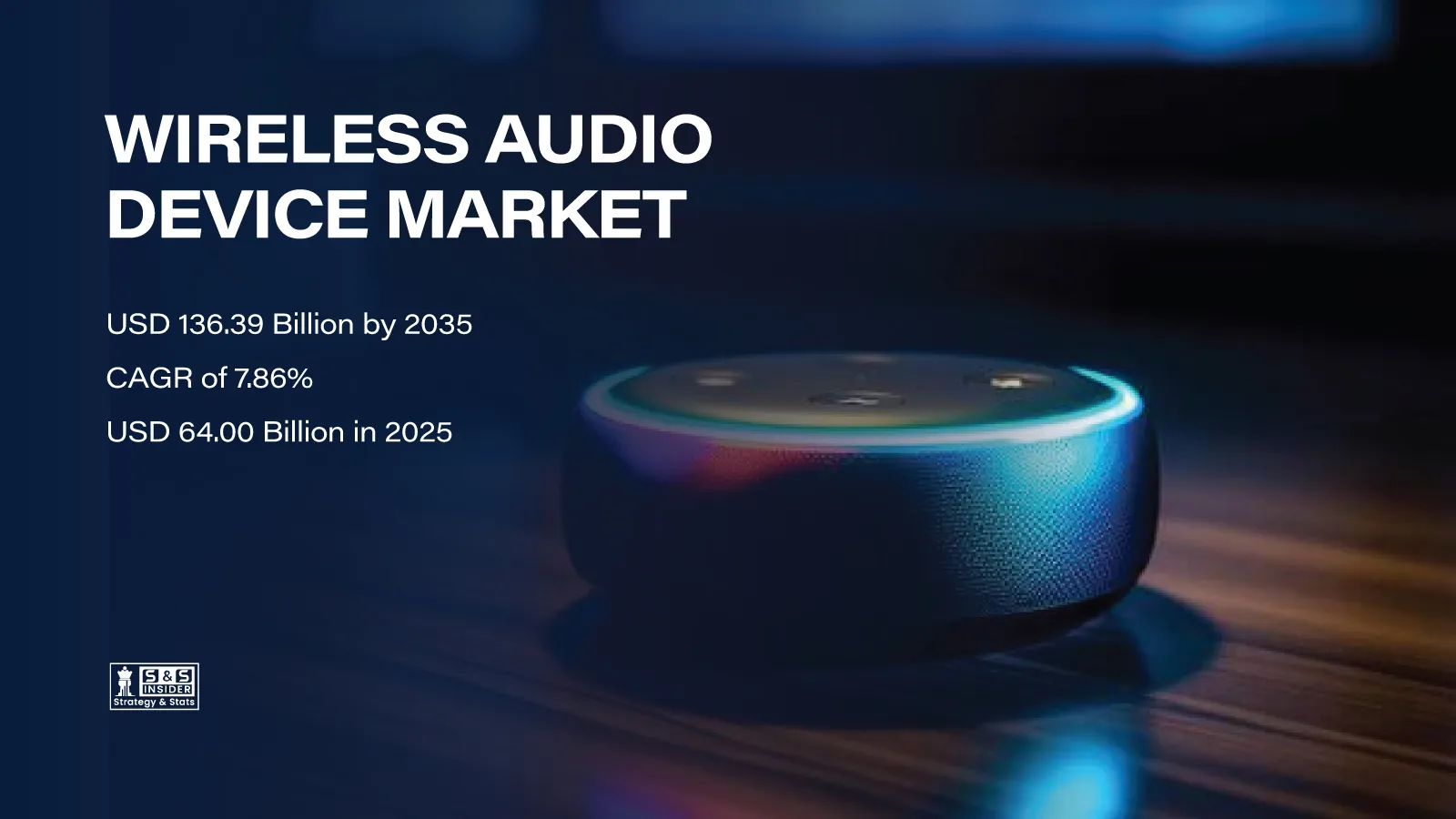
The global wireless audio device market was valued at USD 64.00 Billion in 2025. It is estimated at USD 69.03 Billion in 2026 and is expected to reach USD 136.39 Billion by 2035, at a CAGR of 7.86% during 2026–2035.
Bluetooth remains the main way these devices connect. Wi-Fi based products are growing faster because they support multiroom playback and higher sound quality at home.
Personal listening is still the largest use. Demand is spreading into cars, offices, classrooms and public venues. Bluetooth LE Audio and Auracast broadcast audio are opening new ways to share sound in shared spaces.
Asia Pacific is the largest regional market. The Middle East & Africa is the fastest-growing region.
Market Size and Forecast
|
Market Indicator |
Value |
|
Market Size, 2025 |
USD 64.00 Billion |
|
Market Size, 2026 |
USD 69.03 Billion |
|
Market Forecast, 2035 |
USD 136.39 Billion |
|
CAGR, 2026–2035 |
7.86% |
|
Leading Region, 2025 |
Asia Pacific (41.20%) |
|
Fastest-Growing Region |
Middle East & Africa (9.76% CAGR) |
Demand Drivers and Constraints
Primary Demand Drivers
-
Earbud replacement and upgrades: Buyers trade up for longer battery life, better noise cancellation and new features.
-
Smart home and multiroom audio: More homes link speakers across rooms and control them through voice assistants and apps.
-
Bluetooth LE Audio and Auracast: New standards cut power use and let one source stream to many listeners.
-
Lower component costs: Cheaper parts bring capable mid-priced products to more buyers.
-
New use cases: Hearing-assist features, in-car sound zones and wireless microphones for creators widen the buyer base.
Potential Growth Constraints
-
Saturation in developed markets, where growth depends on replacement.
-
Strong price competition and thin margins.
-
Battery waste concerns and rising compliance costs.
-
Tariffs and trade limits on semiconductors and rare materials.
-
Fast product cycles that shorten the selling life of each model.
Demand Structure by Product
True Wireless Hearables and Earbuds (2025 Market Share: 44.80%; Forecast CAGR: 9.04%)
True wireless hearables and earbuds held 44.80% of the market in 2025. They are also the fastest-growing product type, at a CAGR of 9.04% through 2035. Earbuds are small, easy to carry and work with every major phone platform. Each new generation brings better noise control, longer battery life and smarter features, so people upgrade often. Hearing-assist and health features are giving buyers new reasons to own a pair. Prices now cover a wide range, which helps earbuds reach more people.
Current trend: Faster replacement cycles driven by noise cancellation and LE Audio support.
Major trends: Hearing-assist functions, adaptive noise control, spatial audio and mid-priced feature-rich models.
Demand Structure by Technology
Bluetooth (2025 Market Share: 84.60%)
Bluetooth accounted for 84.60% of the market in 2025. Almost every phone, laptop and car supports it, so it is the easiest choice for both makers and buyers. It handles earbuds, headphones, portable speakers and many in-car systems. LE Audio is making Bluetooth more efficient and improving sound quality at low power. Auracast lets one device stream to many listeners at once. These changes keep Bluetooth at the center of wireless audio even as other options grow.
Current trend: Wider rollout of LE Audio across new earbuds and phones.
Major trends: Auracast broadcast audio, low-power codecs, multipoint pairing and better latency.
Wi-Fi (Forecast CAGR: 10.24%)
Wi-Fi based devices are projected to grow at a CAGR of 10.24% during 2026–2035. Wi-Fi carries more data than Bluetooth, so it supports higher sound quality and steady playback across a whole home. Multiroom speaker systems, soundbars and smart speakers rely on it. As more homes add connected devices and streaming services, buyers want speakers that work together across rooms. Wi-Fi also allows easy software updates, which keeps devices useful for longer.
Current trend: Growing adoption of multiroom speaker systems in connected homes.
Major trends: High-resolution streaming, voice assistant integration, whole-home audio and over-the-air updates.
Demand Structure by Application
Residential and Individual (2025 Market Share: 71.30%)
Residential and individual use represented 71.30% of the market in 2025. Most wireless audio is bought for personal listening, at home or on the move. People use earbuds and headphones for music, calls, video and gaming. At home, smart speakers and soundbars support entertainment and voice control. Remote work and online learning have also increased daily use of headsets. Regular upgrades and gift buying keep demand in this group steady.
Current trend: Continued upgrades of personal earbuds and home speakers.
Major trends: Smart speakers, home theater soundbars, work-from-home headsets and gaming audio.
Automotive (Forecast CAGR: 10.12%)
Automotive applications are expected to grow at a CAGR of 10.12% through 2035. Car makers are adding wireless connections, premium sound systems and personal sound zones that let each passenger hear different audio. Drivers expect phones and earbuds to connect to the car without cables. Electric vehicles, with quieter cabins and digital dashboards, are raising interest in better in-car audio. This makes the car a growing outlet for wireless sound technology.
Current trend: Rising use of wireless connectivity and premium audio in new vehicles.
Major trends: Personal sound zones, in-car streaming, EV cabin audio and seamless phone pairing.
Key Market Participants
The wireless audio device market includes consumer electronics brands, audio specialists and professional sound equipment makers.
Key participants include Apple Inc., Samsung Electronics (HARMAN International), Sony Group Corporation, Bose Corporation, Sennheiser electronic SE & Co. KG, Sonos, Inc., Logitech International S.A., Shure Incorporated, Xiaomi Corporation and Anker Innovations Limited.
Competition centers on sound quality, noise cancellation, battery life, ecosystem fit and price. Recent launches show how fast the field moves. Sony launched the WF-1000XM6 earbuds in February 2026, the same month Samsung unveiled the Galaxy Buds4 and Buds4 Pro. In September 2026, Apple introduced two AirPods 5 models at a lower price point.
Regional Market Dynamics
Asia Pacific (2025 Market Share: 41.20%)
Asia Pacific led the global wireless audio device market with a 41.20% share in 2025. The region has a huge base of smartphone users and a large production network for audio products. China is both a major manufacturer and a major buyer. India is growing quickly as low-cost earbuds reach first-time buyers. Japan and South Korea add demand for premium devices. Strong local brands and wide online retail keep prices low and products easy to find.
Direction: Continued leadership supported by large consumer demand and regional manufacturing strength.
North America (2025 Market Share: 28.40%)
North America held 28.40% of the market in 2025. The United States accounts for most regional demand, with a market value of USD 15.32 Billion in 2025 and a projected CAGR of 7.12%. Buyers here favor premium earbuds, smart speakers and multiroom systems. Most growth now comes from replacement, as many households already own several devices. Hearing-assist features and in-car audio are adding new demand.
Direction: Steady growth driven by premium upgrades and new health and automotive features.
Europe (2025 Market Share: 17.60%)
Europe accounted for 17.60% of the market in 2025. Buyers show strong interest in quality audio brands and home sound systems. Environmental rules on batteries and electronic waste are shaping product design and raising compliance costs. Makers are responding with repairable designs and longer software support. Use of Auracast in public venues and transport is expected to open new demand.
Direction: Moderate growth shaped by quality-focused buyers and sustainability rules.
Middle East & Africa (Forecast CAGR: 9.76%)
The Middle East & Africa held 8.20% of the market in 2025 and is expected to grow fastest, at a CAGR of 9.76% through 2035. Rising smartphone use, a young population and wider online retail are lifting demand. Gulf countries add strong spending on premium devices and car audio. In Africa, affordable earbuds and speakers are reaching more first-time buyers.
Direction: Fastest regional expansion supported by growing device ownership and affordable products.
Latin America
Latin America held 4.60% of the market in 2025. Brazil and Mexico lead regional demand as smartphone use and online shopping grow. Currency swings and import costs make buyers price-sensitive, which favors mid-priced and value brands. Demand for portable speakers and earbuds keeps rising in urban centers.
Direction: Gradual growth supported by smartphone adoption and value-priced products.
Market Outlook (2026–2035)
The global wireless audio device market is forecast to reach USD 136.39 Billion by 2035.
Earbud upgrades, smart home audio and Bluetooth LE Audio will remain the main growth drivers. Wi-Fi based systems are expected to gain ground as more homes adopt multiroom sound.
Cars, hearing-health features, public broadcast audio and wireless microphones will widen demand beyond personal listening.
Asia Pacific will keep its lead in size, while the Middle East & Africa offers the fastest growth.
Overall, the wireless audio device market is set for steady expansion through 2035, with success depending on sound quality, battery life, ecosystem fit and fair pricing.



