The worldwide market for black mass recycling is growing as electric vehicle sales rise and more lithium-ion batteries reach the end of their life. Black mass is the dark powder left after spent batteries are shredded. It contains valuable metals such as lithium, nickel, cobalt and manganese. Battery makers and automakers want a steady local supply of these metals and governments are setting rules for battery collection and recycled content. Recyclers are also building cleaner, more efficient recovery processes, which will support market growth.
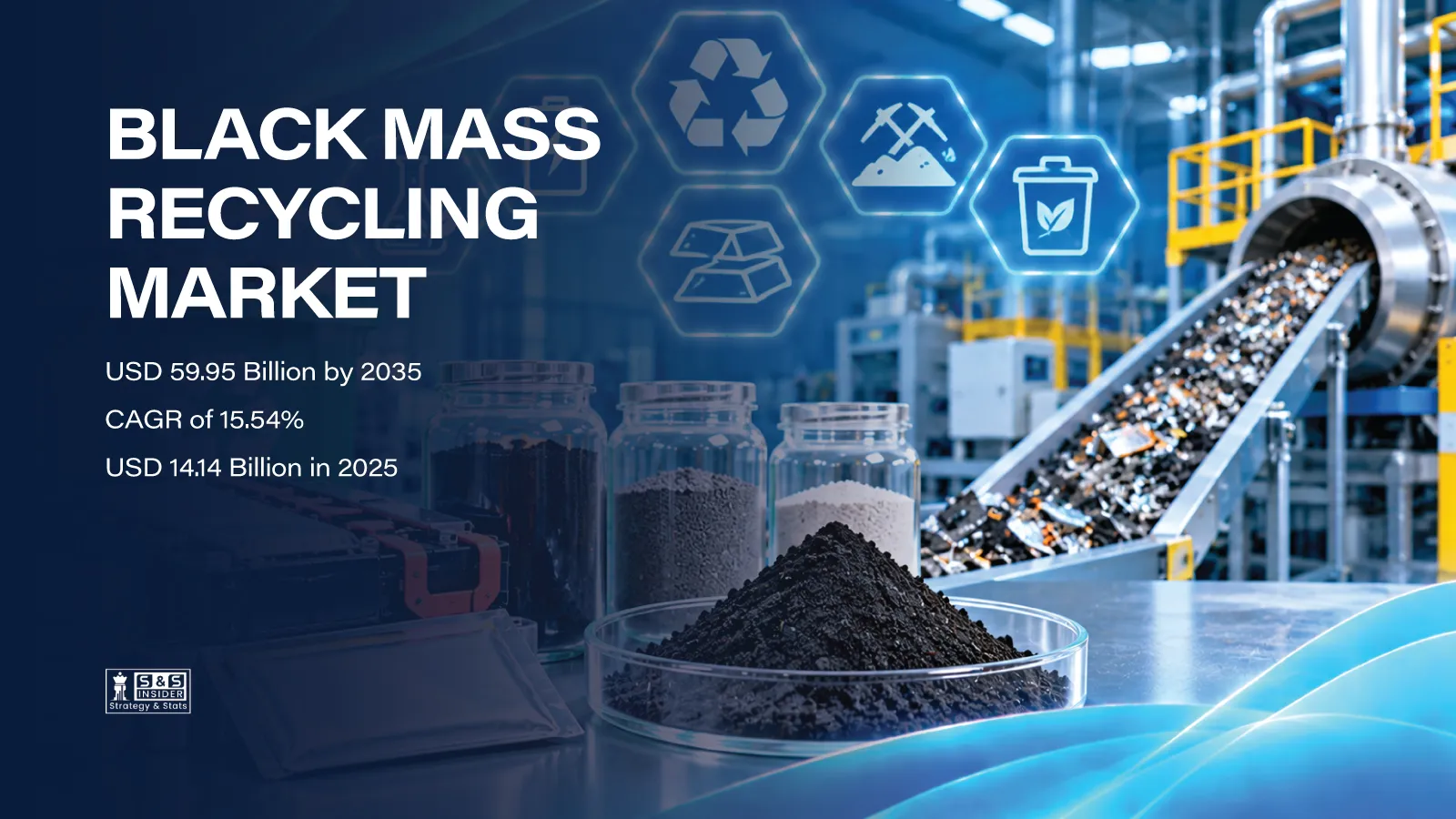
The Black Mass Recycling Market value stood at USD 14.14 billion in 2025 and is anticipated to grow to USD 59.95 billion by 2035, growing at a CAGR of 15.54% in the forecast period of 2026-2035. The automotive segment held around 48.00% of the market by battery source, while hydrometallurgy accounted for about 52.00% of the market by technology in 2025.
Unlock exclusive market insights download the brochure to explore global Black Mass Recycling Market trends, emerging opportunities, competitive developments, and forecasts through 2035.
Regional Analysis of the Black Mass Recycling Market
The black mass recycling market is expanding across North America, Europe, Asia-Pacific, Latin America and Middle East & Africa. Asia-Pacific dominated the market in 2025 owing to its large battery manufacturing base, high EV adoption and strong refining capacity for battery metals. China led the region with around 38.40% of regional revenue. In North America, the US accounted for 85.10% of regional revenue and had a market valuation of USD 1.92 billion in 2025, which is forecasted to reach USD 8.47 billion by 2035 at a CAGR of 16.00%. In Europe, Germany led with around 27.70% of regional revenue, supported by strict battery rules and large automotive production.
Asia-Pacific will also register the fastest growth due to rising battery waste volumes, government support for critical mineral recovery and new recycling plants and the leading countries in Asia-Pacific include China, India, South Korea and Japan. Latin America and Middle East & Africa are witnessing stable growth due to new pilot plants and rising interest in local metal recovery, with Brazil holding 37.60% of Latin American revenue and the UAE holding 26.50% of Middle East & Africa revenue.
Top 10 Trends in the Black Mass Recycling Market
-
Rising volumes of end-of-life EV batteries, the fastest-growing battery origin segment.
-
Fast growth in portable consumer electronics recycling at a CAGR of about 23.82%.
-
Continued leadership of hydrometallurgy for high metal recovery rates.
-
Growing interest in bio-leaching as a lower-energy recovery method.
-
Strong focus on lithium recovery, the fastest-growing recovered metal.
-
Partnerships between chemical companies, automakers and recyclers to secure metal supply.
-
Government funding and policies for critical mineral recycling.
-
Building of local recycling plants to cut dependence on imported metals.
-
Use of manufacturing scrap from gigafactories as a steady feedstock.
-
Growth of cross-border trade in black mass between recycling and refining hubs.
Black Mass Recycling Market Growth Drivers and Opportunities
Growth prospects for the market are due to rising EV production, growing battery waste and the need for a secure supply of critical metals. Recycling lowers the need for new mining and reduces the carbon footprint of battery production. Automakers and battery makers are also signing long-term deals with recyclers to meet recycled content targets. For example, in June 2025, BASF began commercial operations at its black mass plant in Schwarzheide, Germany.
The growing potential is evident in emerging markets and new technologies. For example, in September 2025, India's Union Cabinet approved a USD 170 million (₹1,500 crore) scheme to support critical mineral recycling. Volatile metal prices, high plant costs, safety risks in battery handling and transport and uneven collection systems are some challenges in this market.
Top 10 Companies in the Black Mass Recycling Market
The black mass recycling industry is made up of chemical groups, mining and metals companies and specialist battery recyclers. The competitive advantage for these companies lies in metal recovery technology, access to battery feedstock, refining capacity and long-term supply deals with automakers and battery makers.
-
BASF SE
-
Umicore NV
-
Redwood Materials, Inc.
-
Ascend Elements, Inc.
-
Stena Recycling
-
Glencore plc
-
Li-Cycle Corp.
-
SungEel HiTech Co., Ltd.
-
Fortum Oyj
-
Cirba Solutions
-
BASF SE
BASF SE is a German chemical company and a major supplier of battery cathode materials. The company runs black mass production and metal refining operations to close the battery materials loop in Europe. In June 2025, BASF began commercial operations at its black mass plant in Schwarzheide, Germany.
-
Umicore NV
Umicore NV is a Belgian materials technology company focused on battery materials, catalysts and precious metal recycling. The company recovers cobalt, nickel and lithium from spent batteries and production scrap. It continues to expand its battery recycling capacity to serve European automakers.
-
Redwood Materials, Inc.
Redwood Materials, Inc. is a U.S. battery recycling company based in Nevada. The company recovers lithium, nickel, cobalt and copper from spent batteries and production scrap. It turns these metals into battery components for U.S. cell manufacturers.
-
Ascend Elements, Inc.
Ascend Elements, Inc. is a U.S. company that recycles lithium-ion batteries and makes battery materials. It uses a hydrometallurgical process to turn black mass into new cathode materials. The company continues to advance this technology to lower the cost of recycled battery materials.
-
Stena Recycling
Stena Recycling is a Nordic recycling company that handles metals, electronics and batteries. The company collects and processes lithium-ion batteries into black mass for metal recovery. In January 2024, Stena Recycling signed a collaboration deal with BASF on battery recycling in Europe.
Company Profile
A detailed company profile can cover:
-
Business overview and company snapshot
-
Product portfolio and technology coverage
-
Market position and competitive analysis
-
Financial performance, where available
-
Recent developments, mergers and acquisitions
-
SWOT analysis
The remaining companies can be assessed using the same framework in a comprehensive market research report.
Future Outlook of the Black Mass Recycling Market
Growth in the black mass recycling industry is set to continue as more EV batteries reach the end of their life and countries work to secure critical metal supply. Lithium recovery, bio-leaching and improved hydrometallurgy will widen the value recyclers can capture from black mass. Asia-Pacific will remain the main hub, while North America and Europe will add capacity under local content rules. Companies that secure steady feedstock and invest in efficient recovery technology may gain a stronger competitive position over the forecast period.