
According to the latest SNS Insider Dispatch Console Market report, the global market is growing at a steady pace. Police, fire, emergency medical, transit and utility operators are replacing older dispatch systems. New emergency calling rules and the spread of broadband networks are changing what control rooms need from their consoles.
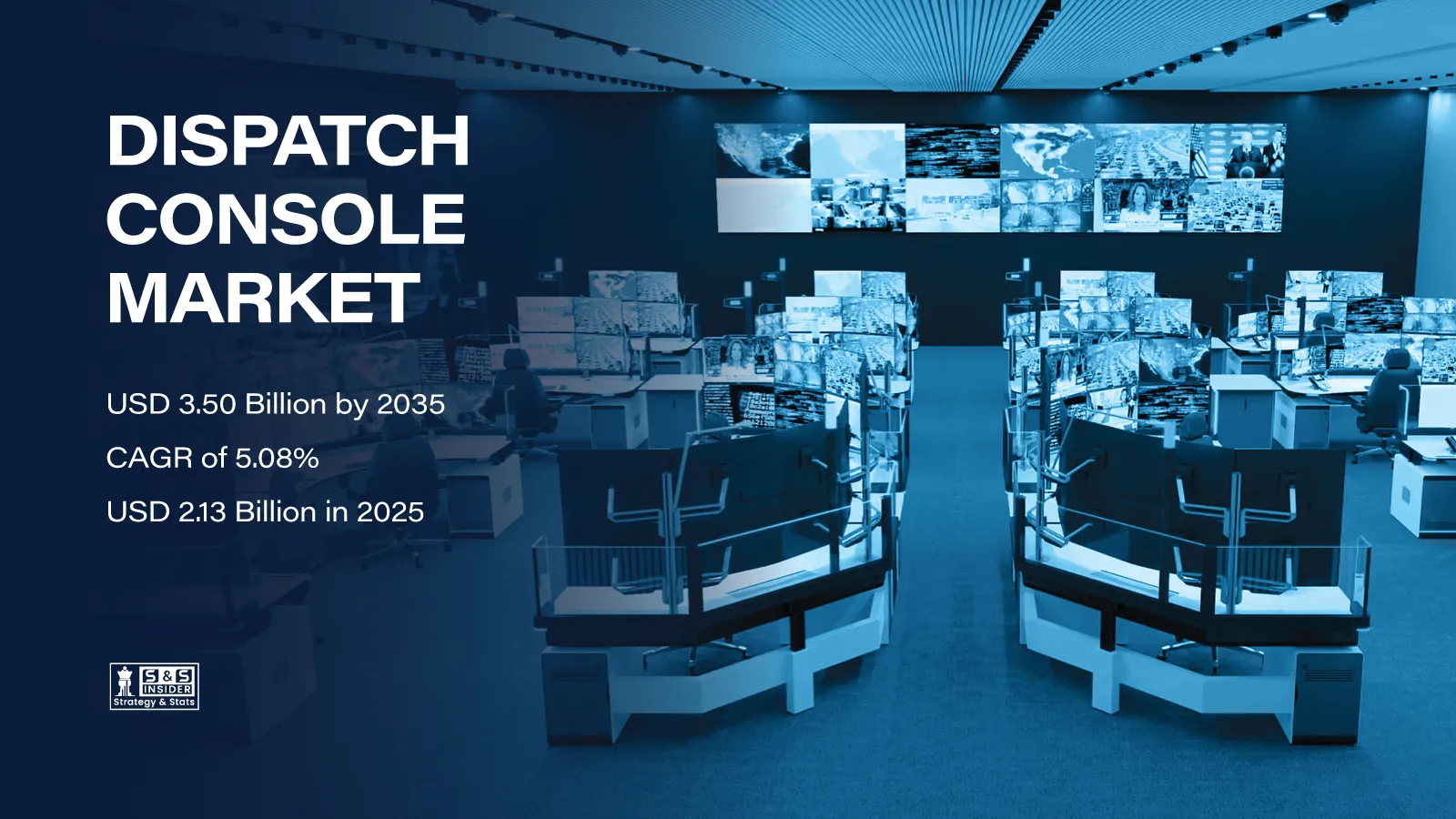
The global dispatch console market was valued at USD 2.13 Billion in 2025 and is estimated at USD 2.24 Billion in 2026. It is projected to reach USD 3.50 Billion by 2035, growing at a CAGR of 5.08% during 2026–2035.
IP-based consoles now hold most of the market because they connect radio, phone and data systems through one interface. Software is the fastest-growing component, as agencies add features through updates rather than replacing hardware.
Public safety is the fastest-growing application. Agencies need consoles that handle voice, data and caller location together, and that stay online during outages. Transportation remains the largest application because rail, transit and logistics operators depend on constant contact with their crews.
North America is the largest regional market, while Asia Pacific is growing fastest as countries expand their public safety networks.
Market Size and Forecast
|
Market Indicator |
Value |
|
Market Size, 2025 |
USD 2.13 Billion |
|
Market Size, 2026 |
USD 2.24 Billion |
|
Market Forecast, 2035 |
USD 3.50 Billion |
|
CAGR, 2026–2035 |
5.08% |
|
Leading Region, 2025 |
North America (36.28%) |
|
Fastest-Growing Region |
Asia Pacific (5.94% CAGR) |
Demand Drivers and Constraints
Primary Demand Drivers
-
NG911 transition rules: Next-generation emergency calling rules are pushing agencies to replace older circuit-switched consoles with IP-based systems.
-
Reliability requirements: FCC reliability rules for NG911 take effect in August 2026, which favors consoles with failover, redundancy and call logging.
-
Public safety broadband growth: More users on networks such as FirstNet raise demand for consoles that manage voice, data and location in one place.
-
National radio network replacement: Programs such as the UK's Emergency Services Network create demand for consoles that work across old and new networks.
-
AI and cloud features: Agencies are adding transcription, location analytics and AI assistants for non-emergency calls, often on a subscription basis.
Potential Growth Constraints
-
Slow public procurement and delays in funding approval.
-
Limited state or national guidance for NG911 rollout in some areas.
-
Long radio network transitions that keep existing consoles in service longer.
-
High integration costs when connecting new consoles to older radio systems.
-
Budget pressure on smaller local agencies.
Demand Structure by Component
Hardware (2025 Market Share: 54.12%)
Hardware accounted for 54.12% of the global dispatch console market in 2025. Every control room needs physical consoles, radio interfaces, headsets, gateways and backup equipment before any software can run. Agencies often buy these items in large batches when they build or upgrade a dispatch center. Hardware must also meet strict reliability standards, because a failed console can delay an emergency response. Steady replacement of aging equipment and new control room construction are expected to keep hardware the largest component through 2035.
Current trend: Replacement of aging radio interfaces and desk consoles in public safety answering points.
Major trends: Rugged console hardware, redundant gateways, modular desk positions, and IP-ready radio interfaces.
Software (Forecast CAGR: 5.79%)
Software is projected to grow at a CAGR of 5.79% during 2026–2035, the fastest rate among components. Agencies want to add new features without replacing their equipment, and software makes that possible through regular updates. Mapping, call recording, transcription and multi-agency coordination tools all run as software layers on top of the console. Many suppliers now sell these features through subscriptions or managed services, which spreads costs over time and suits public budgets.
Current trend: Growing use of subscription-based dispatch software and cloud-hosted features.
Major trends: AI-assisted call handling, cloud dispatch platforms, location analytics, and remote software updates.
Demand Structure by Type
IP-Based (2025 Market Share: 65.84%)
IP-based consoles represented 65.84% of the market in 2025. They connect radio, phone and data systems over standard networks, so dispatchers can manage several channels from one screen. IP systems also make it easier to add positions, link sites and set up backup centers in different locations. NG911 rules depend on IP networks, which makes this type the natural choice for new installations. Its share is expected to stay high as agencies complete their next-generation upgrades.
Current trend: Migration of dispatch centers to IP networks to meet NG911 requirements.
Major trends: Network-based radio control, multi-site redundancy, broadband push-to-talk links, and unified communications.
TDM-Based (Forecast CAGR: 5.61%)
TDM-based consoles are expected to grow at a CAGR of 5.61% through 2035. Many agencies still run large TDM radio systems that will stay in service for years, especially where national network changes take a long time. These users need replacement consoles and upgrades that keep their current systems running safely. Some suppliers offer hybrid designs that support TDM today and allow a later move to IP. This steady need for continuity supports ongoing TDM demand.
Current trend: Ongoing upgrades for agencies that must keep legacy radio systems in operation.
Major trends: Hybrid TDM-IP consoles, lifecycle extension services, gateway integration, and staged migration planning.
Demand Structure by Application
Transportation (2025 Market Share: 32.37%)
Transportation accounted for 32.37% of the market in 2025, the largest application share. Rail, metro, bus, aviation and logistics operators rely on dispatch consoles to stay in contact with drivers, crews and field staff. These networks run around the clock, so operators need consoles that are reliable and easy to scale. Many transit agencies are upgrading their control centers to link radio, CCTV and passenger information systems. Fleet growth and transit expansion projects are expected to keep demand strong.
Current trend: Modernization of rail and transit control centers with integrated communication systems.
Major trends: Integrated transit control rooms, fleet tracking links, multi-network voice control, and centralized operations.
Public Safety (Forecast CAGR: 6.01%)
Public safety is projected to grow at a CAGR of 6.01% during 2026–2035, the fastest rate among applications. Police, fire and emergency medical services are the main users affected by NG911 rules and broadband network growth. These agencies need consoles that receive text, video and location data along with voice calls. Reliability rules also push them toward systems with stronger backup and logging. Multi-agency contracts and new training needs add further demand.
Current trend: Rapid NG911 upgrades across emergency communication centers.
Major trends: NG911-ready consoles, broadband data integration, AI call support, and multi-agency interoperability.
Key Market Participants
The dispatch console market includes radio system manufacturers, specialist control room suppliers and communication software companies.
Key participants include Motorola Solutions (including Avtec), L3Harris Technologies, Zetron, Hytera Communications, Frequentis, Catalyst Communications Technologies, Omnitronics, and Telex Radio Dispatch (Bosch).
Competition centers on reliability, NG911 readiness, broadband integration and software features. Suppliers that offer consoles working across several radio standards, along with training and long-term support, are well placed to win multi-agency contracts.
Regional Market Dynamics
North America (2025 Market Share: 36.28%)
North America led the global dispatch console market with a 36.28% share in 2025. The United States is the main source of demand, with a market value of USD 680.96 Million in 2025 and a projected CAGR of 5.27%. The country has a large number of emergency communication centers, and many are now moving to NG911. FCC reliability rules that take effect in August 2026 add pressure to upgrade. Canada also adds demand, as its NG9-1-1 deadline of March 2027 pushes agencies to replace older consoles.
Direction: Continued market leadership supported by NG911 upgrades and reliability requirements.
Europe (Second-Largest Regional Market)
Europe is the second-largest regional market, with a 27.54% share in 2025. The United Kingdom, Germany and France are the largest country markets. Replacement of national radio networks, such as the UK's Emergency Services Network, creates demand for consoles that can work across old and new systems. Some transitions take many years. In Switzerland, for example, a new system starts in 2030 and the current network runs until 2035, so buyers there keep existing consoles longer. Cloud-based control rooms are also gaining interest among fire and rescue services.
Direction: Steady growth driven by national network replacement and control room modernization.
Asia Pacific (Forecast CAGR: 5.94%)
Asia Pacific is expected to grow fastest, with a CAGR of 5.94% through 2035. China leads regional demand through large public safety and transport networks. India is expanding emergency response systems and urban transit, which adds new dispatch centers. Japan and Australia continue to upgrade their emergency communication infrastructure. Rising investment in smart city projects and public safety broadband is creating demand for modern IP-based consoles across the region.
Direction: Fastest regional growth supported by public safety network expansion and transit investment.
Middle East & Africa
The Middle East & Africa market held a 7.25% share in 2025. Saudi Arabia leads regional activity through national security and smart city programs that need central command centers. The United Arab Emirates is investing in connected emergency services, and South Africa is upgrading public safety and mining communications. Budget limits and uneven network coverage still slow adoption in parts of Africa, which makes managed services and phased upgrades attractive.
Direction: Emerging opportunities driven by command center projects and public safety modernization.
Latin America
Latin America held a 6.47% share in 2025. Brazil and Mexico are the leading country markets, supported by public safety programs, transit systems and utility networks. Agencies in large cities are upgrading their emergency and police dispatch centers. Currency swings and tight public budgets mean buyers often prefer phased projects and subscription-based software.
Direction: Gradual growth supported by urban public safety upgrades and cost-efficient dispatch solutions.
Market Outlook (2026–2035)
The global dispatch console market is forecast to reach USD 3.50 Billion by 2035, supported by steady investment in emergency communication systems.
NG911 rules, reliability requirements and public safety broadband growth will remain the main drivers. IP-based consoles are expected to stay dominant as agencies finish their upgrades.
Software and AI features will take a larger share of spending, as agencies add transcription, analytics and call support through subscriptions instead of new hardware.
Regional growth will remain uneven. North America will keep the largest position, while Asia Pacific grows fastest.
Overall, the dispatch console market is set for steady growth through 2035, with success depending on reliability, NG911 readiness, broadband integration and flexible software offerings.



