
Dispatch Console Market Report Scope and Overview
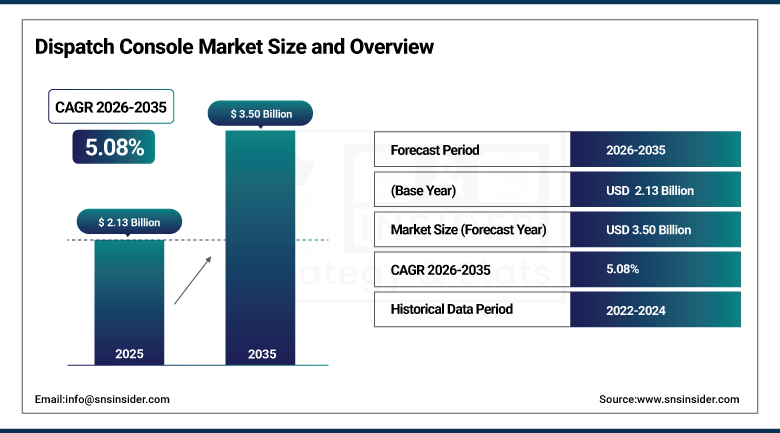
The Dispatch Console Market was valued at USD 2.13 Billion in 2025 and is estimated at USD 2.24 Billion in 2026. The market is forecast to reach USD 3.50 Billion by 2035, registering a CAGR of 5.08% from 2026 to 2035. Growth reflects the replacement of legacy radio consoles with IP-based systems, the rollout of next generation emergency call handling, and the need for control rooms to combine voice, data, and location. North America led the market in 2025 with a share of 36.28%, while Asia Pacific is expected to expand fastest as emergency response networks are built out across the region.
To Get more information Dispatch Console Market - Request Free Sample Report
Key Market Trends & Insights
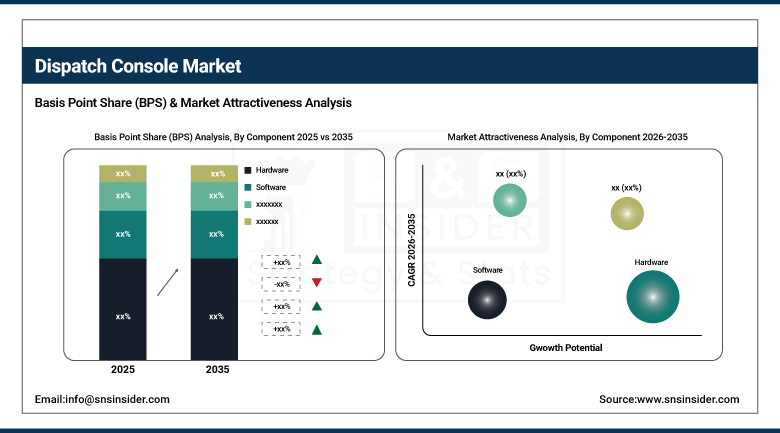
- By component: Hardware held the largest market share of 54.12% in 2025.
- By type: IP-Based consoles held the largest market share of 65.84% in 2025.
- By functionality: Voice Dispatch held the largest market share of 32.50% in 2025.
- By application: Transportation held the largest market share of 32.37% in 2025.
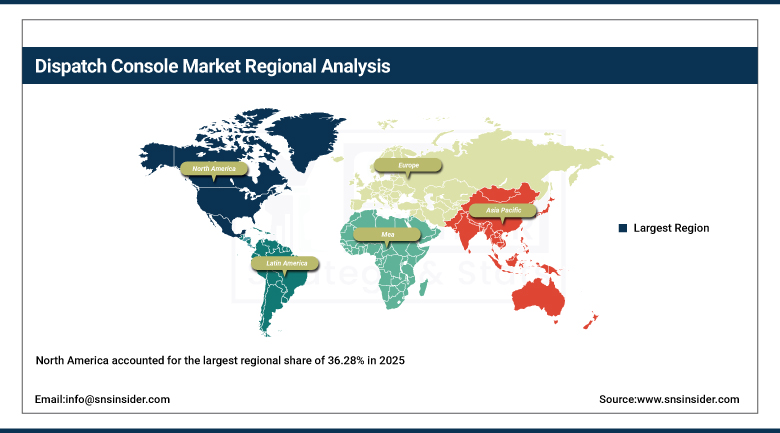
- North America accounted for the largest regional share of 36.28% in 2025.
- Asia Pacific is projected to register the fastest regional CAGR of 5.94% from 2026 to 2035.
- The U.S. is the leading country market, supported by public safety broadband and next generation 911 programs.
Growth Outlook
Public safety broadband is pulling dispatch centers toward consoles that handle voice, data, and location together. In September 2025, at the close of its fiscal year, the First Responder Network Authority reported more than 7.80 million connections across about 30,600 public safety agencies on the FirstNet network. Agencies that equip responders with broadband devices need control rooms that can receive and route this traffic, which raises demand for IP-based consoles with interfaces to land mobile radio, broadband push-to-talk, and computer-aided dispatch systems.
Replacement of national radio networks is a second source of demand. In March 2026, the UK Home Office set March 2028 as the target for the Emergency Services Network to reach full voice service readiness and agreed to extend the existing Airwave service until December 2029. During this long transition, control rooms operate both networks, and they buy consoles that can connect to each system and move to the new one without a second round of replacement. Suppliers with dual-network experience therefore hold a clear advantage in bids.
Market Dynamics
Driver: Next Generation Emergency Call Rules and IP Migration Support Console Upgrades
Mandated moves to next generation emergency calling are forcing public safety answering points to retire circuit-switched equipment. In February 2025, the Canadian Radio-television and Telecommunications Commission extended the deadline for the NG9-1-1 transition to 31 March 2027, after which only next generation calls will be delivered to call centers. Operators that miss the date must arrange alternatives, so many are replacing time division multiplexed consoles with IP-based systems that connect to emergency services networks and carry text, location, and media alongside voice. Console suppliers benefit because upgrades are tied to a fixed regulatory timetable rather than to discretionary budgets. Fixed deadlines also help suppliers plan production and service capacity.
Reliability rules add a second layer of demand. In June 2026, the Federal Communications Commission adopted a Second Report and Order that extends next generation 911 reliability requirements to emergency services IP network operators and core service providers, effective 10 August 2026. Call centers and their vendors must now show resilient architectures, redundancy, and monitoring across the chain from caller to dispatcher. Consoles with integrated failover, secure remote access, and extensive logging can help agencies achieve regulatory compliance and facilitate an upgrade of the existing equipment despite its continued functionality. The current standards of procurement include requirements for consoles with these particular features, providing an edge for vendors with certified products and proof sites.
Restraint: Slow Public Procurement and Long Network Transitions Delay Purchases
Financial constraints and insufficient preparation are barriers in the implementation process. According to the audit performed by the New York State Comptroller in June 2025, it was established that among 36 counties that gave responses, 22 had not been provided with any directions from the state regarding the NG911 rollout, despite the State 911 Plan which was supposed to be available by December 2022 but became available in April 2025. County authorities who had no guidance delayed the acquisition of consoles, while vendors had to go through lengthy selling procedures. Smaller agencies in particular wait for state plans and funding rounds before they issue tenders, which leaves manufacturers with uneven order books and delayed revenue recognition across regions.
Long network transitions also stretch the replacement cycle. In March 2026, the Swiss Federal Office for Civil Protection stated in a fact sheet that the national mobile security communication system would be introduced from 2030 and operated nationwide from 2035, when the existing Polycom network reaches end of life. Buyers in such programs keep current consoles in service for years, and they weigh cybersecurity upgrade costs, vendor lock-in within integrated suites, and limited spectrum below 1 GHz before committing to a new platform. Suppliers that offer open interfaces and phased migration paths are better placed to hold these customers. Procurement teams also compare lifecycle cost rather than purchase price.
Opportunity: Broadband Interworking and Artificial Intelligence Open New Console Functions
Renewals of land mobile radio networks are creating large replacement programs. In December 2025, New Zealand completed the installation of 760 radios in ambulances and first response vehicles under its Public Safety Network program, which is part of a wider national upgrade of critical communications. Such projects require matching dispatch consoles, interfaces to computer-aided dispatch, and training services, and suppliers with proven interoperability across P25, DMR, TETRA, and broadband push-to-talk can win multi-agency contracts that cover police, fire, and ambulance services at once. Training, installation, and long-term maintenance contracts add recurring revenue beyond the initial equipment sale. Interoperability with neighboring agencies is a frequent tender requirement.
Artificial intelligence and cloud hosting add a second opportunity. Dispatch centers face staffing shortages, and non-emergency calls make up a large share of volume, so agencies are testing conversational assistants that handle routine calls, transcription tools that cut note taking, and location analytics that suggest the nearest unit. Consoles that embed such tools, or expose interfaces for them, can be sold as software subscriptions in addition to hardware. Cloud-hosted control rooms also allow agencies to share capacity during disasters and to reduce on-site equipment. Smaller agencies with limited technical staff are particularly open to managed service models that bundle hosting, updates, and support.
Market Characteristics & Concentration
The Dispatch Console Market is Moderately Consolidated. A small group of global radio and critical communications suppliers holds most contracts for large public safety and transportation systems, while regional specialists compete in software consoles, gateways, and integration. Acquisitions of software, analytics, and artificial intelligence companies are common, since larger suppliers use them to add call handling and computer-aided dispatch capability to their console portfolios. Switching costs are high because consoles are tied to radio networks, training, and local procedures.
Regulation influences both product design and purchasing timescales. Rules for next-generation emergency calls in the United States and Canada, emergency number rules in the European Union, and national radio network programs influence the technical specifications for the interfaces as well as the robustness and security thereof. Manufacturers work on certifying their products, securing them against cyber threats, and developing standards-based solutions, while lengthy qualification cycles reward manufacturers that have successful deployments in the field.
Regional expansion follows network programs and smart city investment. Global suppliers expand through local partners, system integrators, and acquisitions in Asia Pacific, the Middle East, and Latin America, where new emergency centers are being built. Local support, language features, and service contracts remain important, and many suppliers pair consoles with maintenance agreements that run for several years. Partnerships with network operators and local integrators help suppliers qualify for public tenders.
Analyst Perspective
Dispatch consoles are turning from voice-only radio terminals into the main working screen of the control room. As emergency calls arrive as text, video, and location data, and responders carry broadband devices, buyers will favor consoles that unify these inputs and connect to radio networks of every generation. Software features such as assisted call handling and cloud hosting will gain share, while hardware will remain essential for the reliability that public safety demands. Suppliers that offer open interfaces, strong cybersecurity, and phased migration will lead renewal programs. An SNS Insider Analyst, Santosh Bhul, commented, "Control rooms will pay for consoles that stay up under pressure, work with every network, and give dispatchers the right information at the right moment."
Segment Analysis
Component Insights
Hardware accounted for the largest share of 54.12% in 2025. Desk consoles, audio units, headsets, and gateways form the physical core of control rooms, and agencies still require dedicated equipment for the reliability and audio quality that emergency work demands. Large radio networks also tie console purchases to infrastructure programs, so hardware is bought with network upgrades and system expansions. Refresh cycles of seven to ten years, strict acceptance tests, and long supplier relationships keep spending steady in public safety, transportation, and utility control rooms. Spare parts and upgrade kits also provide a steady aftermarket.
Software is anticipated to grow at the fastest CAGR of 5.79% from 2026 to 2035. Software consoles run on standard computers, which lowers equipment cost and lets agencies add positions quickly. Vendors add features such as multi-channel audio handling, broadband push-to-talk, geographic displays, and links to computer-aided dispatch, and many sell them as licenses or subscriptions. Cloud hosting and remote dispatching, which gained attention during staffing shortages, also favor software-based approaches and create recurring revenue for suppliers. Open standards for audio and radio interfaces make it easier to mix products from several suppliers.
Type Insights
The percentage for IP based console was at 65.84%. This is linked with radio networks and emergency call systems through packet network and this is useful for multilocation use, remote site and for call processing and location information. The agencies that have migrated to next generation emergency calls and broadband networks select IP-based consoles because it will make future expansion easier without cables and maintenance. Suppliers of software update this on regular basis according to the new radio technology standard and extend its lifespan. Remote positions also allow agencies to keep operating from backup sites during outages.
TDM-based consoles are expected to expand at the fastest CAGR of 5.61% from 2026 to 2035, from a much smaller base. Many agencies operate legacy radio systems that will remain in service for years, and they extend or replace circuit-switched consoles in stages rather than rebuild entire networks. Hybrid interfaces allow TDM positions to work beside IP positions during migration, and this keeps spending on such equipment alive in regions with older infrastructure, long procurement cycles, and tight budgets for full network replacement. Suppliers therefore keep legacy support teams active.
Application Insights
Transportation accounted for the largest share of 32.37% in 2025. Rail operators, airports, ports, bus networks, and logistics firms rely on dispatch consoles to coordinate crews, vehicles, and safety messages over large areas. Regulatory duties on safety communication, growing fleets, and automation of operations raise the number of positions per control center. Operators prefer consoles that integrate voice with vehicle tracking and incident systems, and long asset lives make transportation a stable buyer that signs multi-year service agreements. Ports and rail yards also add positions during network upgrades. Safety audits also drive upgrades.
Public Safety is projected to grow at the fastest CAGR of 6.01% from 2026 to 2035. Police, fire, and ambulance agencies are modernizing call centers, adding broadband devices for responders, and meeting next generation emergency calling rules. Government funding for interoperable communications and response to major incidents such as storms and wildfires supports new control rooms and additional positions. Agencies also seek consoles that link radio, telephone, and computer-aided dispatch in one interface to reduce call handling time. Training and support services are increasingly bundled with each deployment. Funding programs reinforce this trend.
Regional Insights
North America accounted for the largest regional share of 36.28% in 2025. Mature public safety networks, next generation emergency calling programs, and a large installed base of consoles in police, fire, and utility control rooms support demand. In April 2026, the National Telecommunications and Information Administration welcomed House passage of the First Responder Network Authority Reauthorization Act of 2026, which adds federal oversight of milestones for the national public safety broadband network. Canada adds demand through provincial emergency call center upgrades.
Get Customized Report as per Your Business Requirement - Enquiry Now
U.S. Dispatch Console Market
The U.S. Dispatch Console Market was valued at USD 680.96 Million in 2025 and is projected to expand at a CAGR of 5.27% from 2026 to 2035. Thousands of emergency call centers operate across counties, cities, and states, and many are replacing consoles to connect with next generation 911 networks, public safety broadband, and computer-aided dispatch. Utilities, transit agencies, and airports add steady demand, and federal and state grants help smaller agencies fund upgrades. Suppliers compete on interoperability, cybersecurity, and service coverage. Contract awards are often multi-year and include maintenance.
SAFECOM Nationwide Survey conducted by the Cybersecurity and Infrastructure Security Agency was renewed in August 2025. This survey is designed to receive input from 7,215 individuals working in different states, cities, tribes, and territories on capabilities and needs related to emergency communications. This survey will help in setting priorities regarding grants and interoperability planning, and will show staff, cybersecurity, and technology as common issues affecting console purchasing. Smaller agencies also benefit from shared regional systems that lower the cost of new positions. These needs also shape how suppliers position software features and long-term support contracts with agencies.
Europe Dispatch Console Market
Europe accounted for 27.54% of the market in 2025, with the United Kingdom, Germany, and France as the largest national markets. Network renewal programs and strict reliability needs support steady console demand in public safety and transportation. In December 2024, the European Commission reported that 25 Member States plus Iceland and Norway had emergency call centers able to receive handset location information, which increases the data that dispatch positions must display. Suppliers with TETRA and broadband experience hold an advantage. Local language support and national approval processes remain important for suppliers entering the region.
In July 2025, the German Federal Agency for Public Safety Digital Radio reported that its network carried about 140,000 short data messages in four peak days of the Thuringia wildfire, against about 3,000 on a normal day. Events of this kind show why control rooms need resilient consoles and capacity planning, and they support investment in redundant dispatch positions and mobile command options. Several Nordic and Central European countries are also updating radio networks, which adds orders for compatible dispatch positions.
Asia Pacific Dispatch Console Market
Asia Pacific is projected to register the fastest regional CAGR of 5.94% from 2026 to 2035, led by China, India, Japan, and Australia. Urbanization, smart city programs, and the build-out of emergency response systems raise demand for new control rooms and consoles. In October 2025, the Triple Zero Custodian in Australia ran its first simulation exercise, which tested emergency call arrangements across carriers and agencies and increased attention on resilient call handling and dispatch. Public tenders are frequent.
In December 2025, Haryana Police in India reported that its Dial 112 emergency response system had handled about 27.50 million calls since launch in July 2021, and had cut response time from about 16 minutes to under 10 minutes. Large state programs of this kind need command centers with many dispatch positions, and local and global suppliers compete through partnerships with integrators and telecom operators. Rail and metro systems add further demand. Local partners handle installation and training.
Latin America Dispatch Console Market
Latin America accounted for 6.47% of the market in 2025, led by Brazil and Mexico. Security systems, command centers in cities, and transportation initiatives prompt the acquisition of radio and dispatching devices. In December 2024, Anatel introduced the National Emergency Location System in Brazil for calls and texts sent to the 190, 192, and 193 emergency numbers that will provide emergency services with the caller location data and increase demand for consoles using such data. Local integrators and regional support are decisive for suppliers.
Middle East & Africa Dispatch Console Market
The Middle East and Africa held 7.25% of the market in 2025, led by Saudi Arabia, the United Arab Emirates, and South Africa. Gulf governments invest in unified emergency centers, smart city projects, and event security, which require large dispatch rooms. In May 2025, the Saudi Interior Minister opened the Unified Security Operations Center for the 911 number in Madinah, the fourth after Riyadh, Makkah, and the Eastern Province, with a dispatch room that connects 28 government entities. Suppliers that offer Arabic language support and local service teams are best placed.
Key Dispatch Console Market Company Insights
Companies in the dispatch console market are focusing on IP-based and software consoles, interworking between land mobile radio and broadband push-to-talk, and artificial intelligence features that help dispatchers handle calls. Large critical communications suppliers add software and analytics through acquisitions, while specialists compete on open interfaces, audio quality, and fast deployment. Partnerships with network operators, computer-aided dispatch vendors, and system integrators are common, and suppliers increasingly sell subscriptions and managed services alongside hardware.
Key Dispatch Console Companies:
- Motorola Solutions (including Avtec)
- L3Harris Technologies
- Zetron
- Hytera Communications
- Frequentis
- Catalyst Communications Technologies
- Omnitronics
- Telex Radio Dispatch (Bosch)
Recent Developments
- In August 2026, Catalyst Communications Technologies announced a patent approval covering artificial intelligence situational inference for push-to-talk over broadband.
- In June 2026, Hytera unveiled an artificial intelligence command and control center for Europe, along with the HyTalk MC 6.1 platform.
- In April 2026, Motorola Solutions acquired HyperYou, a provider of conversational artificial intelligence for non-emergency 911 calls.
- In March 2026, Frequentis delivered a cloud-based control room for West Yorkshire Fire and Rescue Service covering 40 fire stations.
- In September 2025, Zetron launched Zetron CAD for UK public safety, combining telephony, radio, and incident management in one interface.
- In May 2025, Omnitronics supplied its omnicore Express radio dispatch console to Coastguard Nelson in New Zealand for its move from analog to digital radio.
- In February 2025, Telex Radio Dispatch extended IP-224 radio gateway compatibility to additional Icom radios.
Scope and Research Methodology
The study defines the Dispatch Console Market as hardware and software consoles that let dispatchers communicate with field radios, vehicles, and other control room systems in public safety, transportation, utility, defense, and healthcare settings. IP-based and TDM-based consoles are covered, together with related software and gateways, while stand-alone computer-aided dispatch software and fleet or taxi dispatch applications without radio console functions are outside the scope. The base year is 2025, the forecast period runs from 2026 to 2035, and all values are expressed in USD. The segmentation covers component, type, application, and region, along with leading countries in each region.
The research program combines secondary and primary research. Secondary research draws on company annual reports, investor presentations and filings, regulator and government databases, trade association data, product documentation, and peer-reviewed and industry publications. Primary research consists of structured interviews and surveys with executives, product and business heads, procurement leaders, and end-user stakeholders at console suppliers, system integrators, and public safety and transportation agencies. These discussions validate assumptions on adoption rates, replacement cycles, and pricing. Interviews are cross-checked against company disclosures, and responses are weighted by the relevance and seniority of each respondent to the product line or process under review.
Market engineering follows a bottom-up build from vendor revenue, shipments, and installed base data, cross-checked top-down against public safety, transportation, and utility communications spending. Triangulation across both approaches narrows differences before values are finalized. Forecasts reflect drivers such as regulation, network renewal programs, technology maturity, and macroeconomic conditions, and every estimate passes through an analyst quality review that tests consistency across segments, regions, and years. Sensitivity checks test the effect of changes in adoption speed, pricing, and regulatory timing on each segment, and regional estimates are aligned so that country values add to regional totals and regional totals add to the global value. The final review confirms consistency across years.
Dispatch Console Market Report Scope :
| Report Attributes | Details |
|---|---|
| Market Size in 2025 | USD 2.13 Billion |
| Market Size by 2035 | USD 3.50 Billion |
| CAGR | CAGR of 5.08% From 2026 to 2035 |
| Base Year | 2025 |
| Forecast Period | 2026-2035 |
| Historical Data | 2022-2024 |
| Report Scope & Coverage | Market Size, Segments Analysis, Competitive Landscape, Regional Analysis, DROC & SWOT Analysis, Forecast Outlook |
| Key Segments | • By Component (Hardware and Software) • By Type (IP-Based and TDM-Based) • By Functionality (Voice Dispatch, Text Dispatch, Geo-Location Services, Real-Time Monitoring, Data Analytics and Reporting, and Others) • By Application (Government & Defense, Public Safety, Transportation, Utility, Healthcare, and Others) |
| Regional Analysis/Coverage | North America (US, Canada), Europe (Germany, UK, France, Italy, Spain, Russia, Poland, Rest of Europe), Asia Pacific (China, India, Japan, South Korea, Australia, ASEAN Countries, Rest of Asia Pacific), Middle East & Africa (UAE, Saudi Arabia, Qatar, South Africa, Rest of Middle East & Africa), Latin America (Brazil, Argentina, Mexico, Colombia, Rest of Latin America). |
| Company Profiles | Motorola Solutions (including Avtec), L3Harris Technologies, Zetron, Hytera Communications, Frequentis, Catalyst Communications Technologies, Omnitronics, Telex Radio Dispatch (Bosch) |

Frequently Asked Questions
The market was valued at USD 2.13 Billion in 2025 and is projected to reach USD 3.50 Billion by 2035.
The market is expected to register a CAGR of 5.08% from 2026 to 2035.
North America led the market with a 36.28% share in 2025.
Asia Pacific is expected to grow the fastest, at a CAGR of 5.94% from 2026 to 2035.
Hardware led the component segment with a 54.12% share in 2025, and IP-based consoles led the type segment.
Key players include Motorola Solutions, L3Harris Technologies, Zetron, Hytera Communications, and Frequentis.
