
According to the latest SNS Insider Distributed Fiber Optic Sensor Market report, demand is rising as pipeline operators, utilities, telecom carriers and security agencies look for better ways to watch long assets. A single optical fiber can measure temperature, strain or vibration along many kilometers, so it replaces thousands of separate point sensors.
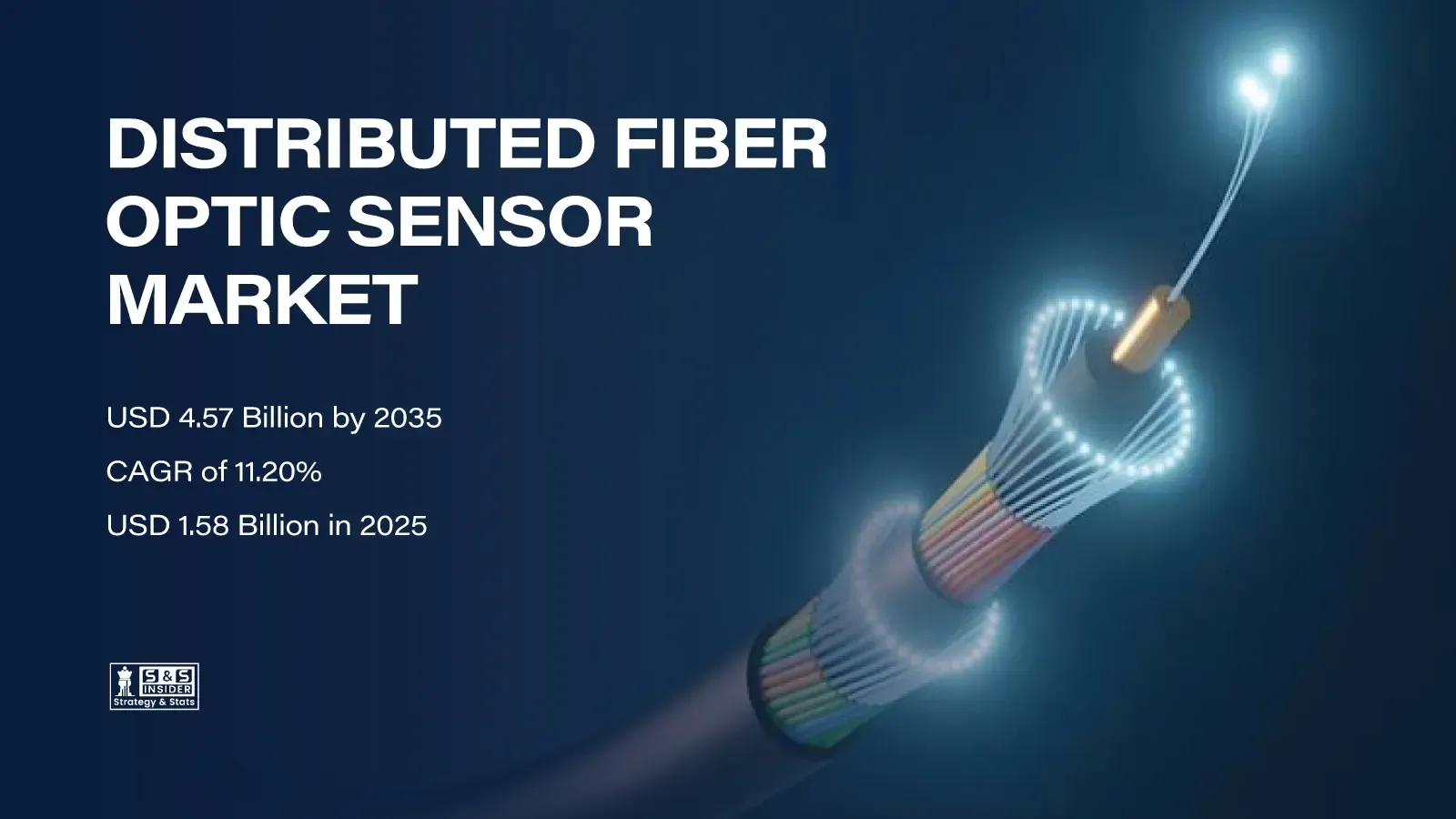
The global distributed fiber optic sensor market was valued at USD 1.58 Billion in 2025 and is estimated at USD 1.76 Billion in 2026. It is expected to reach USD 4.57 Billion by 2035, growing at a CAGR of 11.20% during 2026–2035.
Temperature sensing remains the most widely used technology. Acoustic sensing is growing faster because it can detect leaks, digging and intrusions as they happen.
Oil and gas is still the main buyer, while power utilities are adding fiber monitoring to cables and substations as grids are upgraded. Software that reads fiber signals with machine learning is also making the data easier to use.
North America is the largest regional market. Asia Pacific is growing fastest as it invests in energy, rail and telecom networks.
Market Size and Forecast
|
Market Indicator |
Value |
|
Market Size, 2025 |
USD 1.58 Billion |
|
Market Size, 2026 |
USD 1.76 Billion |
|
Market Forecast, 2035 |
USD 4.57 Billion |
|
CAGR, 2026–2035 |
11.20% |
|
Leading Region, 2025 |
North America (37.80%) |
|
Fastest-Growing Region |
Asia Pacific (13.40% CAGR) |
Demand Drivers and Constraints
Primary Demand Drivers
-
Pipeline integrity and leak detection: Operators use fiber sensing to find leaks, third-party digging and ground movement along the full length of a line.
-
Power grid modernization: Utilities monitor cable temperature and faults so they can carry more load safely and fix problems sooner.
-
Subsea and telecom network security: Carriers use existing fiber to detect anchor drags, fishing activity and tampering near cables.
-
Well and reservoir surveillance: Producers place fiber in wells to track flow, temperature and fracture behavior without stopping production.
-
AI-based signal analytics: Machine learning tools sort large volumes of fiber data and separate real events from background noise.
Potential Growth Constraints
-
High installation and system costs for long or retrofit projects.
-
Signal loss and range limits on very long fiber runs.
-
Shortage of engineers who can design systems and interpret the data.
-
Project delays tied to energy prices and public funding cycles.
-
Competition from lower-cost point sensors and camera systems.
Demand Structure by Technology
Distributed Temperature Sensing (2025 Market Share: 44.80%)
Distributed temperature sensing accounted for 44.80% of the market in 2025. The technology is well proven and used widely in oil wells, power cables, fire detection and industrial plants. It gives a continuous temperature profile along the fiber, so operators can spot hot spots, leaks and insulation faults early. Utilities use it to rate cables based on real conditions instead of fixed limits. Steady use in energy and safety projects should keep demand strong through 2035.
Current trend: Wider use of temperature monitoring on high-voltage and export cables.
Major trends: Dynamic cable rating, fire detection in tunnels, well temperature profiling, and integrated plant monitoring.
Distributed Acoustic Sensing (Forecast CAGR: 14.30%)
Distributed acoustic sensing is projected to grow at a CAGR of 14.30% during 2026–2035. It turns a fiber into a long line of microphones that pick up vibration from leaks, digging, trains or intruders. Pipeline operators, rail networks and telecom carriers value the ability to see events in real time over long distances. Better interrogators and AI software have improved accuracy and cut false alarms. Use in subsea cable protection and city infrastructure is expected to expand.
Current trend: Growing use of acoustic sensing on existing telecom fiber.
Major trends: Subsea cable monitoring, rail track surveillance, perimeter security, and AI event classification.
Demand Structure by Fiber Type
Single-Mode Fiber (2025 Market Share: 71.60%)
Single-mode fiber held 71.60% of the market in 2025. It carries light over much longer distances with less loss, which suits pipelines, power lines and border projects that run for many kilometers. Most acoustic and Brillouin systems are built around single-mode fiber, and much of the telecom fiber already in the ground is single-mode. This allows operators to reuse existing cables and lower project costs. Long-distance monitoring needs should keep this fiber type dominant.
Current trend: Reuse of installed telecom fiber for sensing projects.
Major trends: Long-range interrogators, dark fiber sensing, multi-parameter systems, and network-wide monitoring.
Multimode Fiber (Forecast CAGR: 13.20%)
Multimode fiber is expected to expand at a CAGR of 13.20% through 2035. It works well for shorter runs where strong signal strength matters, such as Raman temperature sensing in plants, tunnels and buildings. Many fire detection and industrial process systems rely on it. As more factories, data centers and transit tunnels add continuous temperature monitoring, demand for multimode systems is expected to rise steadily.
Current trend: Rising use in short-range fire and process monitoring.
Major trends: Tunnel fire detection, data center thermal monitoring, process safety, and compact sensing units.
Demand Structure by Scattering Principle
Raman Scattering (2025 Market Share: 38.90%)
Raman-based systems represented 38.90% of the market in 2025. Raman scattering is the standard method for distributed temperature measurement, and it has a long record in energy and safety uses. The systems are reliable, well understood and supported by many suppliers. Oil and gas wells, power cables and fire detection projects continue to specify Raman equipment, which keeps it the largest principle in the market.
Current trend: Continued use of Raman systems in temperature-focused projects.
Major trends: Higher spatial resolution, longer range units, cable rating software, and safety system integration.
Brillouin Scattering (Forecast CAGR: 13.70%)
Brillouin-based systems are projected to grow at a CAGR of 13.70% during 2026–2035. Brillouin sensing measures both strain and temperature over long distances, which helps operators watch pipelines, dams, bridges and slopes for movement. Interest is rising as infrastructure owners look for early signs of ground shift and structural stress. Improvements in speed and resolution are widening its use in civil and energy projects.
Current trend: Growing demand for strain monitoring on pipelines and civil structures.
Major trends: Geohazard detection, structural health monitoring, combined strain and temperature sensing, and long-range systems.
Demand Structure by End Use
Oil and Gas (2025 Market Share: 38.50%)
Oil and gas accounted for 38.50% of the market in 2025. Producers use fiber in wells to track flow and fracture performance, while pipeline operators use it for leak and intrusion detection. Strict safety and environmental rules push operators to find problems before they cause damage. Fiber sensing covers long distances with few active parts in the field, which keeps maintenance low. Ongoing pipeline and well projects will continue to support demand.
Current trend: Rising use of permanent fiber installations in wells and pipelines.
Major trends: Leak detection systems, well surveillance, reservoir monitoring, and pipeline intrusion alerts.
Power and Utilities (Forecast CAGR: 14.60%)
Power and utilities are expected to grow at the fastest CAGR of 14.60% through 2035. Grid operators are adding underground and subsea cables to connect renewable power, and these assets need constant monitoring. Fiber sensing shows cable temperature, faults and outside damage, which helps utilities carry more power and reduce outages. Offshore wind projects and grid upgrades are expected to be the main sources of new demand.
Current trend: Fast adoption on offshore wind export cables and urban power networks.
Major trends: Dynamic line rating, subsea cable protection, substation monitoring, and fault location.
Key Market Participants
The distributed fiber optic sensor market includes specialist sensing companies, oilfield service providers and industrial instrument makers.
Key participants include Luna Sensing Group, Halliburton, Yokogawa Electric, AP Sensing, Omnisens, OptaSense, Silixa, LIOS Technology, Bandweaver, Neubrex, Prisma Photonics, Ava Risk Group, Viavi Solutions, Febus Optics, and FiberSense.
Competition centers on sensing range, accuracy, false alarm rates and software quality. Suppliers that pair reliable interrogators with clear analytics and support for existing fiber are best placed to win large infrastructure contracts.
Regional Market Dynamics
North America (2025 Market Share: 37.80%)
North America led the global market with a 37.80% share in 2025. The United States accounts for about 82.00% of regional demand, supported by a large pipeline network, active shale wells and grid upgrade programs. The U.S. market reached USD 489.74 Million in 2025 and is projected to grow at a CAGR of 11.80%. Utilities, oil producers and security agencies are all expanding fiber monitoring. Canada adds demand through pipeline and oil sands projects.
Direction: Continued leadership backed by energy infrastructure and grid investment.
Europe (2025 Market Share: 25.20%)
Europe held 25.20% of the market in 2025. Germany leads the region with about 31.00% of regional demand, supported by power cable and grid projects. Offshore wind growth in the North Sea is creating steady demand for export cable monitoring. Rail operators and city utilities are also testing acoustic sensing on existing fiber. Concern over subsea cable safety has made network monitoring a higher priority for governments and carriers.
Direction: Steady growth driven by offshore wind, grid security and rail monitoring.
Asia Pacific (Forecast CAGR: 13.40%)
Asia Pacific is expected to grow fastest, at a CAGR of 13.40% through 2035. China leads the region with about 26.40% of regional demand, driven by pipelines, high-speed rail and power networks. Japan is funding fiber sensing work through green innovation programs, while India and Australia invest in energy and transport links. New infrastructure built with fiber from the start lowers the cost of adding sensing.
Direction: Fastest regional expansion supported by new energy, rail and telecom networks.
Middle East & Africa
The Middle East & Africa held 5.60% of the market in 2025. Saudi Arabia leads with about 43.50% of regional demand, supported by large oil and gas pipelines and new city projects. Gulf producers use fiber sensing for well monitoring and pipeline safety. Border and site security projects add further demand. In Africa, adoption is slower due to budget limits, though pipeline and mining projects create openings.
Direction: Gradual growth led by energy infrastructure and security projects.
Latin America
Latin America is a smaller but developing market. Brazil leads with about 51.20% of regional demand, supported by offshore oil fields and pipeline networks. Mexico and Argentina are adding monitoring to oil and gas assets, and utilities are starting to test cable sensing. Price sensitivity and funding delays slow large projects, so buyers often start with targeted pilot installations.
Direction: Moderate growth supported by offshore energy and pipeline safety needs.
Market Outlook (2026–2035)
The global distributed fiber optic sensor market is forecast to reach USD 4.57 Billion by 2035, as more operators choose continuous monitoring over periodic inspection.
Pipeline safety, grid upgrades and network security will remain the main growth drivers. Acoustic sensing and power utility use are expected to gain share over the forecast period.
Better analytics software will make fiber data easier to act on, which should widen use in rail, civil structures and cities.
North America will stay the largest market, while Asia Pacific offers the strongest growth.
Overall, the distributed fiber optic sensor market is set for steady expansion through 2035, with success increasingly tied to sensing range, data accuracy, software quality and the ability to use existing fiber networks.



