
According to the latest SNS Insider Life Science Analytics Market report, drug makers and research groups are spending more on analytics because they hold more data than ever. Clinical trials, lab tests, patient records and sales activity all produce data that companies must turn into clear decisions.
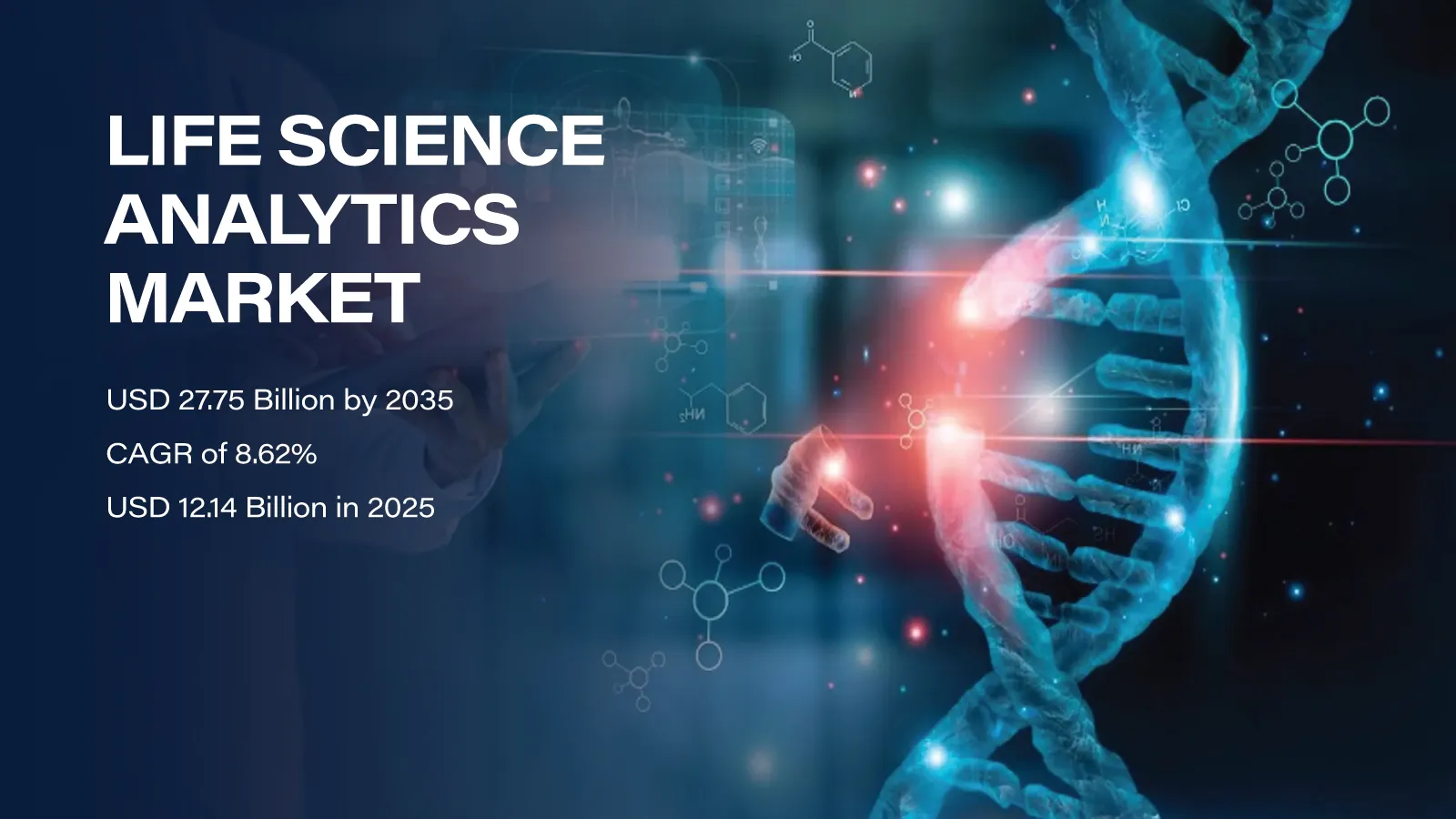
The global life science analytics market was valued at USD 12.14 Billion in 2025. It is estimated at USD 13.19 Billion in 2026 and is projected to reach USD 27.75 Billion by 2035, growing at a CAGR of 8.62% from 2026 to 2035.
Services hold the largest share of spending today, because many companies lack in-house data teams. Software is growing faster as firms build their own tools and add AI to daily work.
Descriptive analytics still leads, as companies first need to understand what has already happened. Predictive analytics is growing fastest, as firms try to forecast trial results, demand and patient outcomes before they spend money.
North America is the largest regional market. Asia Pacific is growing fastest as research activity expands in Japan, China and India.
Market Size and Forecast
|
Market Indicator |
Value |
|
Market Size, 2025 |
USD 12.14 Billion |
|
Market Size, 2026 |
USD 13.19 Billion |
|
Market Forecast, 2035 |
USD 27.75 Billion |
|
CAGR, 2026–2035 |
8.62% |
|
Leading Region, 2025 |
North America (47.42%) |
|
Fastest-Growing Region |
Asia Pacific (9.76% CAGR) |
Demand Drivers and Constraints
Primary Demand Drivers
-
More types of research data: Genomic, imaging, trial and real-world data must be combined and studied together.
-
Regulatory demand for evidence: Regulators expect proof of safety and value across a drug’s full life, not only at approval.
-
Pressure on R&D costs: Drug development is costly, so firms use analytics to pick better targets and run shorter trials.
-
Precision medicine: Trials built around biomarkers need detailed patient data and careful analysis.
-
AI in daily workflows: AI agents and shared learning across sites help teams work faster without moving sensitive data.
Potential Growth Constraints
-
Data held in separate systems that do not share common standards.
-
Growing privacy rules and limits on moving data across borders.
-
Few clear rules for checking AI tools used in regulated work.
-
High cloud computing costs for large genomic studies.
-
A shortage of staff who understand both data science and life science.
Demand Structure by Type
Descriptive Analytics (2025 Market Share: 36.85%)
Descriptive analytics held 36.85% of the market in 2025. Companies use these tools to report what has already happened in trials, sales and safety monitoring. Dashboards and reports help managers track trial progress, product sales and side effect reports. These tasks are required in daily work, so spending stays steady. Descriptive tools are also the first step for most firms, because they must clean and organize data before they can predict anything. This keeps the segment at the center of analytics budgets.
Current trend: Firms are moving routine reports onto shared, self-service dashboards.
Major trends: Self-service reporting, live trial dashboards, safety signal tracking and sales performance reports.
Predictive Analytics (Forecast CAGR: 9.50%)
Predictive analytics is projected to grow at a CAGR of 9.50% from 2026 to 2035. Drug makers want to know which trial sites will enroll patients fastest and which compounds are likely to fail. Forecasting these outcomes early saves time and money. Sales teams also use predictive models to plan launches and find the right doctors to reach. As AI tools become easier to use, more teams outside data science can run these models. This widens the group of buyers inside each company.
Current trend: Companies are using models to forecast trial enrollment and launch demand.
Major trends: Trial site selection models, launch forecasting, patient risk scoring and AI-assisted planning.
Demand Structure by Component
Services (2025 Market Share: 56.95%)
Services accounted for 56.95% of the market in 2025. Many life science companies do not have large in-house data teams. They hire outside firms to set up systems, clean data and run analysis. Smaller biotech companies depend on these partners most. Large drug makers also use services for complex projects, such as linking trial data with real-world records. Ongoing support and managed analytics contracts give providers steady revenue each year.
Current trend: Drug makers are signing longer managed analytics contracts.
Major trends: Managed analytics services, data integration projects, consulting support and outsourced reporting.
Software (Forecast CAGR: 10.99%)
Software is expected to grow at a CAGR of 10.99% through 2035. Companies want tools they can control and use every day, rather than relying only on outside teams. Cloud platforms make it easier to buy software by subscription and add users as needed. Vendors are also building AI agents into their products to handle tasks such as data review and report writing. This lowers the skill needed to use the tools and speeds up adoption across departments.
Current trend: Vendors are adding AI agents to clinical and commercial software.
Major trends: Cloud subscriptions, built-in AI agents, unified data platforms and low-code analytics tools.
Demand Structure by Application
Sales and Marketing Support (2025 Market Share: 31.95%)
Sales and marketing support represented 31.95% of the market in 2025. Drug makers spend heavily to launch and sell products and they want to know which efforts work. Analytics helps them find the right doctors, plan sales territories and measure campaign results. Market access teams also use data to show payers the value of a product. Because these tools link directly to revenue, companies are willing to keep investing in them.
Current trend: Sales teams are using combined claims and prescription data to target doctors.
Major trends: Doctor targeting, territory planning, campaign measurement and payer value studies.
Research and Development (Forecast CAGR: 10.20%)
Research and development is projected to grow at a CAGR of 10.20% from 2026 to 2035. Drug development takes many years and costs a great deal, so firms look for ways to work faster. Analytics helps teams pick better drug targets, design smarter trials and spot safety issues early. Biomarker-led trials and genomic studies add large and complex data sets. As more research moves to data-led methods, R&D teams will need more advanced analytics tools.
Current trend: Research teams are using analytics to design trials and select patients.
Major trends: Trial design tools, biomarker analysis, target discovery and real-world evidence studies.
Demand Structure by End User
Pharmaceutical Companies (2025 Market Share: 44.20%)
Pharmaceutical companies accounted for 44.20% of the market in 2025. They run the largest trial programs and sell products in many countries. This creates large volumes of research, safety and sales data. They also face strict rules on reporting and record keeping. Large drug makers have the budgets to buy full analytics platforms and long service contracts. Their spending sets the direction for vendors and keeps them the largest buyer group.
Current trend: Large drug makers are joining research and sales data on single platforms.
Major trends: Enterprise analytics platforms, safety monitoring, global sales analysis and AI-led workflows.
Biotechnology Companies (Forecast CAGR: 9.10%)
Biotechnology companies are expected to grow at a CAGR of 9.10% through 2035. Many biotech firms work on gene therapies, cell therapies and targeted drugs. These products depend on detailed genomic and biomarker data. Smaller firms often lack their own data teams, so they turn to cloud tools and outside services. As more biotech products move into late-stage trials and launch, their need for analytics grows quickly.
Current trend: Biotech firms are adopting cloud analytics instead of building in-house systems.
Major trends: Genomic data analysis, cloud-based tools, outsourced analytics and launch planning support.
Key Market Participants
The life science analytics market includes large data and technology companies, clinical software vendors and specialist analytics firms. Each group serves a different part of the drug development and sales cycle.
Key participants include IQVIA, Veeva Systems, Oracle, SAS Institute, Medidata (Dassault Systèmes), Clarivate, Komodo Health, Axtria, Saama, Maxis AI, Datavant, Tellius, WhizAI and Cognizant.
Competition centers on data access, AI features and ease of use. Many vendors are adding AI agents and buying smaller firms to widen their offers, because buyers want one partner that can support both research and sales work.
Regional Market Dynamics
North America (2025 Market Share: 47.42%)
North America led the market with a 47.42% share in 2025. The United States holds 80.65% of regional demand. It is home to many of the largest drug makers and a large share of global clinical trials. The country also has deep pools of claims and health record data that companies use for research and sales. Strong venture funding supports biotech firms that buy analytics tools. Canada adds demand through its research hospitals and public health data programs.
Direction: The region will stay the largest market, supported by trial activity and data access.
Europe (Second-Largest Regional Market)
Europe is the second-largest regional market. Germany leads the region with 28.74% of regional demand, supported by a strong drug industry and research base. The United Kingdom, France and Switzerland also add steady demand. Strict privacy rules shape how companies handle patient data. This has increased interest in methods that let teams study data without moving it across borders. The European Health Data Space is expected to make more health data available for research over time.
Direction: Steady growth, with privacy-safe data sharing shaping vendor choice.
Asia Pacific (Forecast CAGR: 9.76%)
Asia Pacific is the fastest-growing region, with a CAGR of 9.76% through 2035. Japan leads the region with 35.18% of regional demand, supported by its large drug industry and aging population. China and India are growing quickly, as more global trials run there and local drug makers expand. South Korea and Australia add demand through strong research programs. Lower trial costs and large patient groups draw more research work to the region.
Direction: The region will be the main source of new demand through 2035.
Middle East & Africa
The Middle East and Africa market is smaller but growing as governments invest in health research. Saudi Arabia leads the region with 31.46% of regional demand and is its most developed market. National programs are building health data systems and research centers. The United Arab Emirates is also investing in genomic and clinical research. In Africa, demand comes mainly from public health studies and trials supported by global partners.
Direction: Gradual growth, led by national health research programs.
Latin America
Latin America is an emerging market for life science analytics. Brazil leads the region with 52.93% of regional demand, supported by its large patient base and growing trial activity. Mexico, Argentina and Colombia are also hosting more clinical studies. Drug makers use analytics to plan sales and manage pricing in these markets. Budget limits and uneven data systems lead many buyers to choose cloud tools and outside services.
Direction: Moderate growth, supported by rising trial activity and cloud adoption.
Market Outlook (2026–2035)
The global life science analytics market is forecast to reach USD 27.75 Billion by 2035, as drug makers rely more on data to guide their decisions.
Growing research data, evidence requirements and pressure on R&D costs will remain the main growth drivers. Predictive tools and software will gain ground as AI becomes part of daily work.
Research and development use will grow quickly, widening demand beyond sales and marketing.
Growth will differ by region. North America will keep its lead, while Asia Pacific will add the most new demand.
Overall, the life science analytics market will grow steadily through 2035 and vendors that offer trusted data, practical AI tools and strong privacy controls will be best placed to win.



