
More patients now expect to repair damaged tissue rather than live with it. Hospitals want treatments that shorten recovery, and payers want fewer repeat procedures. That is moving tissue engineering out of research labs and into everyday surgical care. For product makers, it opens commercial paths in orthopedic, wound, cardiac and specialty care.
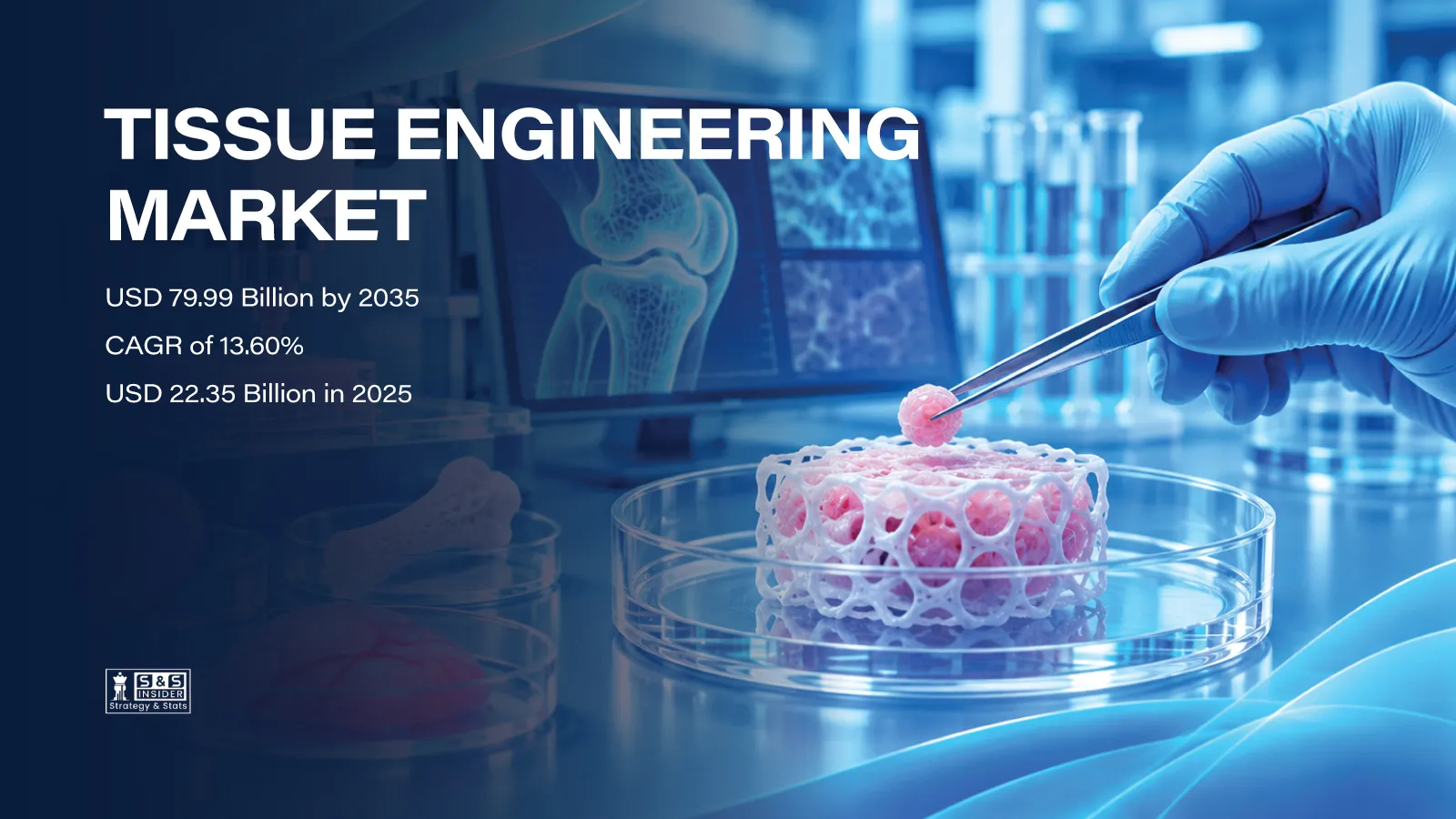
According to a recent study by SNS Insider, the global Tissue Engineering Market was valued at USD 22.35 Billion in 2025 and is expected to reach USD 79.99 Billion by 2035, growing at a CAGR of 13.60% over 2026–2035. The market is estimated at USD 25.39 Billion in 2026.
Gain Actionable Intelligence on the Tissue Engineering Market - Request a Sample Report
Better Outcomes Are Becoming the Selling Point
Surgeons and hospital buyers now judge products by what happens after surgery. A graft or scaffold that helps tissue heal faster can mean shorter hospital stays and fewer return visits, and both carry clear financial value.
So suppliers have to show results, not only features. Companies that collect strong clinical data and share it clearly have an edge in hospital purchasing talks.
Outcome-based buying also creates room for longer contracts. A hospital that sees steady results from one product is likely to keep using it across departments, which gives suppliers more predictable revenue.
Manufacturing Scale Will Decide Who Grows
Many engineered tissue products are hard to make in large volumes. Living cells, sterile handling and strict quality checks all add cost and time, and a product can perform well in trials yet struggle to reach the market for lack of capacity.
Companies that invest early in reliable production can meet rising demand without delays. They can also lower unit costs over time, which helps in price-sensitive markets.
Contract manufacturing and shared production platforms may help smaller developers. Partnerships of this kind let new products reach patients sooner without each company building its own plant.
Tissue Engineering Market Segmentation Highlights
By Material: Synthetic materials held 51.80% of the market in 2025. Hybrid and composite materials are growing fastest, at a 15.30% CAGR, as developers combine strength with better compatibility with the body.
By Product Type: Scaffolds accounted for 53.60% in 2025. Cell-based constructs and others are expanding fastest, at a 16.40% CAGR, which points to demand for more advanced therapies.
By Application: Orthopedics and musculoskeletal care held 44.60% in 2025. Cardiovascular uses are growing fastest, at a 15.90% CAGR, and are opening a new area of demand.
By End User: Hospitals and surgical centers held 61.20% in 2025. Specialty regenerative clinics are growing fastest, at a 14.80% CAGR, which gives suppliers a new sales channel.
North America Leads with 46.80% Market Share as Asia Pacific Advances at 16.20% CAGR
North America held 46.80% of the market in 2025. The U.S. was valued at USD 9.20 Billion and is growing at a 13.00% CAGR. Strong surgical volumes and early uptake of new products keep the region the largest market.
Asia Pacific held 20.20% and is the fastest-growing region, at a 16.20% CAGR. Rising surgical capacity in Japan, China, India and South Korea makes it a key target for expansion.
Europe held 25.50%, Latin America 4.20% and the Middle East & Africa 3.30%. Steady hospital investment in these regions supports gradual demand.
Specialty Clinics Could Open a New Commercial Channel
Most sales still go through hospitals, but specialty regenerative clinics are becoming a separate customer group. These clinics focus on a narrow set of treatments and often adopt new products faster than large hospitals.
For suppliers, this means shorter sales cycles and direct contact with the doctors who use the products. Training, support and bundled product kits can help build loyalty in this channel.
Clinics also tend to share patient feedback quickly. That gives companies useful information for improving products and planning the next launch.
Competitive Outlook: Clinical Proof and Broad Portfolios
Competition centers on clinical evidence, product range and links with surgeons. Large medical device companies use their reach in orthopedics and wound care. Specialist firms compete on advanced cell-based and biologic products.
Partnerships and acquisitions are likely to stay common. Larger players want access to new technologies, and smaller developers need wider distribution to reach more hospitals.
Tissue Engineering Market Outlook Through 2035
The market is set to more than triple by 2035, from USD 22.35 Billion in 2025 to USD 79.99 Billion. Growth will come from orthopedic and cardiovascular demand, faster uptake in Asia Pacific and the spread of specialty clinics. The best-placed suppliers will be those with proven outcomes and reliable manufacturing.



