
The worldwide market for DNA sequencing is growing as hospitals, research labs, and drug developers use genetic data more often in diagnosis, treatment planning, and drug discovery. Sequencing a genome now costs far less than it did ten years ago. That has brought the technology out of large research centers and into clinical labs and smaller institutes. National genomics programs, wider use of cancer profiling, and rising interest in personal genetic testing have led to more sequencing runs worldwide, which will support market growth.
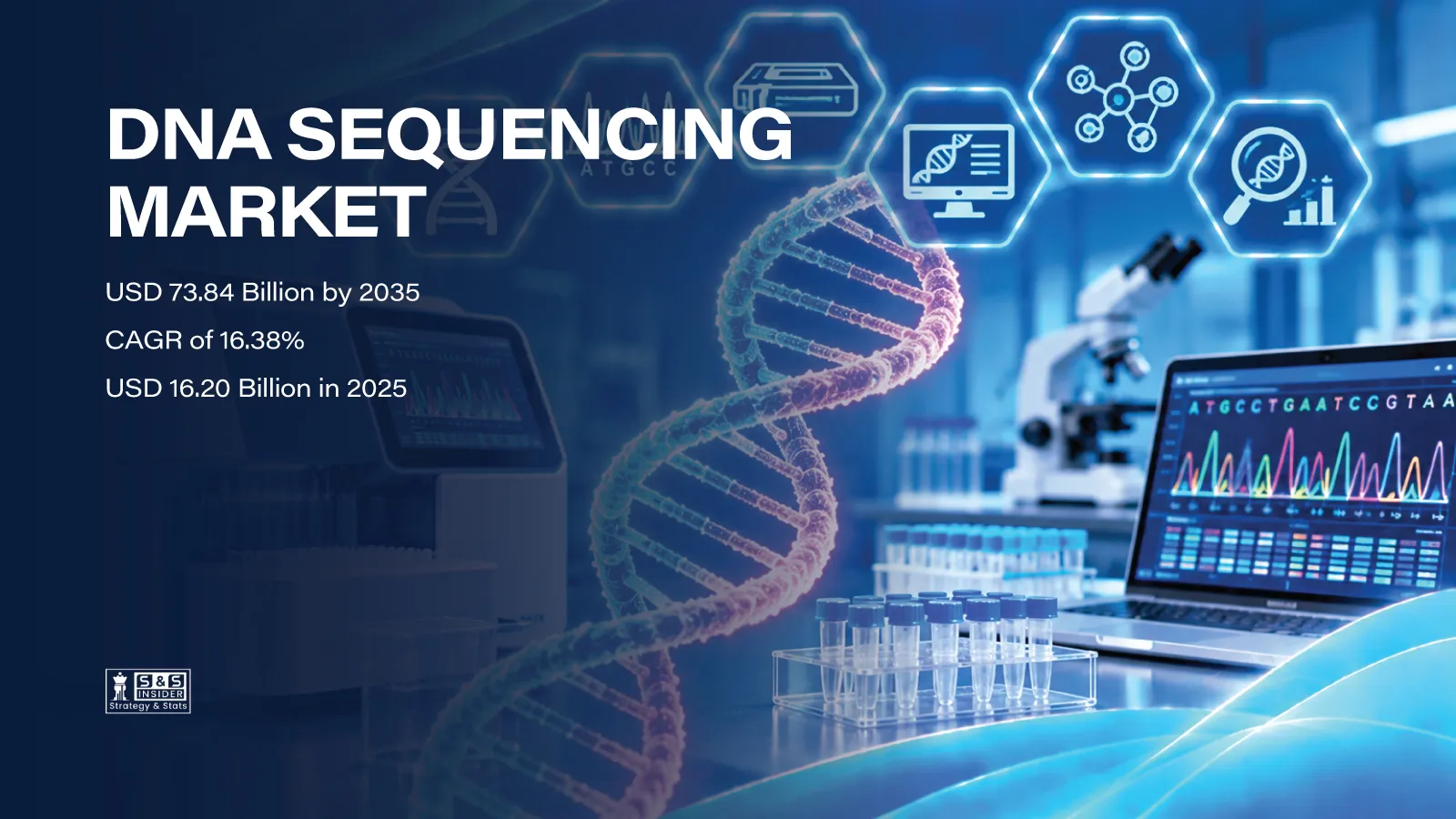
The DNA Sequencing Market value stood at USD 16.20 billion in 2025 and is anticipated to grow to USD 73.84 billion by 2035, growing at a CAGR of 16.38% in the forecast period of 2026-2035. Next-generation sequencing accounted for around 84.60% of the market by technology, while consumables held 49.20% of total demand in 2025.
Unlock exclusive market insights download the brochure to explore global DNA Sequencing Market trends, emerging opportunities, competitive developments, and forecasts through 2035.
Regional Analysis of the DNA Sequencing Market
The DNA sequencing market is expanding across North America, Europe, Asia-Pacific, Latin America, and Middle East & Africa. North America dominated the market with around 46.20% share in 2025 owing to strong research funding, early clinical use of genomic tests, and the presence of leading sequencing platform makers. North America is dominated by the US, which had a market valuation of USD 5.99 billion in 2025 and is forecasted to grow at a CAGR of 15.46%. Europe accounted for around 23.60%, and the UK, Germany, and France were leading in population genomics and clinical sequencing programs.
Asia-Pacific will register the highest CAGR of 18.04% due to government-funded genome projects, growing hospital capacity, and the rise of local sequencing equipment makers, and the leading countries in Asia-Pacific include China, Japan, and Singapore. Latin America and Middle East & Africa are witnessing stable growth due to better access to genetic testing, new research partnerships, and growing national health programs.
Top 10 Trends in the DNA Sequencing Market
-
Falling cost per genome making sequencing practical for routine clinical use.
-
Fast growth of third-generation sequencing, the quickest-growing technology at a CAGR of 22.16%.
-
Oncology remaining the largest application, with a 25.40% share.
-
Rising demand for consumer genomics, which has the highest application CAGR of 19.78%.
-
Growth of sequencing services as labs outsource runs instead of buying instruments.
-
Wider use of long-read sequencing for complex genetic regions.
-
Launch of benchtop sequencers suited to smaller hospital labs.
-
Expansion of national precision medicine and population genomics programs.
-
Growing use of AI tools for data analysis and variant interpretation.
-
New entry of companies offering alternative sequencing chemistries.
DNA Sequencing Market Growth Drivers and Opportunities
Growth prospects for the market are due to rising use of genetic testing in cancer care, rare disease diagnosis, and prenatal screening. Lower instrument and reagent costs are allowing more labs to run sequencing in-house. Government projects are also creating large, steady demand for sequencing capacity. For example, in November 2026, Ultima Genomics' UG200 platform was selected for the sequencing study in the third phase of Singapore's national precision medicine program.
The growing potential is evident in clinical diagnostics, spatial biology, and smaller lab settings. For example, in September 2026, QIAGEN launched QIAmini, a benchtop nucleic acid extraction system that supports sample preparation before sequencing. High instrument costs, complex data storage needs, a shortage of trained bioinformatics staff, and data privacy concerns are some challenges in this market.
Top 10 Companies in the DNA Sequencing Market
The DNA sequencing industry is made up of sequencing platform makers, life sciences tool suppliers, and genomics service providers. The competitive advantage for these companies lies in sequencing accuracy, cost per run, a large installed instrument base, and a strong supply of reagents and software.
-
Illumina, Inc.
-
F. Hoffmann-La Roche Ltd
-
Oxford Nanopore Technologies plc
-
MGI Tech Co., Ltd.
-
Element Biosciences, Inc.
-
Thermo Fisher Scientific Inc.
-
Pacific Biosciences of California, Inc.
-
QIAGEN N.V.
-
Agilent Technologies, Inc.
-
Ultima Genomics, Inc.
-
Illumina, Inc.
Illumina, Inc. is a U.S.-based genomics company and one of the largest suppliers of sequencing systems worldwide. It makes short-read sequencers, reagents, and analysis software for research and clinical labs. In October 2026, the company reported third-quarter revenue of USD 1.13 billion and raised its full-year outlook on NovaSeq X placements.
-
F. Hoffmann-La Roche Ltd
F. Hoffmann-La Roche Ltd is a Swiss healthcare company active in pharmaceuticals and diagnostics. Its diagnostics division supplies lab systems, assays, and molecular testing tools. In June 2026, Roche launched AXELIOS 1, its first sequencing-by-expansion platform, for research use.
-
Oxford Nanopore Technologies plc
Oxford Nanopore Technologies plc is a UK-based company that develops nanopore-based long-read sequencing devices. Its products range from portable sequencers to high-output systems used in research and public health. In August 2026, the company set a target of more than USD 700.00 million in revenue by 2030.
-
MGI Tech Co., Ltd.
MGI Tech Co., Ltd. is a China-based maker of sequencing instruments, reagents, and lab automation systems. The company serves research institutes, hospitals, and genomics service providers. In March 2026, MGI Tech acquired the spatial omics business STOmics and the nanopore developer CycloneSEQ.
-
Element Biosciences, Inc.
Element Biosciences, Inc. is a U.S.-based company that makes benchtop sequencing systems built on its own sequencing chemistry. Its AVITI platform is used by research and clinical labs looking for flexible, lower-cost runs. In October 2026, the company launched AVITI Dx in 10 European countries.
Company Profile
A detailed company profile can cover:
-
Business overview and company snapshot
-
Product portfolio and application coverage
-
Market position and competitive analysis
-
Financial performance, where available
-
Recent developments, mergers, and acquisitions
-
SWOT analysis
The remaining companies can be assessed using the same framework in a comprehensive market research report.
Future Outlook of the DNA Sequencing Market
Growth in the DNA sequencing industry is set to continue as genetic testing becomes a standard part of cancer care, rare disease diagnosis, and drug development. Lower costs, long-read systems, and benchtop instruments will bring sequencing to more hospitals and smaller labs. Asia-Pacific will add strong new demand through national genome programs, while North America will keep its lead. Companies that offer accurate, affordable platforms with strong data analysis tools may gain a competitive edge over the forecast period.



