
The worldwide market for neuromorphic computing is growing on account of high demand for low-power, fast, and efficient processing in AI applications. Unlike traditional processors, neuromorphic chips work like the human brain and handle data only when an event takes place, which saves energy and reduces delay. Growing use of AI in smart devices, drones, wearables, and industrial sensors is leading to wider adoption. Manufacturers are also developing new chips and software tools that make this technology easier to use, which will support market growth.
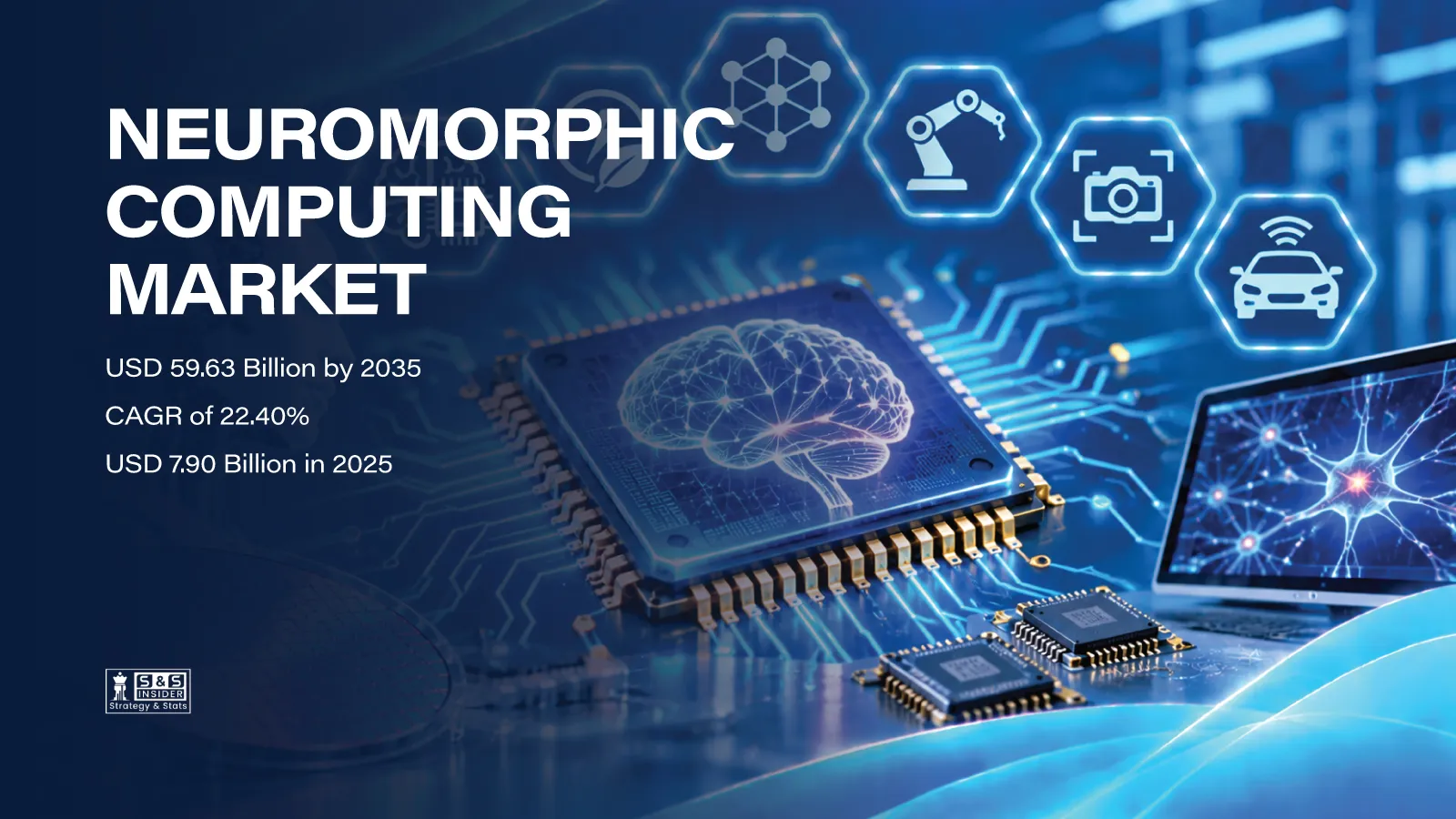
The Neuromorphic Computing Market value stood at USD 7.90 billion in 2025 and is anticipated to grow to USD 59.63 billion by 2035, growing at a CAGR of 22.40% in the forecast period of 2026-2035. Hardware held around 76.40% of the market by offering in 2025, while edge deployment accounted for 62.40% of total demand.
Unlock exclusive market insights download the brochure to explore global Neuromorphic Computing Market trends, emerging opportunities, competitive developments, and forecasts through 2035.
Regional Analysis of the Neuromorphic Computing Market
The neuromorphic computing market is expanding across North America, Europe, Asia-Pacific, Latin America, and Middle East & Africa. North America dominated the market with around 38.20% share in 2025 owing to strong semiconductor research, high defense and government funding, and the presence of leading chip developers. North America is dominated by the US, which had a market valuation of USD 2.63 billion in 2025 and is forecasted to grow at a CAGR of 21.18%. Europe accounted for around 24.60%, and Germany, the Netherlands, Switzerland, and the UK were leading in neuromorphic research and startups.
Asia-Pacific will register the highest CAGR of 26.84% due to large electronics manufacturing capacity, rising investment in AI chips, and growing demand for smart consumer devices, and the leading countries in Asia-Pacific include China, Japan, and South Korea. Latin America and Middle East & Africa are witnessing stable growth due to rising digital investment, smart city projects, and growing interest in edge AI.
Top 10 Trends in the Neuromorphic Computing Market
-
Rising demand for low-power AI chips in battery-operated edge devices.
-
Fast growth of neuromorphic software, the quickest-growing offering at a CAGR of 29.84%.
-
Increasing use of event-based vision sensors in drones, robotics, and automotive systems.
-
Growing cloud deployment of neuromorphic systems for research and large-scale workloads.
-
Strong lead of image processing applications in current demand.
-
Rising use in signal and data processing for voice, radar, and sensor data.
-
Growth of analog and compute-in-memory designs that cut power use.
-
Higher venture funding flowing into neuromorphic startups.
-
Expanding partnerships between chipmakers, universities, and government research programs.
-
Wider use in defense and security, including drone detection.
Neuromorphic Computing Market Growth Drivers and Opportunities
Growth prospects for the market are due to increasing demand for AI processing that uses little power and responds in real time. Standard processors struggle to run AI on small devices without draining batteries, which is creating space for brain-inspired chips. Research institutions are also adopting large neuromorphic systems for advanced computing studies. For example, in November 2025, SpiNNcloud Systems deployed a SpiNNaker2 system at the University of Texas at San Antonio for the NSF THOR project.
The growing potential is evident in edge AI, smart sensors, wearables, and defense applications. For example, in December 2025, Mythic raised USD 125.00 million in a round led by DCVC to scale its analog compute-in-memory processors. High development costs, lack of standard programming tools, limited skilled talent, and competition from conventional AI chips are some challenges in this market.
Top 10 Companies in the Neuromorphic Computing Market
The neuromorphic computing industry is made up of large semiconductor companies, technology groups, and specialized startups. The competitive advantage for these companies lies in chip design know-how, energy-efficient architectures, software support, and partnerships with research bodies and device makers.
-
BrainChip Holdings Ltd.
-
Prophesee
-
Innatera Nanosystems
-
Applied Brain Research
-
Mythic
-
Intel Corporation
-
IBM Corporation
-
SynSense
-
SpiNNcloud Systems
-
POLYN Technology
-
BrainChip Holdings Ltd.
BrainChip Holdings Ltd. is an Australian-listed company with operations in the United States, focused on neuromorphic AI processors. Its Akida technology allows devices to run AI tasks locally with very low power use. In June 2026, the company began commercial production shipments of its AKD1500 chip, built on GlobalFoundries 22FDX technology.
-
Prophesee
Prophesee is a French company that develops event-based vision sensors and software inspired by the human eye. Its technology captures only changes in a scene, which reduces data load and power use. In June 2026, the company launched its Mantara event-based drone detection camera and closed a funding round led by Critical Path Ventures.
-
Innatera Nanosystems
Innatera Nanosystems is a Dutch company that designs neuromorphic processors for sensor-based edge applications. Its chips help devices process audio, radar, and other sensor data with very low power. In March 2026, the company launched Synfire, a software platform for edge AI neuromorphic development.
-
Applied Brain Research
Applied Brain Research is a Canadian company working on neuromorphic and time-series AI processing. Its products target voice and speech applications in small, low-power devices. In January 2026, the company closed an oversubscribed seed round led by Two Small Fish Ventures to scale its TSP1 voice chip.
-
Mythic
Mythic is a U.S.-based company that develops analog compute-in-memory processors for AI workloads. Its chips run AI models with lower power and cost than many digital processors. In December 2025, the company raised USD 125.00 million in a funding round led by DCVC.
Company Profile
A detailed company profile can cover:
-
Business overview and company snapshot
-
Product portfolio and application coverage
-
Market position and competitive analysis
-
Financial performance, where available
-
Recent developments, mergers, and acquisitions
-
SWOT analysis
The remaining companies can be assessed using the same framework in a comprehensive market research report.
Future Outlook of the Neuromorphic Computing Market
Growth in the neuromorphic computing industry is set to continue as demand rises for AI that runs fast and uses less power. Growth in edge devices, drones, wearables, and smart sensors will widen the customer base. Asia-Pacific will add strong demand, while North America will remain the main center for chip design. Companies that offer energy-efficient chips with easy-to-use software may achieve a competitive edge, and neuromorphic computing will likely become an important part of future AI systems.



