
The global EMI shielding industry is growing steadily. Electronic products now pack more circuits, radios and power components into smaller spaces. Each added component raises the risk of signal interference and interference problems found late in development can lead to failed certification tests, redesign costs and delayed product launches. As a result, manufacturers now plan shielding at the design stage instead of adding it as a fix after testing.
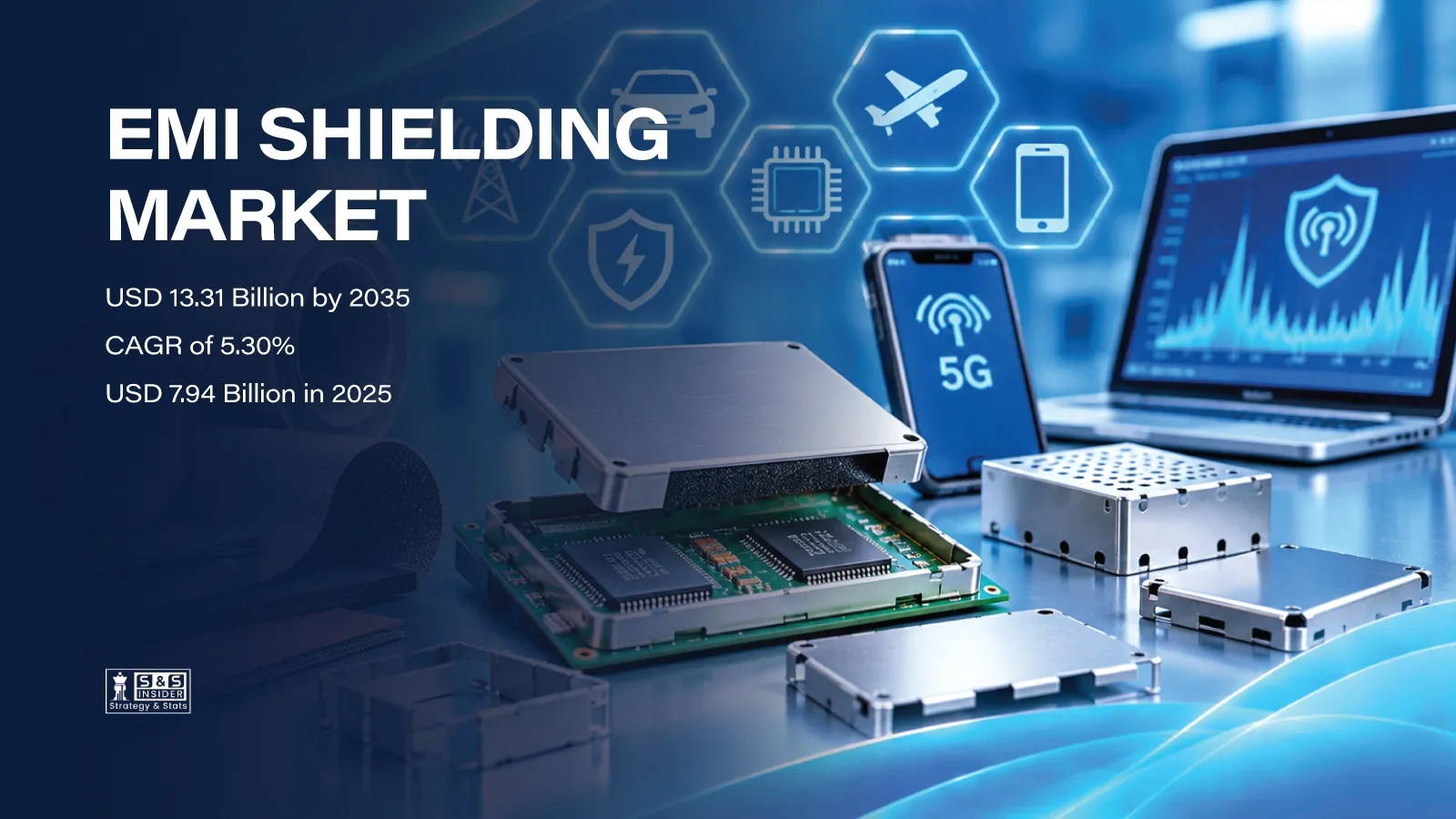
According to a recent study by SNS Insider, the global EMI Shielding Market size was valued at USD 7.94 Billion in 2025 and is anticipated to reach USD 13.31 Billion by 2035, registering a CAGR of 5.30% over the forecast period 2026–2035. The market is estimated at USD 8.36 Billion in 2026.
Certification Risk Is Making Shielding a Design Priority
Electronic products must pass interference tests before they can be sold in most major markets. A failed test can push back a launch date by weeks and add engineering and retesting costs. For high-volume products, that delay can affect quarterly revenue.
Product teams are therefore bringing shielding suppliers into projects earlier. Joint design work helps them avoid late changes to housings, circuit boards and cable layouts.
Suppliers that offer design support, simulation help and pre-compliance testing can position themselves as partners in launch planning, not only as material vendors.
To Get Detailed Insights on the EMI Shielding Market – Request a Sample Report
Lighter, Thinner Materials Open New Value Opportunities
Device makers want shielding that adds little weight and takes up little space. This is especially important in wearables, smartphones, electric vehicles and aircraft systems, where every gram and millimeter counts.
This need creates room for premium materials that combine conductivity with low weight and flexibility. Carbon-based foams, MXene films and aerospace- and defense-grade shielding filters are among the areas where suppliers can build higher-margin product lines.
Companies that pair new materials with application engineering and custom die-cut or molded parts can deepen customer relationships and earn repeat orders across product generations.
EMI Shielding Market Segmentation Highlights
By Material
Conductive coatings held the largest market share at about 32.70% in 2025, owing to their broad use on plastic housings and enclosures. Conductive polymers are the fastest-growing material segment. They give suppliers opportunities in lightweight, moldable parts for compact devices.
By Method
Radiation shielding accounted for about 88.60% of the market in 2025, as most interference control in electronics targets radiated emissions. Conduction is the fastest-growing method, supported by demand for filtering in power electronics and charging systems.
By End Use
Consumer electronics accounted for the largest share at about 31.50% in 2025. Automotive is the fastest-growing end use, with opportunities in battery systems, motor drives, radar modules and in-vehicle connectivity.
By Type
Broadband shielding held the larger share in 2025. Narrowband shielding is expected to grow at the fastest CAGR of about 6.70%, opening opportunities in frequency-specific applications such as radar and dedicated wireless links.
Asia Pacific Leads with 41.40% Market Share as the U.S. Advances at 5.40% CAGR
Asia Pacific led the EMI Shielding Market with about 41.40% of revenue in 2025 and is also the fastest-growing region. China accounted for about 39.20% of regional revenue. The region's large electronics production base creates demand for cost-effective materials, local supply and fast design support.
In North America, the U.S. accounted for about 84.70% of regional revenue. The U.S. market was valued at USD 1.62 Billion in 2025 and is expected to reach USD 2.74 Billion by 2035, at a CAGR of 5.40%. Defense, aerospace, medical and automotive buyers in this market value certified quality and long-term supply reliability.
In Europe, Germany held about 28.30% of regional revenue. In Latin America, Brazil held about 38.10% and in the Middle East & Africa, the UAE held about 26.50%. Opportunities in these regions will vary with automotive production, telecom investment and local manufacturing growth.
Design-Support Services Could Create Recurring Revenue
Many mid-sized device makers do not have in-house interference specialists. They need help with material selection, enclosure design and pre-compliance checks before formal testing.
Engineering services, test lab partnerships and design toolkits can help meet this need by safeguarding suppliers. These services help suppliers win business earlier on a project and influence material selection.
Such models can also generate recurring revenue through test packages, custom component programs and long-term supply contracts linked to product platforms.
Competitive Outlook: Application Expertise to Become a Key Differentiator
The competition in the EMI shielding industry in the future might depend on more than the material performance. Customers want suppliers who understand their application, help solve problems quickly, and can deliver custom parts at scale.
Suppliers that offer reliable materials along with design support, fast prototyping and regional production may be better positioned. Contract manufacturers, test labs and automotive and telecom suppliers can also partner for broader commercial reach.
EMI Shielding Market Outlook Through 2035
Over the next decade, EMI shielding is set to become a more central part of product design, certification planning and supply chain decisions. Suppliers that help customers cut redesign risk, reduce weight and speed up compliance will be best placed to capture new demand across electronics, automotive, telecom, aerospace and healthcare.
About the Author

Get in touch




