
The global laser cladding industry is moving into a phase of solid commercial growth. Asset owners are paying closer attention to the cost of replacing worn parts. Heavy components such as turbine blades, drilling tools, shafts, and hydraulic rods are expensive to make and slow to source. Restoring these parts, rather than scrapping them, has become a practical way for operators to protect budgets and keep equipment running.
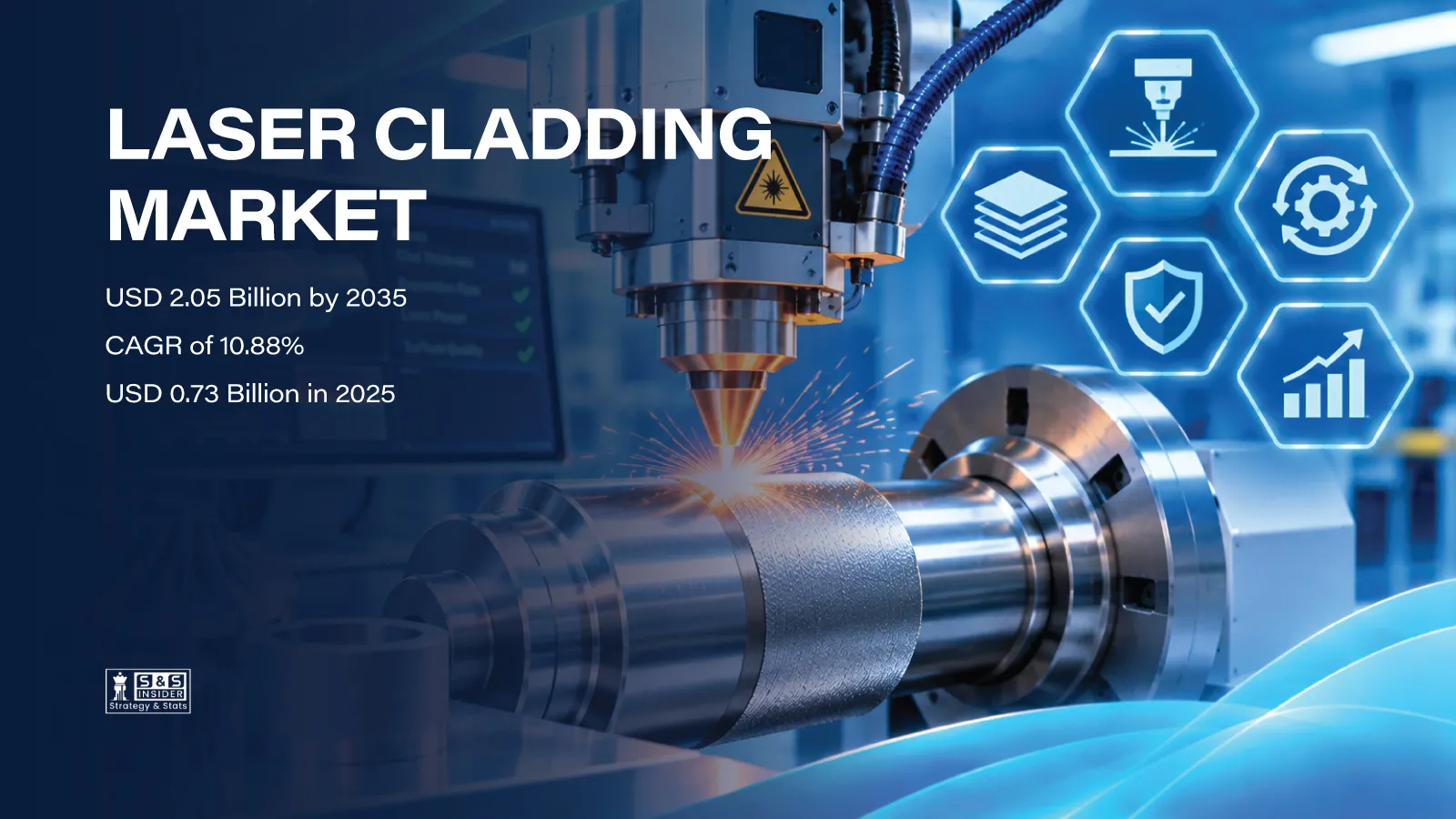
According to a recent study by SNS Insider, the global Laser Cladding Market size was valued at USD 0.73 Billion in 2025 and is anticipated to reach USD 2.05 Billion by 2035, registering a CAGR of 10.88% over the forecast period 2026–2035. The market is estimated at USD 0.81 Billion in 2026.
Asset Life Economics Is Reshaping Maintenance Budgets
Industrial operators now judge maintenance spending by how much longer it keeps an asset in service. A part that lasts twice as long reduces both purchase costs and the downtime needed to swap it out. Laser cladding fits this approach well, because it adds a durable surface layer without changing the base part.
Plant managers in energy, mining, and heavy machinery are building planned refurbishment cycles into their yearly budgets. This gives service providers more predictable work and longer customer relationships.
Suppliers that can show clear gains in service life per dollar spent are well placed to win long-term maintenance contracts. The sales discussion moves from the cost of each job to the savings across the life of the equipment.
To Get Detailed Insights on the Laser Cladding Market – Request a Sample Report
Supply Chain Pressure Opens Doors for Local Repair Capacity
Long lead times for forged and cast parts have pushed many operators to look for faster options. Restoring a worn part close to the site can cut weeks from a repair schedule. This creates room for regional job shops and in-house repair cells.
Compact cladding cells, ready-made process recipes and remote process monitoring can help equipment makers make this transition. Such tools help smaller shops achieve consistent quality.
Recurring income can be generated from process software, powder supply agreements, operator training and service contracts. Suppliers also maintain contact with customers after the initial system sale.
Laser Cladding Market Segmentation Highlights
By Laser Modality
In 2025, fiber lasers had the biggest market share, due to their stable output and low maintenance, making them suitable for daily production work. The fastest growing is predicted to be the direct diode laser. This opens opportunities for suppliers of energy efficient systems with large beam profiles for large surface coverage.
By Material Type
Metals and alloys dominated the market in 2025 due to their extensive use in wear and corrosion protection. But the greatest growth is expected to come from cermets used in tough-duty applications where parts must endure both heat and abrasion.
By Application
Repair and refurbishment accounted for the largest share in 2025. Functional coating is expected to grow the fastest, supported by demand for new parts built with wear-resistant surfaces from the start.
By End User
Aerospace and defense held the largest share in 2025. The energy segment is projected to grow the fastest, with opportunities in power generation equipment, turbine parts, and drilling components.
Europe Leads the Market as Asia Pacific Records the Fastest Growth
Europe held the largest share of the Laser Cladding Market in 2025, accounting for 28.60% of the regional revenue. There are good prospects for suppliers to aerospace engine shops, toolmakers and machinery builders. European buyers tend to look at process quality, certification and energy use.
Asia Pacific is expected to grow at the fastest rate during 2026-2035. China accounts for 36.30% of the regional revenue in 2025. New power and mining projects and growing manufacturing bases are creating demand for cost-effective systems, local service teams and operator training.
In North America, the U.S. accounted for 85.60% of regional revenue in 2025. The U.S. market was valued at USD 0.16 Billion in 2025 and is expected to reach USD 0.46 Billion by 2035, at a CAGR of 10.90%. In Latin America, Brazil held 37.20% of regional revenue, and in the Middle East & Africa, the UAE held 27.40%. Opportunities in these markets will depend on oil and gas activity, mining output, and local repair capacity.
Cladding-as-a-Service Could Widen the Customer Base
Laser cladding systems need a large upfront investment and skilled operators. Many plants with irregular repair needs cannot justify owning a full system. Contract cladding, mobile on-site repair units, and pay-per-part pricing give these buyers a practical way to access the technology.
Manufacturers can reach this group through partnerships with service bureaus, repair networks and equipment dealers. It’s a way to expand the market reach without relying just on direct system sales.
These models can also generate recurring revenue through maintenance plans, consumables supply and training programs.
Competitive Outlook: Process Consistency to Become a Key Differentiator
In the future, competition in the laser cladding industry will probably depend on more than just laser power. “Customers want more and more systems that yield repeatable results, demand less operator skill and can be tailored to existing production lines.
Suppliers that combine reliable lasers with process monitoring, easy software and strong field support may be better placed. Alliances with powder makers, automation integrators and repair service firms can also help with commercial growth.
Laser Cladding Market Outlook Through 2035
In the next decade, laser cladding is expected to have a greater role in maintenance planning, part design and supply chain resilience. Suppliers who can show measurable gains in part life, repair speed and total operating cost will be best positioned to capture new demand across aerospace, energy, automotive and heavy industry.
About the Author

Get in touch




