
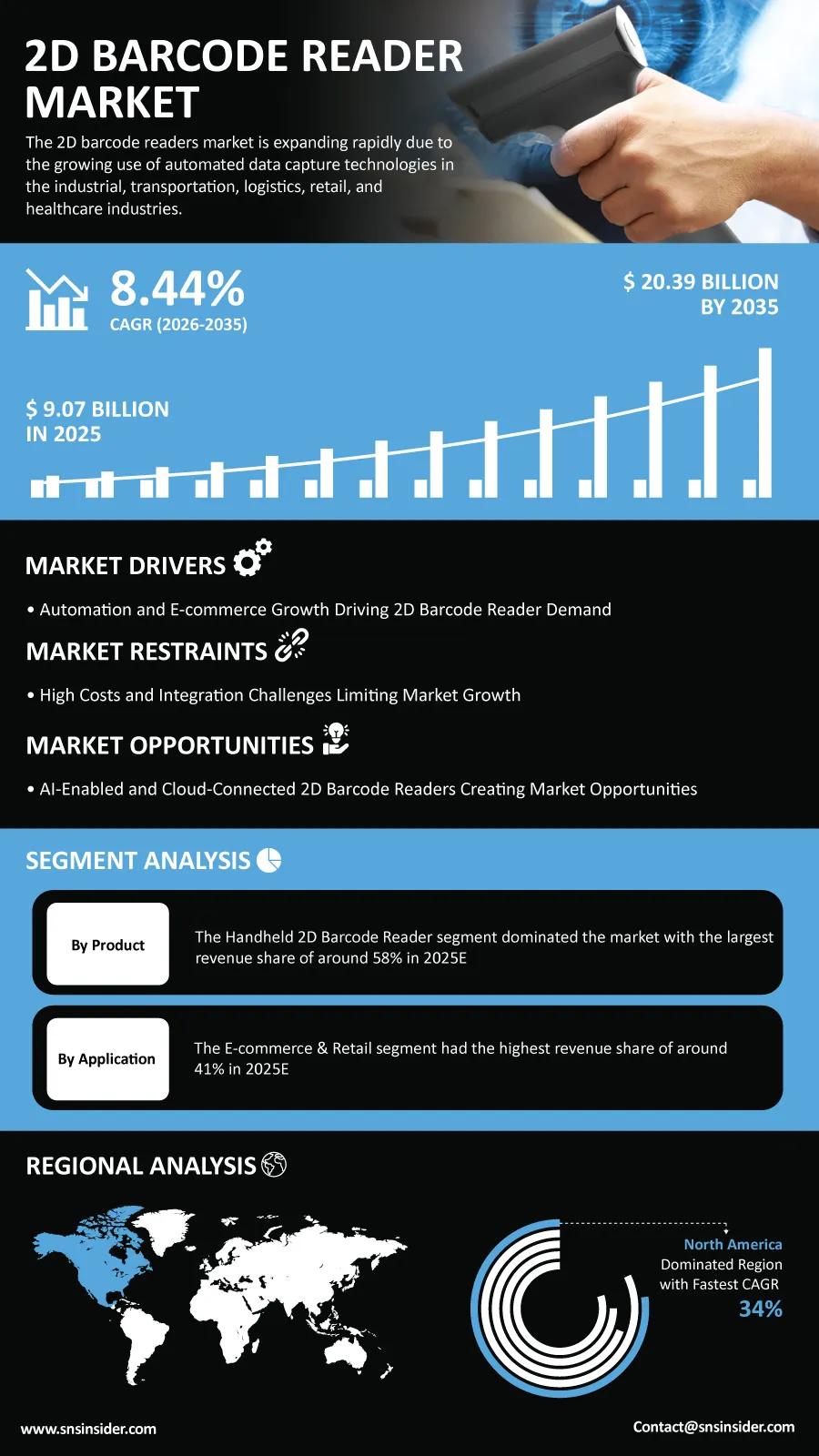
The global 2D Barcode Reader Market is witnessing strong expansion as businesses accelerate the transition toward automated identification, digital inventory control, and real-time data capture. According to a recent study by SNS Insider, the global 2D Barcode Reader Market size valued at USD 9.07 billion in 2025, is anticipated to grow to USD 20.39 billion by 2035, registering a CAGR of 8.44% over the 2026–2035 forecast period.
The rapid expansion of e-commerce, organized retail, automated warehouses, and digitally connected manufacturing operations is increasing demand for scanning systems that can process QR codes, Data Matrix codes, and other two-dimensional formats quickly and accurately. Healthcare providers and regulated industries are also adopting advanced imaging-based readers to strengthen product traceability, serialization, and compliance.
Meanwhile, improvements in image sensors, decoding software, connectivity, and device design are expanding the use of 2D barcode readers across both frontline and automated environments. The technology is increasingly becoming an integral part of smart retail, logistics automation, industrial production, and digital payment ecosystems.
To Get Detailed Insights on the 2D Barcode Reader Market – Request a Sample Report
Automation and Digital Commerce Create New Growth Opportunities
The continued growth of online shopping is placing greater pressure on fulfillment centers and distribution networks to process rising order volumes while minimizing errors. As a result, logistics operators are deploying high-performance scanning systems throughout receiving, sorting, picking, packing, and shipping operations.
Retailers are also expanding the use of 2D scanning solutions for checkout, mobile payments, loyalty programs, and product information access. At the same time, manufacturers are integrating fixed readers into production lines and robotic workstations to support component identification and process traceability.
The increasing adoption of cloud-connected devices and AI-assisted decoding is opening additional opportunities for solution providers. These capabilities can help enterprises monitor scanning performance, manage distributed devices remotely, and extract operational insights from captured data.
Key Market Insights Highlight Shifting Demand Patterns
By product, handheld 2D barcode readers are expected to account for approximately 58% of market revenue in 2025 due to their flexibility across retail stores, warehouses, healthcare facilities, and logistics operations. Fixed 2D barcode readers are projected to register the fastest growth at a CAGR of approximately 9.4% through 2035, supported by increasing automation in distribution centers, manufacturing facilities, conveyor systems, and self-service retail environments.
Based on application, e-commerce and retail are anticipated to dominate the market with around 41% of revenue in 2025. High transaction volumes, omnichannel fulfillment, and expanding QR code usage are supporting widespread deployment across stores and fulfillment operations. Factory automation is expected to be the fastest-growing application, advancing at nearly 10.1% during the forecast period as manufacturers embrace Industry 4.0, smart production, and automated material handling.
Intelligent Scanning Technology Strengthens Operational Efficiency
The market is moving toward smarter scanning platforms capable of handling challenging codes and operating in demanding environments. AI-assisted image processing is helping improve decoding performance for damaged, poorly printed, or low-contrast symbols, reducing scanning interruptions and manual intervention.
Cloud connectivity and mobile integration are also changing the way enterprises manage barcode infrastructure. Businesses can increasingly combine scanning hardware with software platforms and analytics tools to monitor device performance and improve workflow efficiency across geographically distributed operations.
North America Leads with 34% Revenue Share While Asia Pacific Advances at Over 9.6% CAGR
North America is expected to account for approximately 34% of global market revenue in 2025, supported by advanced retail infrastructure, high e-commerce penetration, automated logistics networks, and widespread adoption of digital enterprise technologies. The United States remains the leading contributor to regional demand due to strong investments in fulfillment automation, healthcare traceability, and smart retail systems.
Asia Pacific is projected to be the fastest-growing regional market, recording a CAGR of more than 9.6% through 2035. Expanding e-commerce, QR-based digital payments, manufacturing activity, and warehouse automation are accelerating adoption across the region. China remains a major contributor, supported by large-scale online commerce, extensive manufacturing operations, and domestic technology development.
Europe is also maintaining strong demand, with the region expected to represent approximately 27% of global market revenue in 2025. Regulatory requirements related to traceability, serialization, and product safety, along with growing automation across logistics and manufacturing, are supporting continued investment. Germany leads the European market, driven by its advanced industrial base and strong Industry 4.0 adoption.
Industry Participants Focus on Smarter and More Connected Solutions
Competition in the 2D Barcode Reader Market remains active as technology providers invest in advanced imaging, AI-powered decoding, fixed-mount automation, and connected device management. Manufacturers are concentrating on improving scan accuracy, durability, processing speed, and integration capabilities to meet increasingly demanding enterprise requirements.
Key companies operating in the global 2D Barcode Reader Market include Zebra Technologies Corporation, Honeywell International Inc., Denso Wave Inc., Cognex Corporation, SICK AG, Keyence Corporation, Datalogic S.p.A., Panasonic Corporation, SATO Holdings Corporation, Toshiba TEC Corporation, Wasp Barcode Technologies, Omron Microscan Systems, Inc., Code Corporation, Socket Mobile, Inc., Unitech Electronics Co., Ltd., Opticon Sensors Europe B.V., Newland EMEA, Casio Computer Co., Ltd., JADAK – A Novanta Company, and Scandit AG.
An SNS Insider analyst Sushant Kadam commented, “The shift toward automated fulfillment, smart manufacturing, and digitally connected retail is creating sustained demand for high-performance 2D barcode readers. Vendors that combine reliable imaging with AI-driven decoding, cloud connectivity, and flexible deployment options will be well positioned to capture emerging opportunities across both established and rapidly digitizing markets.”
About the Author

Get in touch




