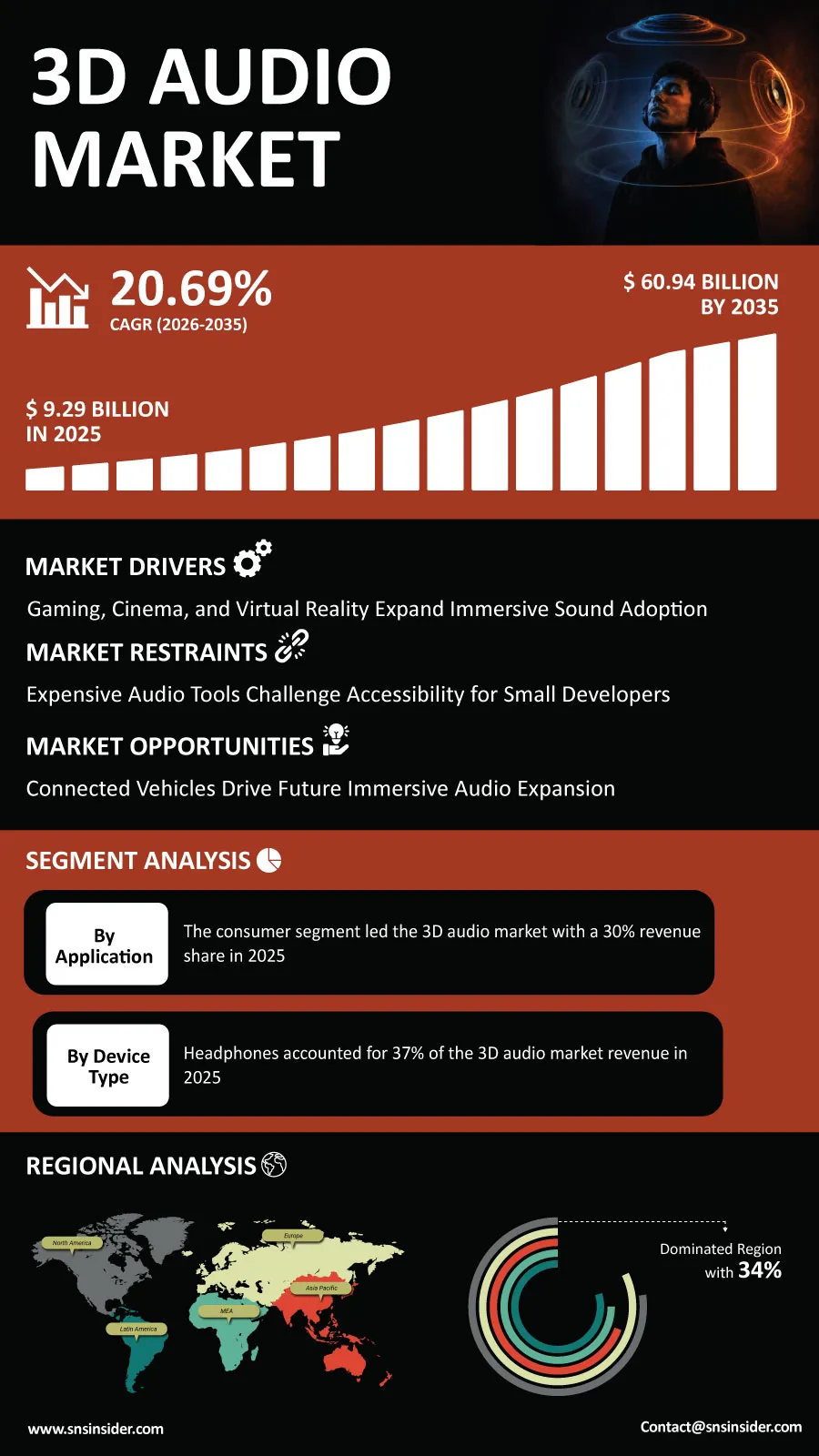
The world 3D Audio Market is experiencing a new phase of growth as demand for immersive digital experiences redefines consumer electronics, gaming, media, and automotive entertainment. “According to a recent study by SNS Insider, the global 3D Audio Market size valued at USD 9.29 billion in 2025, is anticipated to grow to USD 60.94 billion by 2035, registering a CAGR of 20.69% over the 2026–2035 forecast period.”
The fast-paced growth of digital entertainment technology has led to a change in consumer demands from traditional stereo sound to an audio experience which feels as if you were present in the sound environment itself. Companies are now making massive investments in technologies that would help replicate the sound environment for better engagement.
Increasing adoption of premium headphones, intelligent speakers, virtual collaboration tools, and future infotainment systems will drive market growth even further. With advancements in AI-based sound processing and rendering, personalization of audio experience is becoming much more achievable through various devices.
To Get Detailed Insights on the 3D Audio Market – Request a Sample Report
Immersive Entertainment and Connected Devices Create Strong Growth Opportunities
With the rising deployments in augmented reality, virtual reality and mixed reality platforms, there are wide prospects for companies that are developing sophisticated spatial audio system. With the rise in popularity and adoption of immersive technologies for education, enterprise collaboration, healthcare and entertainment so too has our need to accurately place sound in 3D space.
Automotive OEMs also invest in immersive audio for premium vehicle cabins, both to enhance infotainment experiences and provide better passenger comfort. With the rise of more advanced software-defined vehicles, spatial audio technologies can be included into driving instructions for navigation, different entertainment channels with immersive motion-based experiences and intelligent in-car communication systems.
For example, cloud-based content creation platforms and AI-driven audio production tools are democratizing sophisticated sound design for developers and creators alike. Such innovations are simplifying production while helping deploy immersive audio experiences rapidly at a global scale.
Key Market Insights Highlight Shifting Demand Patterns
According to the deployment mode, the on-premise solutions contributed towards 54% of the global market revenue share in 2025 as they offered low latency performance and operational control for professional production settings. Furthermore, the cloud deployment mode is likely to show the fastest growth till 2035 since companies will prefer scalable and remote production capabilities.
The consumer application is responsible for capturing almost 30% of the market revenue in 2025 owing to the popularity of immersive audio among entertainment devices. The AR/VR application is expected to witness the highest growth rate throughout the forecast period as the spatial sound is an important part of the virtual environment.
By the device type, the revenue share of the headphones in the market was 37% in 2025 owing to the adoption of spatial audio technology among consumers. The VR devices and drones are going to witness the fastest growth rate till 2035 owing to the use of immersive applications.
Artificial Intelligence and Spatial Computing Accelerate Industry Innovation
In today’s world, technology companies are incorporating artificial intelligence with acoustic models to bring about more personalized listening experience. The machine learning algorithm has been able to personalize the sound positioning according to the position of the user, their device, and the environment.
The coming up of spatial computing has also led software developers to develop advanced applications, which incorporate immersive sounds as an integral part of user interface. At the same time, advancements in digital signal processing, low latency wireless technologies and object-based audio formats are ensuring consistent performance across various hardware platforms.
All these technological advances have made it possible for wider use in gaming, media, healthcare simulation, industrial training, education and virtual collaboration domains.
North America Held 34% of the 3D Audio Market Share in 2025; Asia Pacific Projected to Register the Fastest CAGR Through 2035
In 2025, North America represented around 34 % of the international market profits, energized by its powerful digital products ecosystem and also widespread adoption of transaction electronic devices and also charitable financial investments in immersive technologies. US still dominating innovation for gaming, streaming and cutting-edge audio platform development.
Asia Pacific will register rapid expansion over the forecast timeline due to rising smartphone penetration rates, expanding mobile gaming community, increased rollout of next-generation connectivity and growing investments in immersive digital technologies across China, Japan, South Korea and India.
Europe is still showing good market growth, with continued investmentin automotive innovation, gaming, professional media production and smart consumer electronics. This gradual uptake is also being seen in emerging economies throughout Latin America and the Middle East & Africa as digital entertainment infrastructure improves.
Industry Participants Focus on Expanding Immersive Audio Ecosystems
However, competition in the global 3D Audio market is becoming increasingly fierce, thanks to the efforts of hnology firms to innovate in terms of software development, audio processing via AI, content ecosystem, and cross-platform compatibility. Collaboration by firms dealing in consumer electronics, gaming, streaming, and even automotive industries is making this possible.
Key companies operating in the global 3D Audio Market include Apple Inc., Auro Technologies, Bang & Olufsen, Blue Ripple Sound, BOSE Corporation, Dolby Laboratories, Inc., DTS, Inc., Google LLC, Magic Leap, Inc., Qualcomm Technologies, Inc., Samsung Electronics Co., Ltd., Sennheiser Electronic GmbH & Co. KG, Sony Corporation, VisiSonics Corporation, Waves Audio Ltd., Dirac Research AB, Ceva, Inc., Fraunhofer Institute for Integrated Circuits, Sound Particles S.A., and BarcoPIX.
An SNS Insider analyst Sakshi Kale commented, “Growing consumer demand for immersive digital experiences is redefining the future of audio technology across entertainment, gaming, automotive, and spatial computing. Organizations investing in intelligent sound processing, AI-enabled personalization, and scalable immersive audio platforms are expected to strengthen their competitive position as global adoption continues to accelerate.”
About the Author

Get in touch