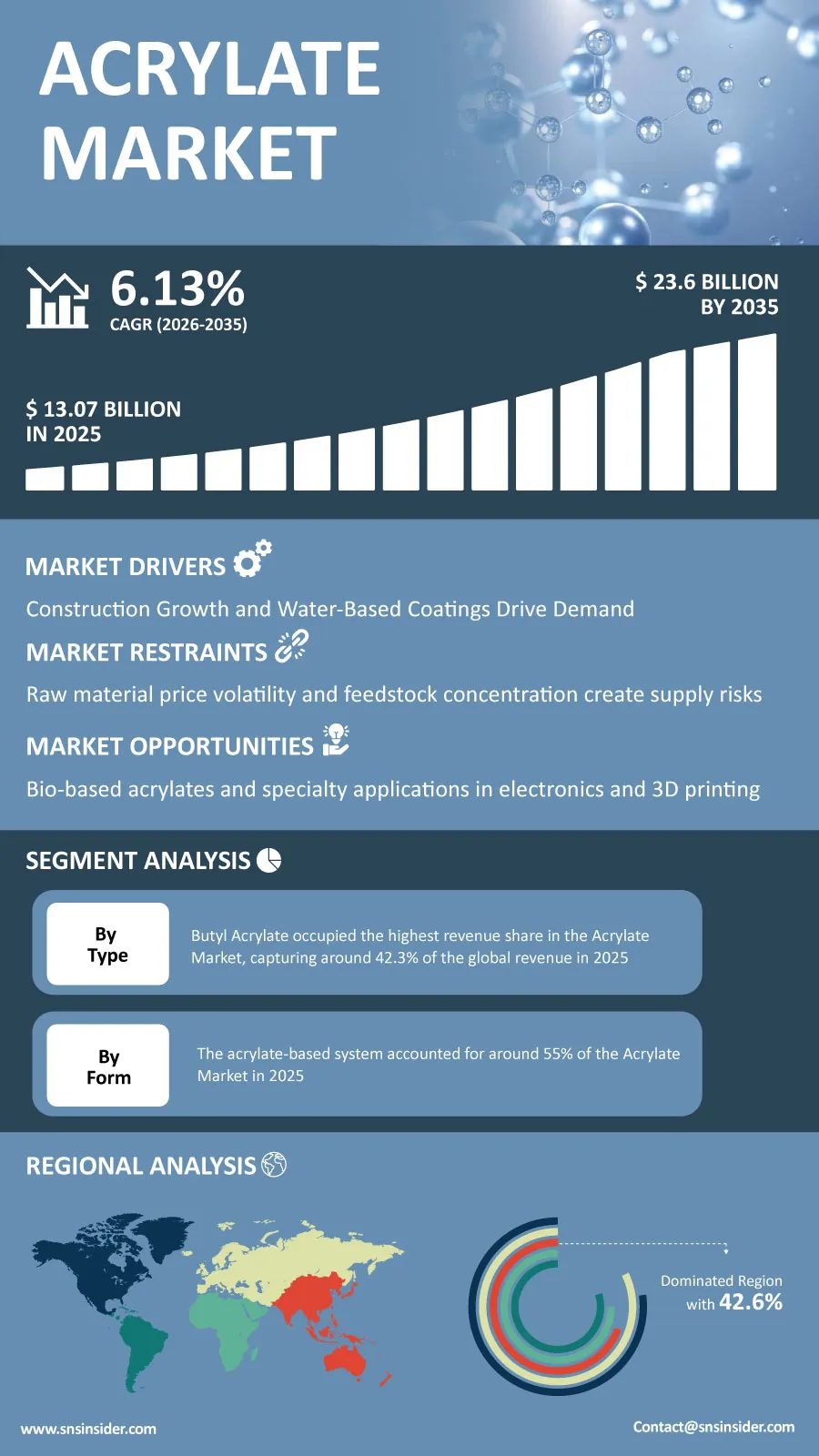
The global Acrylate Market is set to experience continuous growth as high-performance eco-friendly chemical alternatives become more commonplace in industries ranging from coatings, adhesives, packaging, automotive to construction. “According to a recent study by SNS Insider, the global Acrylate Market size valued at USD 13.07 Billion in 2025, is anticipated to grow to USD 23.6 Billion by 2035, registering a CAGR of 6.13% over the 2026–2035 forecast period.”
Environmental regulations, increasing investment in infrastructure development, and increased demand for polymer technology are some of the factors that are contributing to the development of the global acrylate industry. There is increased interest in next generation products with enhanced performance and lower environmental impacts.
Increasing construction projects, manufacturing of automobile parts, and packaging needs are contributing to the increased demand for acrylate-based products. Technological innovations in the development of polymers and biodegradable feedstock have opened up new markets for this product.
To Get Detailed Insights on the Acrylate Market – Request a Sample Report
Sustainable Chemistry and Infrastructure Investments Create Long-Term Growth Opportunities
Governments and private sectors alike are ramping up investments into green infrastructure, energy efficient buildings and sustainable manufacturing processes. These efforts are driving the use of advanced acrylate formulations in architectural coatings, waterproofing systems, industrial adhesives and protective sealants.
Chemical manufacturers also are witnessing massively lucrative prospects from the move upward inside waterborne technologies. As more companies and manufacturers look to comply with stricter environmental regulations while at the same time meet performance requirements, many are adopting low-VOC products for a much wider range of residential, commercial and industrial purposes.
Simultaneously, the development of novel bio-based acrylates and UV-curable technologies expands opportunities for the industry. By using renewable raw materials and specialty formulations specifically designed for applications in electronics, optical coatings, and additive manufacturing, producers can expand their product offerings to align with global sustainability goals.
Key Market Insights Highlight Evolving Product Demand
On the basis of type, Butyl Acrylate garnering 42.3% share of global revenue in 2025 owing owing to versatile application across coatings, adhesives, textiles and sealants. Specialty acrylates are anticipated to be the fastest-growing product type including high-performance variants for pressure-sensitive adhesives and advanced polymers across the forecast period.
By application, Adhesives & Sealants held at 35.3% of total market revenue in 2025 due to growing construction, packaging, automotive assembly and consumer goods manufacturing projects. Paints & Coatings continues to remain as another important application area, as industrial production shifting towards more durable, weather resistant and environmentally compliant coating technologies.
With respect to the form, Water-Based acrylate systems accounted for over 55% of demand share in 2025 when manufacturers were phase-out solvent-based technologies faster. An increasing regulatory pressure on VOC emissions is likely to increase the adoption of sustainable formulations across various industrial sectors.
Advanced Polymer Technologies Drive Industry Transformation
The acrylate industry is so evolving through ongoing innovations in polymer chemistry and techniques, sustainable feedstocks, and cost-effective manufacturing technologies. Manufacturers are focusing on bio-derived acrylic monomers, higher energy curing applications such as UV-curable systems, and high-performance specialty polymers better able to provide exceptional curing efficiency, durability and environmental performance.
The recent trends that provide further opportunities for high-value specialty acrylates include digital manufacturing processes, maturation of formulation technologies, and increasing penetration in electronics, medical devices, optical films and 3D printing. Such innovations are assisting manufacturers in managing evolving customer needs and going beyond sustainable goals by 2030.
Asia Pacific Captured 42.6% Market Share in 2025 as North America and Europe Expand High-Performance Acrylate Demand
In 2025, Asia Pacific accounted for around -42.6% of revenue share the worldwide market size, primarily owing to high levels of chemical production in China, along with increasing construction activities and automotive andre markets supported by strong manufacturing base across India and Southeast Asia. Besides, the region is still bolstered by buoyant feedstock availability and growing investments in specialty chemical production.
North America continues to be a strong growth area, driven by infrastructure updates for anti-corrosive paintings; greater use of environmentally compliant coatings; and increased demand from construction & industrial manufacturing. Continuous innovation in complex advanced chemical processes and novel sustainably produced chemicals further increase regional competitiveness.
Europe will also sustain its large share through stringent environmental regulations, strong innovation and increasing penetration of bio-based and specialty acrylate products throughout high performance industrial applications.
Industry Participants Focus on Sustainable Innovation and Capacity Expansion
The competition in the international market of acrylates is highly intense as the chemical giants increase their production capacity and also engage in R&D for more sustainable and eco-friendly products. New low-emission, renewable raw material-based, and specialty products have been released by the chemical firms to cater to the rising demands of the market.
Key companies operating in the global Acrylate Market include BASF SE, Dow Inc., Arkema S.A., Celanese Corporation, Allnex Group, Evonik Industries AG, Nippon Shokubai Co. Ltd., Mitsubishi Chemical Corporation, LG Chem Ltd., CNOOC and Shell Petrochemicals, Formosa Plastics Corporation, Toagosei Co. Ltd., Sasol Limited, Sumitomo Chemical Co. Ltd., Wanhua Chemical Group Co. Ltd., Solvay S.A., Jiangsu Jurong Chemical Co. Ltd., H.B. Fuller Company, Sartomer, and DSM.
An SNS Insider analyst Himanshu Sharma commented, "The growing shift toward sustainable chemical manufacturing, combined with expanding demand for advanced coatings, adhesives, and specialty polymers, is creating long-term opportunities across the global acrylate industry. Companies investing in bio-based technologies, innovative polymer development, and environmentally responsible production capabilities are expected to strengthen their competitive position throughout the coming decade."
About the Author

Get in touch