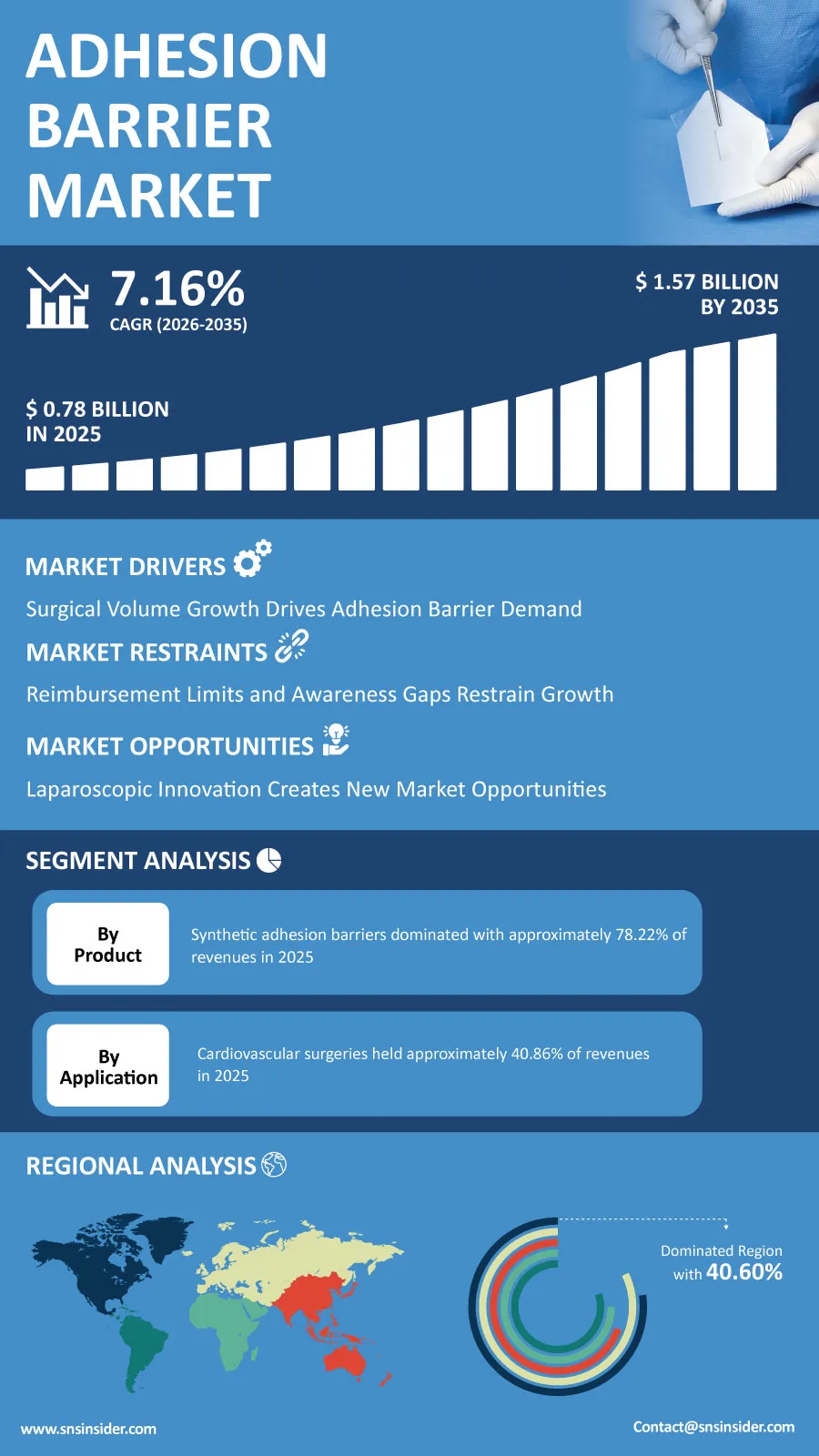
The global Adhesion Barrier Market is gaining momentum as healthcare providers increasingly focus on reducing post-surgical complications and improving long-term patient outcomes. “According to a recent study by SNS Insider, the global Adhesion Barrier Market size valued at USD 0.78 Billion in 2025, is anticipated to grow to USD 1.57 Billion by 2035, registering a CAGR of 7.16% over the 2026–2035 forecast period.” The expanding volume of surgical procedures, combined with growing awareness of adhesion-related complications, is encouraging hospitals and surgeons to integrate preventive solutions into routine clinical practice.
There is an increased importance being attached to technologies that enhance patient recovery but reduce the likelihood of follow-up procedures being required. The use of adhesion barriers has been made more important in the case of abdominal, cardiac, gynecological, and other complicated surgeries through their role in reducing tissue bonding during the healing process.
To Get Detailed Insights on the Adhesion Barrier Market – Request a Sample Report
Advanced Surgical Technologies Expand Clinical Adoption
The swift development of modern surgical practices creates new possibilities for the use of anti-adhesive agents. With the increased prevalence of minimally invasive and robotic surgeries, companies have started manufacturing special products that could be used in laparoscopic surgeries easily.
Furthermore, scientists are developing bioresorbable materials, improving their time of degradation, and making sprays or gels that could help cover hard-to-reach areas of surgery. Thus, surgeons will manage to increase the efficiency of surgeries and ensure good recovery for patients.
Key Market Findings Highlight High-Growth Segments
By product, synthetic adhesion barriers accounted for approximately 78.22% of market revenue in 2025, supported by consistent performance, predictable absorption profiles, and broad clinical acceptance. Natural adhesion barriers are projected to record the fastest growth, expanding at a CAGR of 7.57% through 2035.
By application, cardiovascular surgeries represented approximately 40.86% of global revenue in 2025 owing to the high clinical importance of preventing tissue adhesions during repeat cardiac procedures. Gynecological surgeries are expected to be the fastest-growing application, registering a 7.79% CAGR throughout the forecast period.
Based on formulation, film and mesh products captured approximately 50.84% of total market revenue in 2025 due to their widespread use in open surgical procedures. Meanwhile, gel formulations are forecast to achieve the fastest expansion at a CAGR of 8.22%, supported by increasing adoption in minimally invasive surgeries.
By end user, hospitals dominated with approximately 72.86% of market revenue in 2025 as they remain the primary centers for advanced surgical procedures. Ambulatory Surgery Centers (ASCs) are projected to witness the fastest growth, advancing at a 7.58% CAGR through 2035.
Innovation and Clinical Evidence Strengthen Market Outlook
Product innovation is continuously changing the competitive playing field through the development of materials that enhance manipulation capabilities, tissue tolerance, and surgical performance. Bioresorbable products, along with innovative delivery systems, are aiding the efforts of surgeons in meeting increasing demands in the operating theater.
The healthcare industry is also appreciating the financial gains associated with the prevention of adhesions in the long term. With adhesions costing the United States healthcare system more than USD 2 Billion a year due to readmissions, there is an increased interest in exploring methods for preventing these complications.
Regional Markets Continue to Advance
North America continued to be the leading regional market in terms of share in 2025, contributing about 40.60% of the total global market revenue. The U.S. accounted for around 83.5% of the sales in North America and continues to derive benefits owing to well-established healthcare infrastructure, good reimbursement policies, and increased volumes of surgeries being conducted. The U.S. market was estimated to be valued at about USD 0.240 Billion in 2025 and is expected to rise up to USD 0.48 Billion by 2035 at a 7.07% CAGR.
Asia-Pacific is anticipated to grow at the fastest CAGR of 7.91% during the forecast period ending in 2035. China accounted for about 40.7% of the regional revenue due to increasing health care investments and higher surgeries.
Amongst Europe, Germany accounted for about 26.4% of the regional revenue in 2025. Brazil accounted for about 44.1% of the revenues in Latin America, while Saudi Arabia accounted for 29.8% of Middle East & Africa region revenue.
Leading Companies Intensify Product Innovation
Competition remains strong as manufacturers continue expanding research programs, manufacturing capabilities, and surgeon education initiatives. Major companies operating in the global adhesion barrier market include Becton, Dickinson and Company, Ethicon (Johnson & Johnson), Baxter International Inc., FzioMed Inc., Molnlycke Health Care, Confluent Surgical, CryoLife, Inc., Integra LifeSciences, Terumo Corporation, Cohera Medical, Inc., Medtronic plc, Adhezion Biomedical, BioHorizons, Inc., Anika Therapeutics, Inc., Cousins Medical, GlucoSite Medical, Axia Medical, Hemoshear Technologies, Polyganics BV, and SurgiQuest.
An SNS Insider analyst Parry Kardani commented, "The increasing focus on surgical quality, patient safety, and value-based healthcare is driving sustained demand for advanced adhesion prevention technologies. Companies delivering clinically validated, easy-to-apply, and bioresorbable solutions will be well positioned to capitalize on future growth opportunities across global surgical care."
About the Author

Get in touch