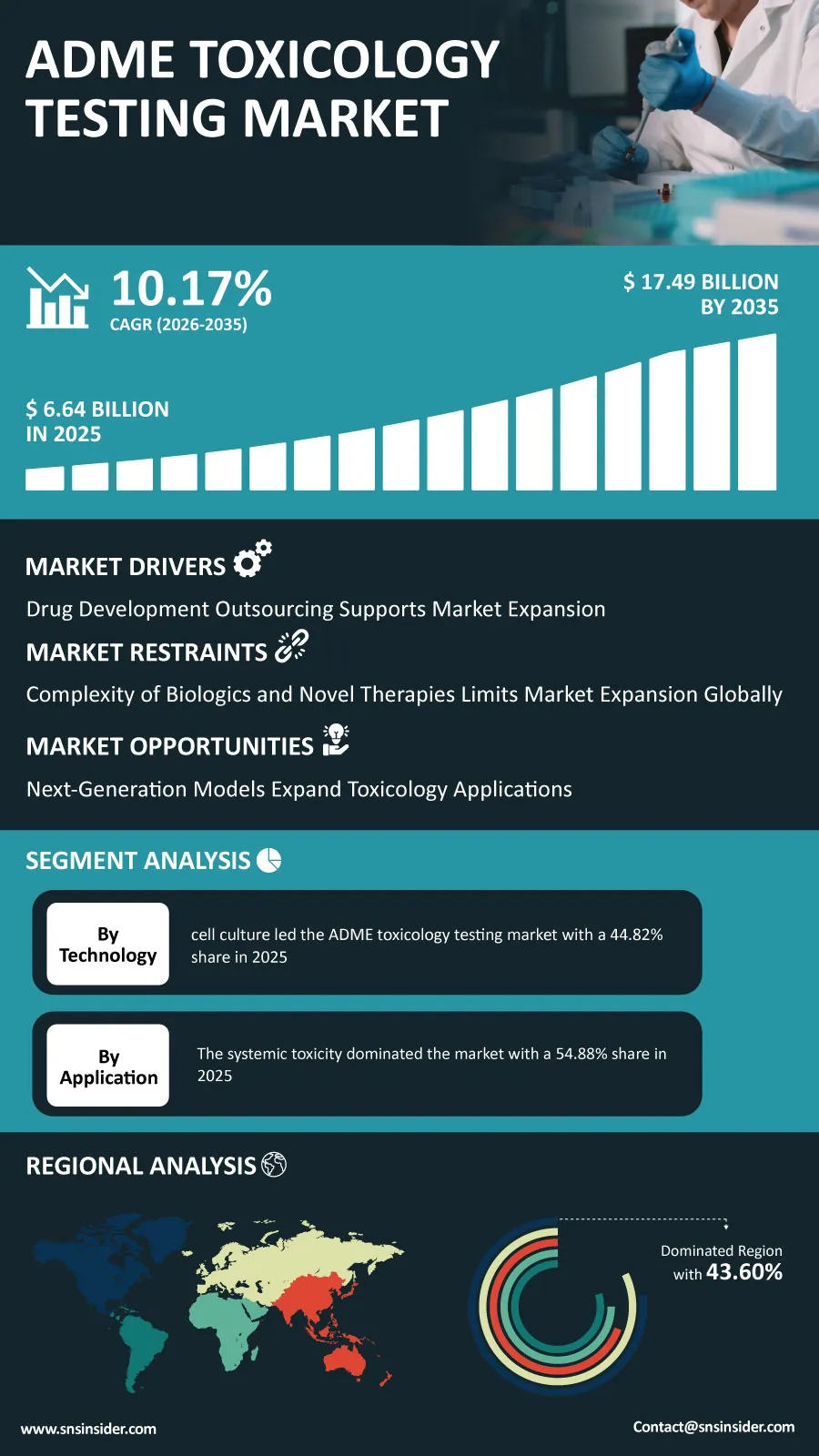
The global ADME Toxicology Testing Market is witnessing robust expansion as pharmaceutical and biotechnology companies intensify investments in safer and faster drug development. “According to a recent study by SNS Insider, the global ADME Toxicology Testing Market size valued at USD 6.64 billion in 2025, is anticipated to grow to USD 17.49 billion by 2035, registering a CAGR of 10.17% over the 2026–2035 forecast period.” Increasing demand for predictive safety evaluation, regulatory compliance, and advanced preclinical testing technologies is positioning ADME toxicology studies as an indispensable component of modern drug discovery.
Increasing pipeline of biologics, gene therapies, and innovative drugs has created a continuous demand for advanced ADME/Tox studies. The pharmaceutical companies are relying on CROs with expertise in ADME/Tox studies to expedite their product development process without compromising on quality. With an increasing focus of regulatory authorities on the safety of the drug prior to conducting clinical trials, there is a growing investment in automation, artificial intelligence-based predictive models, and next-generation lab equipment by testing service providers.
To Get Detailed Insights on the ADME Toxicology Testing Market – Request a Sample Report
Advanced Preclinical Technologies Transform Drug Safety Assessment
The rapid progress in life sciences is changing the way that drugs are being assessed during the preclinical stage of their development. Modern testing facilities have started using artificial intelligence, organs on chips, three-dimensional cell cultures, and computational toxicology to produce quick and accurate information about the safety of drugs.
Such techniques allow identifying risks at an early stage of development and reducing the costs associated with failed trials at the later stages of research. The increasing use of digital technology in laboratories also allows increasing the number of tests carried out.
Key Market Findings Highlight High-Growth Segments
By technology, cell culture accounted for the largest share of the ADME toxicology testing market with 44.82% of revenue in 2025, reflecting its broad use in predictive in vitro testing. Meanwhile, high-throughput technologies are projected to expand at the fastest pace with a 10.81% CAGR through 2035.
By application, systemic toxicity represented 54.88% of the market in 2025 as comprehensive safety evaluation remains central to regulatory approval. The renal toxicity segment is forecast to register the highest growth at a 10.96% CAGR during the forecast period.
Based on method, cellular assays generated the leading 45.84% market share in 2025 owing to their effectiveness in evaluating drug responses at the cellular level. Biochemical assay platforms are expected to record the fastest expansion with a 10.69% CAGR through 2035.
Among end users, pharmaceutical and biotechnology companies contributed 45.86% of total market revenue in 2025. However, contract research organizations (CROs) are anticipated to deliver the strongest growth, advancing at a 10.49% CAGR as outsourcing continues to reshape preclinical development.
Innovation, Automation, and Regulatory Compliance Drive Industry Evolution
With the changing environment, testing facilities are developing their capabilities to include more than just routine laboratory analysis. Predictive toxicology through artificial intelligence, automated screening technologies, and advanced laboratory analyses help make pre-clinical safety assessment more effective and reliable.
Higher demands by regulatory organizations such as the FDA, the European Medicines Agency (EMA), and the International Conference on Harmonization (ICH) lead to the increased use of standardized tests. Moreover, the closer cooperation between pharma firms and CROs helps speed up the process of research.
Regional Markets Continue Strengthening Global Drug Development
North America accounted for the maximum share in terms of value contribution in 2025 and is expected to contribute 43.60%. The reason behind this is due to its strong pharmaceutical R&D investments, well-established preclinical infrastructure, and advanced technology adoption in labs. The U.S. ADME Toxicology Testing Market is estimated to be USD 2.18 billion in 2025 and will increase to USD 5.71 billion by 2035 at a CAGR of 10.10%. The strong demand for these services from innovative pharmaceutical companies and prominent CROs further boosts the market position of the United States in preclinical testing in the global landscape.
In Asia-Pacific, the fastest regional growth is forecasted over the coming years, at a CAGR of 11.10% during 2021-2035. Increasing investments in the pharmaceutical sector, expanding network of CROs in India and China, and the increased use of artificial intelligence-powered toxicology platforms are contributing to the strong growth.
Europe has been maintaining its strong market position through pharmaceutical manufacturing and investments in biologics R&D. Emerging countries in Latin America and Middle East & Africa are also gaining strength in the form of rising healthcare investments and capabilities in research.
Leading Companies Expand Global Testing Capabilities
Competition remains strong as industry participants broaden laboratory networks, invest in advanced predictive technologies, and strengthen partnerships with pharmaceutical innovators. Key companies operating in the global ADME Toxicology Testing Market include Thermo Fisher Scientific Inc., Promega Corporation, Agilent Technologies Inc., Beckman Coulter Inc., Catalent Inc., Charles River Laboratories, Eurofins Scientific, GE HealthCare Technologies Inc., Miltenyi Biotec, IQVIA Inc., BioIVT LLC, Albany Molecular Research Inc. (AMRI), Cyprotex PLC (Evotec AG), WuXi AppTec, Evotec SE, Pharmaron, Shanghai Medicilon Inc., Sai Life Sciences, Tecan Group Ltd., and Bio-Rad Laboratories Inc.
An SNS Insider analyst Parry Kardani commented, "As drug pipelines become increasingly complex, ADME toxicology testing is evolving into a technology-driven discipline powered by artificial intelligence, advanced cell models, and specialized CRO expertise. Organizations investing in predictive testing capabilities and regulatory excellence will be well positioned to support the next generation of pharmaceutical innovation."
About the Author

Get in touch