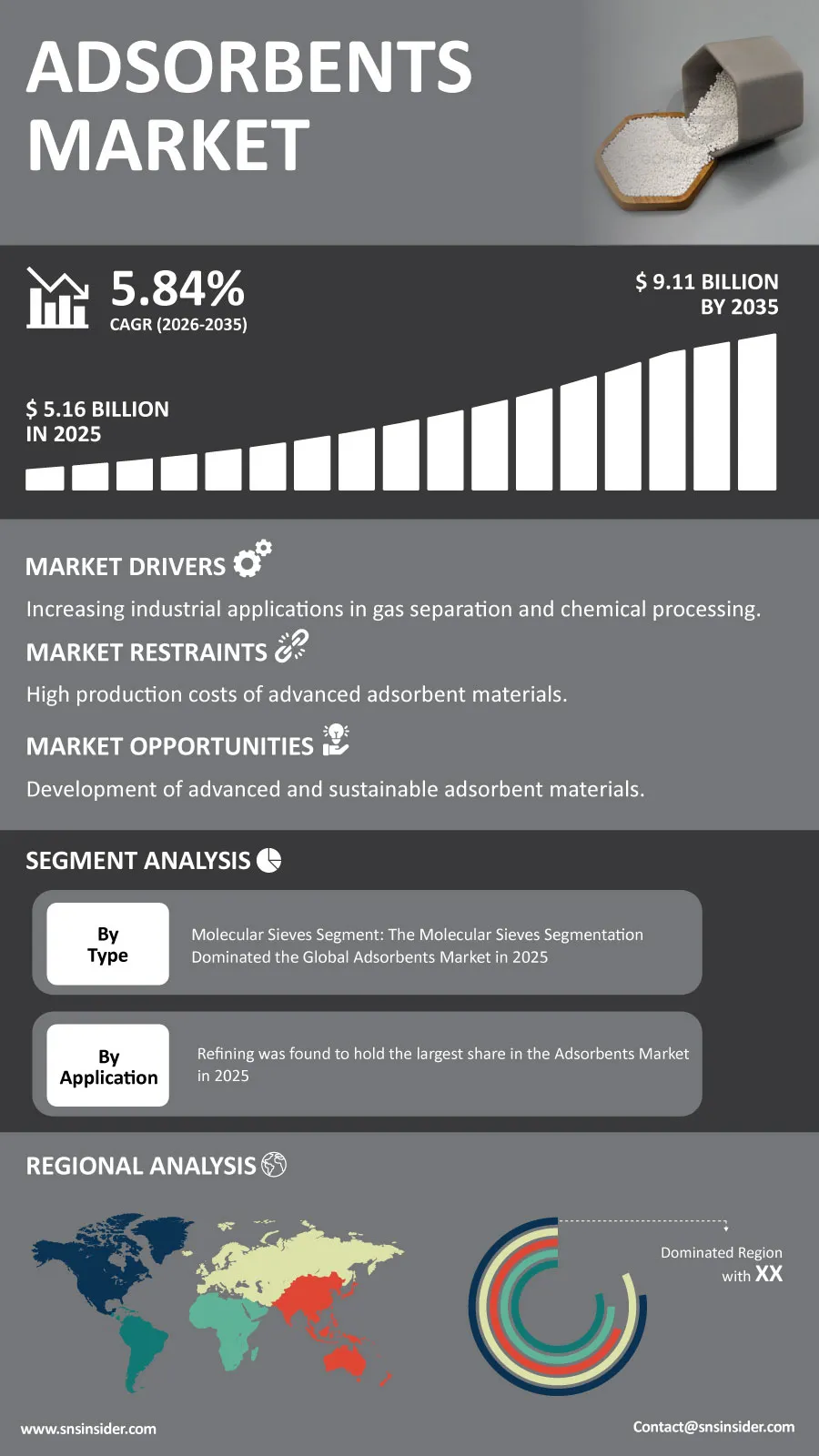
The Global Adsorbents Market is forecasted to exhibit stable growth as a result of increasing investments from companies all around the world in protecting the environment, green manufacturing, and efficient separation technologies. “According to a recent study by SNS Insider, the global Adsorbents Market size valued at USD 5.16 Billion in 2025, is anticipated to grow to USD 9.11 Billion by 2035, registering a CAGR of 5.84% over the 2026–2035 forecast period.”
Industrial pollution emissions, wastewater contamination, and resource protection issues are increasing, which is leading to faster implementation of adsorption technologies. Adsorption is now essential for the purification of water, separation of gases, refining of petrochemicals, the pharmaceutical industry, food processing, and air pollution control because it can eliminate pollutants with greater efficiency while enhancing process efficiency.
The growth in the market is also being facilitated by fast industrial growth, stringent environmental regulations, and investments in hydrogen production, natural gas processing, and carbon capture processes. Improvements in adsorption materials are making these processes efficient and sustainable.
To Get Detailed Insights on the Adsorbents Market – Request a Sample Report
Environmental Regulations and Clean Energy Projects Create Long-Term Growth Opportunities
Massive investment from governments and industrial players are going into the direction of wastewater recycling, emission reduction and sustainable manufacturing infrastructure. Increasingly stringent regulatory standards on pollutants and the growing demand for high-performance adsorbents to remove water, gases, and contaminants from industrial process streams enable potential high growth.
The move towards more sustainable energy systems is giving rise to additional markets for adsorption technologies. Advanced adsorbent materials are increasingly used to enhance the operation of hydrogen purification, liquefied natural gas processing, renewable natural gas production and carbon capture facilities.
Apart from that, Manufacturers are also fast-tracking innovation by developing biobased adsorbents, reusable filtered media and AI-enabled monitoring systems that can optimise adsorption performane while decreasing maintenance requirements and operating costs.
Key Market Insights Highlight Expanding Industrial Applications
Worldwide revenue was around 45% for Molecular Sieves in terms of type in 2025 and is likely to rise due to their heavy utilization by gas separation, petrochemical processing, hydrogen production and industrial dehydration applications. In the forecast period, its faster growth is anticipated driven by rising investments in water treatment, PFAS removal, industrial air purification, and emission control technologies.
Petroleum Refining accounts for almost 26 percent of revenue generated in the market in 2025 in terms of application segment on account of high-volume use of adsorbents for hydrocarbon purification, catalyst protection, sulfur removal and enhancement of fuel quality. Water Treatment is forecast to register the maximum growth until 2035 due to expansion in investments at national levels for municipal water treatment, wastewater reuse and advanced contaminant removal systems.
Advanced Adsorption Technologies Drive Industry Innovation
Continuous development in technology is back up the adsorbents industry by improving adsorption efficiency, regeneration capability and environmental sustainability. Nanostructured materials, customized molecular sieves, adsorbents from biomass and also next generation activated carbon products are increasing the efficiency of modern purification systems.
Industrial filtration is also being changed by artificial intelligence with predictive monitoring, optimized adsorbent replacement times and the automation of processes. These advancements enable industrial facilities to conserve operating temperatures and maximize purification to ensure effective performance in complex processing environments.
North America Accounted for More Than One-Third of Market Revenue in 2025; Asia Pacific to Lead Growth by 2035
The regional North America also maintains a high market share for all the three provide cycles backed with numerous large-scale investments spanning industrial wastewater, PFAS remediation, air quality improvement and carbon capture infrastructure as well. Ongoing global growth supplemented by strict environmental regulation and expand portfolio will assist the market growth across refining, pharmaceuticals and municipal water treatment.
Asia Pacific is projected to be the fastest-growing market for biogas, as rapid industrial development and associated rising water demand along with a growing refining capacity and increasing chemical production across China, India, Japan, and Southeast Asia are inceptional emissions towards high investments in water infrastructure. Additionally, regional demand is also being further propelled by government initiatives in support of sustainable manufacturing and industrial pollution control.
Europe also continues to represent an important market opportunity with stringent environmental legislation, sustainable hydrogen economy projects expansion efforts, and ongoing investments in industrial decarbonization, advanced filtration technologies, sustainable chemical processing areas.
Industry Participants Focus on Sustainable Purification Solutions
The competitive landscape of the global Adsorbents Market is still seemingly fierce with major players expanding their production capacity and enhancing research development efforts while launching breakthrough adsorption material types that can aid in industrial level purification efforts. With changing regulations and customer demand, the companies continue to invest in innovation with advanced activated carbon, molecular sieves, specialty adsorbents, environmentally friendly manufacturing technologies.
Key companies operating in the global Adsorbents Market include BASF SE, Calgon Carbon Corporation, Cabot Corporation, Arkema S.A., Clariant AG, Honeywell International Inc., Zeochem AG, W. R. Grace & Co., Kuraray Co., Ltd., Jacobi Carbons Group, Sorbead India, Evoqua Water Technologies, Ingevity Corporation, Purolite Corporation, CECA (Arkema Group), Zeolyst International, Hengye Inc., Multisorb Technologies, Silcarbon Aktivkohle GmbH, and Universal Carbons Ltd.
An SNS Insider analyst Himanshu Sharma commented, "The increasing emphasis on clean water access, industrial decarbonization, and sustainable manufacturing is creating long-term opportunities for advanced adsorption technologies. Companies investing in innovative purification materials, carbon capture applications, and environmentally responsible production processes are expected to strengthen their competitive position as global environmental standards continue to evolve."
About the Author

Get in touch