
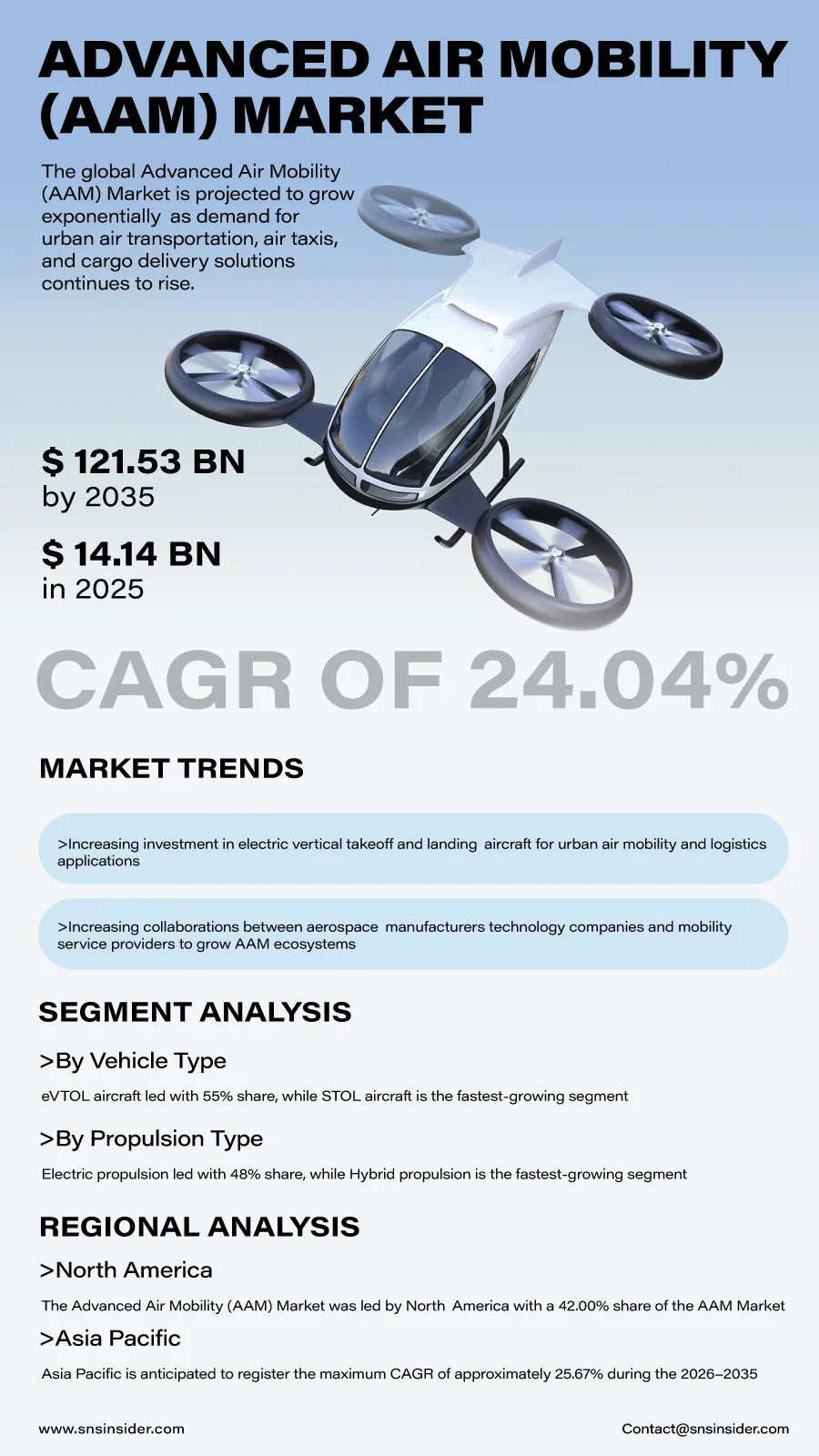
The global Advanced Air Mobility (AAM) Market is poised for remarkable expansion over the next decade as urban transportation systems evolve toward cleaner, faster, and more efficient mobility solutions. According to a recent study by SNS Insider, the global Advanced Air Mobility Market size valued at USD 14.14 billion in 2025, is anticipated to grow to USD 121.53 billion by 2035, registering a CAGR of 24.04% over the 2026–2035 forecast period.
Increased urban congestion, the need for environmentally friendly modes of transport, and the development of electric aviation technology are changing the future of short-haul flights. The aerospace industry, tech firms, and mobility operators are investing more in developing new aircraft that will be used for passenger movement, cargo logistics, emergency purposes, and connectivity between regions.
There are also other factors driving the growth of the advanced air mobility market, such as the positive change in regulatory environments, expansion of smart cities, and investments in digital air traffic management systems. Governments are increasingly focusing on the development of low emission transportation networks.
Technology Innovation Creates Significant Growth Opportunities
The ongoing innovation in terms of electric propulsion systems, autonomous flights, lightweight materials, and batteries is enhancing the prospects for commercial success for advanced air mobility solutions. Such developments help airplane producers make their operations more efficient while expanding the distance covered and improving safety standards.
Increased investments into vertiport construction and airspace management systems are helping deploy AAM services commercially in the future. Public and private partnerships are helping build the ecosystem through cooperation between aerospace companies, technology vendors, municipalities, and infrastructure developers.
At the same time, increasing research into hybrid-electric propulsion systems is expanding operational capabilities for regional transportation and cargo applications where longer flight endurance is required.
Key Market Insights Highlight Shifting Demand Patterns
By vehicle type, in 2025, eVTOL aircraft will make up 55% of total market revenues due to the efficiency in transporting from point to point in urban areas. STOL aircraft will have the highest growth rate till 2035 as there will be more demand for air mobility on the regional level.
Based on propulsion type, Electric propulsion is estimated to provide 48% of the market revenue by 2025 due to the adoption of electric propulsion technology in many UAM vehicles. On the other hand, hybrid propulsion is projected to experience the highest CAGR in the forecast period as companies look to maximize range and payload capacity.
By operating range, short-range flights below 100 kilometers held 52% of global market revenue in 2025 due to increasing deployment of urban air taxi services. Medium-range operations between 100 and 300 kilometers are projected to grow with the fastest CAGR during the forecast period as regional mobility and intercity transportation continue expanding.
In terms of application, the urban air mobility and air taxis are projected to generate about 46% of the market revenues by 2025. The cargo and logistics applications are likely to become the fastest-growing segments due to the increasing use of aerial delivery systems by firms.
By end user, the commercial companies are expected to generate 41% of the revenue in the global market by 2025. The logistic services companies are forecasted to show the highest growth rate until 2035 due to the increasing demand for faster freight transportations.
Sustainable Urban Transportation Remains a Primary Industry Focus
Air mobility is gaining as city authorities are looking for ways to solve traffic problems by offering greener options that will minimize environmental consequences compared to other means of transport. Electric aircraft with vertical takeoff and landing capabilities have opened up new avenues for increasing commuter mobility without airports.
Participants in the industry are also making investments in the area of autonomous navigation technology and safety as well as digital fleet management. It is expected that this development will enhance commercialization of drones in areas such as transport services, delivery of cargo, emergency medical services, and public safety.
Regional Markets Continue Accelerating Adoption
The North America region is predicted to hold 42% of the overall market share in 2025 owing to the presence of efficient aerospace technology, high investment, positive regulatory framework, and well-developed urban air mobility ecosystem. Ongoing cooperation among aircraft producers, tech companies, and aviation authorities is contributing to the regional market supremacy.
The Asia-Pacific region is forecasted to emerge as the fastest growing regional market with a CAGR of 25.67% during the forecast period up to 2035. Urbanization, governmental support for smart transportation systems, advancements in aerospace industry manufacturing facilities, and investments in electric aviation solutions are some of the key factors driving regional growth.
As countries continue investing in sustainable transportation infrastructure, advanced air mobility is expected to become an increasingly important element of future multimodal transportation networks.
Industry Participants Focus on Commercial Deployment and Innovation
The competition landscape changes further with an accelerated effort by companies to certify their aircraft, increase production capacities, and form strategic alliances within the advanced air mobility space. They have been focusing on the development of electric power systems, autonomy, air traffic integration, and manufacturing scalability for commercial applications in the future.
Key companies operating in the global Advanced Air Mobility (AAM) Market include Airbus S.A.S., The Boeing Company, Joby Aviation, Archer Aviation, Lilium GmbH, Volocopter GmbH, Guangzhou EHang Intelligent Technology Co. Ltd., Vertical Aerospace Group Ltd., Embraer S.A. (Eve Air Mobility), Bell Textron Inc., Hyundai (Supernal), Beta Technologies, Pipistrel (Textron), Neva Aerospace, Honda Motor Co., TCab Tech, Horizon Aircraft (New Horizon Aircraft Ltd.), Sarla Aviation, Workhorse Group, and Zipline.
An SNS Insider analyst Santosh Bhul commented, “Rapid advancements in electric aviation, autonomous flight technologies, and supportive regulatory initiatives are accelerating the commercialization of advanced air mobility worldwide. Organizations that prioritize technology innovation, infrastructure development, and scalable operating models will be well positioned to capitalize on the industry's long-term growth potential.”
About the Author

Get in touch




