
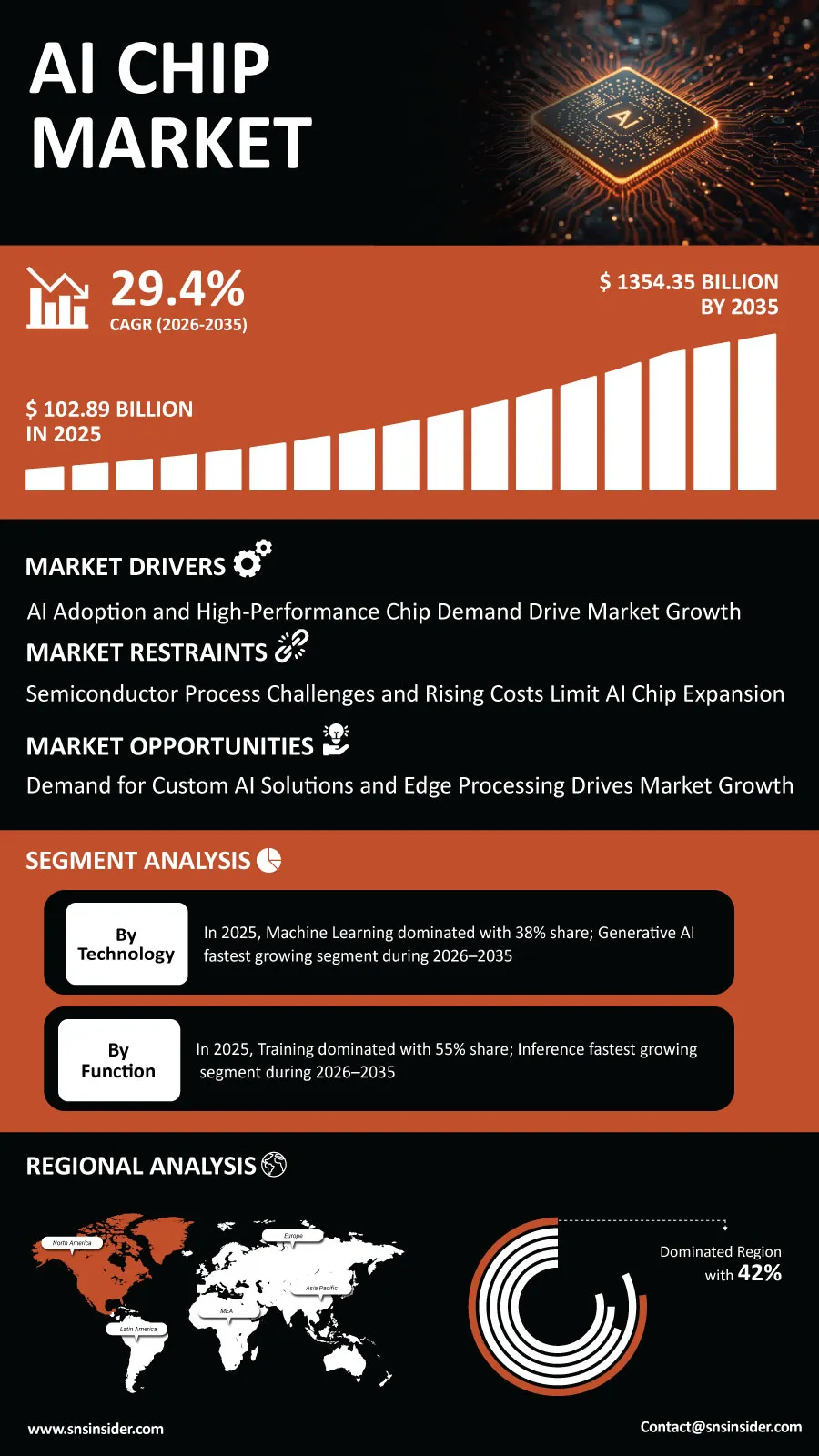
The global AI Chip Market is about to enter an era of rapid growth as firms, tech vendors, and even governments boost their investments in computing capabilities tailored for artificial intelligence applications. According to a recent study by SNS Insider, the global AI Chip Market size valued at USD 102.89 billion in 2025, is anticipated to grow to USD 1354.35 billion by 2035, registering a CAGR of 29.4% over the 2026–2035 forecast period.
The fast commercialization of generative AI, machine learning, autonomous computing and intelligence has led to an increased demand for specific processors. The data center infrastructure is being upgraded to handle the heavy computational workload for AI. Enterprises are using AI-powered applications in health care, finance, manufacturing, automotive and retail industries.
On the hardware level, the growing number of devices such as smartphones, machinery, robots, and others will create yet another route to implementing AI processors. Hence, semiconductor firms now need to design systems that have increased efficiency and speed and reduced power usage.
To Get Detailed Insights on the AI Chip Market – Request a Sample Report
Generative AI Infrastructure Creates New Growth Opportunities
The increasing adoption of larger AI models is changing the demands for semiconductors, as companies will need specific hardware that can process massive amounts of data. GPUs are still essential in numerous training scenarios, but application-specific accelerators are also becoming popular because of their energy efficiency and reduced costs.
Cloud service providers and data center operators that operate at hyperscale are also beginning to deploy more accelerators for their AI-as-a-service solutions. On the other hand, businesses are becoming more interested in inference hardware that can be used for processing AI workloads locally.
Further improvements in semiconductor manufacturing technologies, heterogeneous system design, and specialized processing will provide additional opportunities for AI chip designers.
Key Market Insights Highlight Shifting Demand Patterns
Considering the technology aspect, it is estimated that machine learning will contribute towards generating 38% of the revenues of the global AI Chips Market by 2025 on account of widespread use across enterprises and industries. Generative AI will experience the fastest growth until 2035 due to rapid adoption of AI-created text, images, software, and other computationally intensive content applications.
With respect to the type of chips, it is expected that the GPUs will remain dominant and capture the 46% of the market revenue by 2025 owing to the fact that these chips can conduct highly parallel computations necessary for AI algorithms. The fastest growth rate is expected to be achieved by the ASICs on account of opportunities to enhance computation.
In terms of application, training is anticipated to account for 55% of market revenue by 2025 on the back of growing adoption of large scale models. Growth will be the highest in the case of inference as AI solutions are likely to work in real-time in enterprise applications, autonomous systems, industrial machinery, and consumer devices.
In terms of end-user, the share of data center is predicted to reach 49% in 2025 as investments in cloud platforms that are compatible with AI increase. The share of consumer will show the fastest growth due to the rising presence of AI in smartphones, wearable technology, smart home technology, and other consumer electronics.
Edge Intelligence and Energy Efficiency Reshape Chip Development
Processing through AI is gradually getting away from centralized cloud architecture. Edge computing allows for local analysis of data, useful in scenarios where time, privacy, connection issues, and bandwidth are key considerations.
The trend is pushing chip vendors to design small accelerators tailored to specific requirements and limited power conditions. Neural processing units, specialized architectures, and chiplets have the potential to make AI functionalities possible on industrial machinery, cars, phones, and infrastructure connections.
North America Leads with 42% Revenue Share While Asia Pacific Advances at a 31.2% CAGR
North America will capture roughly 42% share of the revenue from the global AI Chip Market in 2025, thanks to the significant presence of companies that manufacture semiconductors, cloud companies, hyperscale data centers, and those developing AI technology. Continued investments in computing infrastructures and semiconductor capacity continue to solidify the position of the region.
The Asia Pacific region is expected to be the fastest growing regional market, with a CAGR of 31.2% during 2025-2035. Increasing digitalization, growing data center capacity, growing manufacturing of electronics, and considerable investment in AI and semiconductor technologies in China, Japan, South Korea, and India are contributing to the growth of the region.
The Europe region is also building up its semiconductor ecosystem owing to the technological sovereignty agenda, chip manufacturing, automation, and AI in the automotive sector.
Industry Participants Accelerate AI Hardware Innovation
Competition is heating up among chip makers, cloud computing providers, and technology companies in an effort to offer better AI computing systems. Strategic spending has shifted toward accelerator designs, advanced packaging, power efficiency, data center performance, and edge AI.
Key companies operating in the global AI Chip Market include NVIDIA Corporation, Intel Corporation, Xilinx Inc., Samsung Electronics Co., Ltd., Micron Technology, Qualcomm Technologies, IBM Corporation, Google Inc., Microsoft Corporation, Apple Inc., Amazon Web Services (AWS), Advanced Micro Devices, Inc., Graphcore, General Vision, Mellanox Technologies, Huawei Technologies Co. Ltd., Fujitsu, Wave Computing, Mythic Inc., and Adapteva.
An SNS Insider analyst Sushant Kadam commented, “The rapid adoption of generative AI is fundamentally increasing the computing requirements of enterprises and data center operators. The strongest opportunities will emerge for companies capable of delivering scalable AI acceleration with greater performance, energy efficiency, and application flexibility across both centralized and edge computing environments.”
About the Author

Get in touch




