
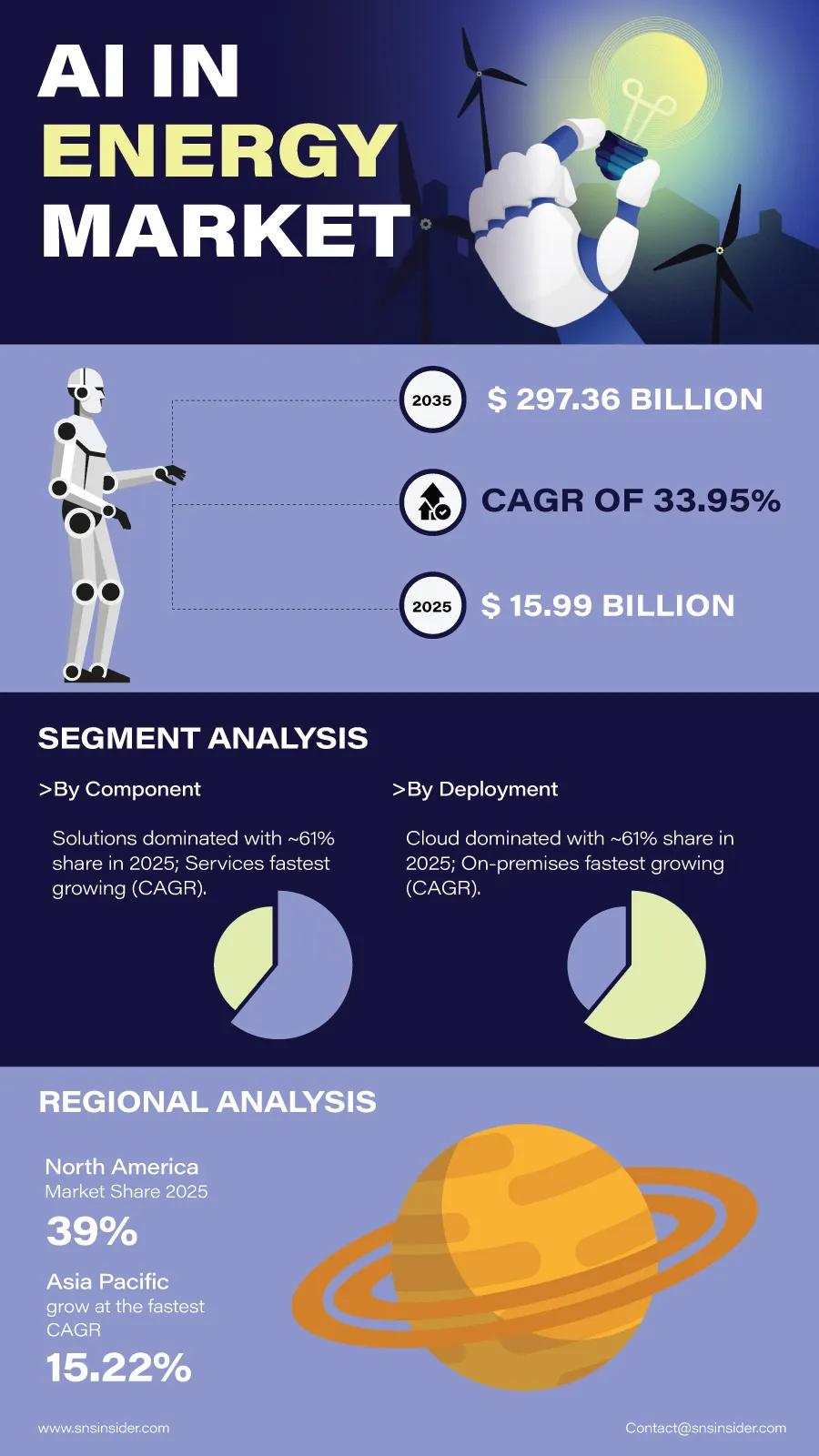
The global Artificial Intelligence in Energy Market is poised for remarkable expansion over the next decade as utilities, power producers, and grid operators increasingly adopt artificial intelligence to modernize energy infrastructure and improve operational efficiency. According to a recent study by SNS Insider, the global AI in Energy Market size valued at USD 15.99 billion in 2025, is anticipated to grow to USD 297.36 billion by 2035, registering a CAGR of 33.95% over the 2026–2035 forecast period.
Increasingly rapid movement towards renewable energy sources, electrification, and smart grids is resulting in the growing need for AI solutions to cope with the complexity of energy systems. Advanced analytical techniques, machine learning, and automation are utilized by energy providers to achieve better forecasting results, optimal asset performance, and increased grid resilience at reduced expenses.
With the process of digital transformation influencing the entire global energy industry, artificial intelligence becomes an integral part of technology stack required to implement real-time decisions in energy production, transmission, distribution, and energy trade. Continuous improvements in cloud computing, IoT, and predictive analytics contribute to increased commercial viability of AI energy management solutions.
Intelligent Grid Modernization Creates Significant Growth Opportunities
Globally, governments and utility companies are making huge investments towards updating old power infrastructures, and incorporating more renewable energy sources into the existing electricity grids. Artificial intelligence allows them to balance the production of power, manage the generation of power in line with the demand, and improve the resilience of the growing decentralized energy system.
The use of smart meters, sensors, and digital substations is producing tons of operational data, and artificial intelligence can turn them into usable information. Predictive maintenance, automatic fault finding, energy management, and rapid outage repair are some of the functions enabled by artificial intelligence, and they allow utility companies to provide better services and minimize maintenance costs.
Technology vendors will have many opportunities arising from the growing investment in cloud-based energy platforms, intelligent automation, and artificial intelligence-powered demand response solutions.
Key Market Insights Highlight Shifting Demand Patterns
By component, the AI solutions are forecasted to account for around 61% of worldwide revenue generation in 2025 owing to the widespread use of platforms offering predictive maintenance, grid optimization, and asset performance management capabilities. It is also expected that services will record the fastest growth up to 2035 due to the rising need for consulting, integration, optimization, and lifecycle management of AI.
Based on end user, utilities are expected to account for 34% of market share in terms of revenue in 2025 on account of extensive use of AI in monitoring grids, outage management, and optimizing networks. Energy generation is estimated to be the fastest-growing segment in terms of CAGR for the forecast period, owing to the increasing use of AI in renewable energy plants.
In terms of application, renewables management market share will contribute about 23% of total revenue across the world in 2025 owing to the necessity of forecasting and performance optimization of solar, wind, and energy storage resources. The demand forecasting is anticipated to become the fastest growing segment driven by high electrification rate and use of electric vehicles.
By deployment model, cloud-based platforms are expected to generate around 61% market revenue in 2025 and also grow at the highest rate till 2035. Their ability to scale up, manage the central data repository, and integrate with the IoT infrastructure is increasing their adoption.
Artificial Intelligence Reshapes Modern Energy Operations
Through artificial intelligence, energy companies are becoming more effective in how they operate as it is making it possible for them to have data-driven predictions in all stages in the value chain. The development of machine learning techniques has facilitated equipment diagnosis, automation of grid controls, forecasts of renewables, and trading strategies.
There are continued investments in digital twins, edge computing, and generative AI by manufacturers and technology companies. They help utilities cut down on downtimes, allocate resources effectively, and achieve infrastructure resiliency and long-term decarbonization.
With the increasing interconnection of power grids, AI is set to play a crucial part in the creation of flexible, efficient, and secure energy ecosystem that will be able to meet future energy needs.
Regional Markets Demonstrate Strong Growth Potential
The North American region is estimated to constitute about 39% share of the worldwide AI in Energy Market revenues in 2025 owing to highly developed digital infrastructure, early adoption of AI technologies, significant investment in smart grids, and strong cooperation between technology vendors and utilities. Government initiatives toward grid modernization in this region are adding to its dominance.
The Asia Pacific region is expected to grow at the highest CAGR of about 15.22% during 2025 to 2035 owing to rapid urbanization, increase in demand for electricity, increased generation from renewable sources of energy, and increasing investments in smart energy infrastructures.
As governments continue prioritizing energy security, sustainability, and digital transformation, AI deployment is expected to accelerate across both mature and emerging electricity markets worldwide.
Industry Participants Focus on AI Innovation and Digital Energy Platforms
The competitive landscape is still very dynamic, considering that technology vendors have continued making investments in cutting-edge analytics, cloud-based technologies, intelligent automation, and AI-driven grid management systems. It is imperative for technology vendors to pursue strategic collaborations with utility companies and make innovations in software applications in their quest for market competitiveness.
Key companies operating in the global AI in Energy Market include General Electric, Siemens Energy, Schneider Electric, ABB Ltd, Honeywell International, IBM, C3.ai, AutoGrid, SparkCognition, Uplight, DataRobot, Iberdrola, Tibber, Samotics, Envision Digital, Hitachi Energy, SenseTime, Fujitsu, Origami Energy, and ATOS SE.
An SNS Insider analyst Sakshi Kale commented, “The accelerating digital transformation of global energy infrastructure is making artificial intelligence an essential capability for modern utilities and power producers. Organizations investing in scalable AI platforms, predictive analytics, and intelligent automation will be best positioned to improve operational efficiency while supporting the transition toward more resilient and sustainable energy systems.”
An Infographic Representation of the Global AI in Energy Market
About the Author

Get in touch




