
AI in Energy Market Report Scope & Overview:
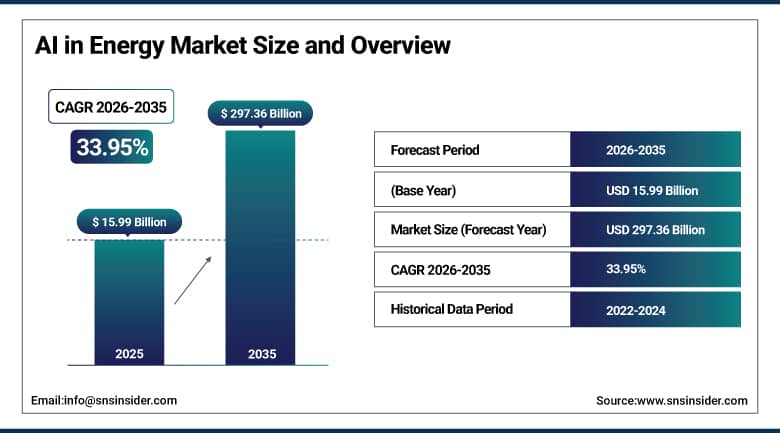
The AI in Energy Market was valued at USD 15.99 billion in 2025 and is expected to reach USD 297.36 billion by 2035, growing at a CAGR of 33.95% from 2026-2035.
The AI in Energy Market is growing rapidly due to increasing adoption of smart grids, renewable energy integration, and digital energy management solutions. Rising demand for predictive maintenance, demand forecasting, operational efficiency, and cost optimization drives utilities and energy companies to implement AI technologies. Expanding electrification, regulatory support, and the need for real-time analytics further accelerate market growth, making AI essential for modern, sustainable, and reliable energy systems globally.
For example, AES Ohio partnered with Landis+Gyr for a major grid upgrade, deploying 500,000 smart meters integrated with cloud-based AI analytics via the Gridstream Connect IoT platform to enhance network management and demand forecasting.
AI in Energy Market Size and Forecast
-
Market Size in 2025: USD 15.99 Billion
-
Market Size by 2035: USD 297.36 Billion
-
CAGR: 33.95% from 2026 to 2035
-
Base Year: 2025
-
Forecast Period: 2026–2035
-
Historical Data: 2022–2024
To Get more information On AI in Energy Market - Request Free Sample Report
AI in Energy Market Trends
-
Rising need for grid optimization, predictive maintenance, and energy efficiency is driving the AI in energy market.
-
Growing adoption of AI across smart grids, renewable energy integration, and power generation is boosting market growth.
-
Expansion of machine learning and advanced analytics for load forecasting, demand response, and energy trading is fueling adoption.
-
Increasing focus on reducing operational costs, downtime, and carbon emissions is shaping market trends.
-
Advancements in AI-powered automation, real-time monitoring, and asset management are improving reliability and performance.
-
Rising investments by utilities, energy producers, and technology providers are supporting market expansion.
-
Collaborations between AI vendors, energy companies, and research institutions are accelerating innovation and global deployment.
U.S. AI in Energy Market Insights:
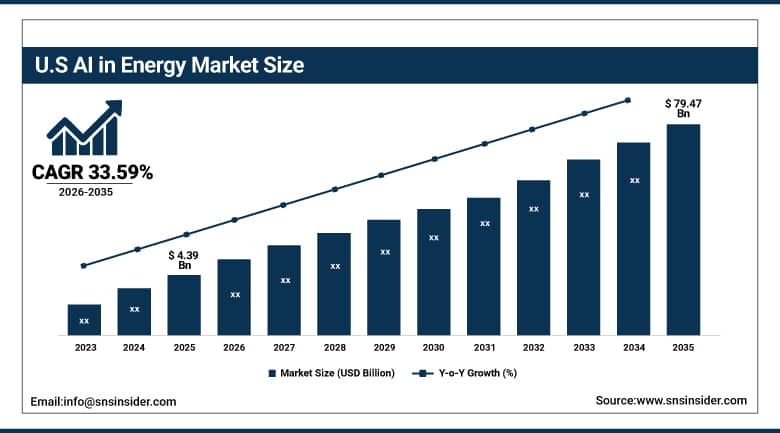
The U.S. AI in Energy Market was valued at USD 4.39 billion in 2025 and is expected to reach USD 79.47 billion by 2035, growing at a CAGR of 33.59% from 2026-2035.
The U.S. AI in Energy Market is growing due to advanced grid digitalization, early AI adoption, renewable energy expansion, and strong government support, driving utilities to implement AI for predictive maintenance, demand forecasting, operational efficiency, and cost optimization.
For instance, the U.S. Department of Energy’s Smart Grid Investment Grants have historically funded billions in AI-enabled infrastructure and continue to support projects through 2026 regulatory mandates aimed at enhancing grid resilience.
AI in Energy Market Growth Drivers:
-
Rising operational complexity and cost pressures across power generation and grids push utilities toward intelligent, automated decision systems globally worldwide
Growing variability in electricity demand, renewable energy intermittency, fuel price volatility, and grid congestion forces energy companies to adopt advanced analytics for faster and more accurate decisions. AI enables real-time load forecasting, predictive maintenance, and asset performance optimization, directly reducing unplanned outages and operational expenditure. Utilities increasingly rely on AI to balance supply and demand, optimize dispatch, and manage distributed energy resources efficiently. The ability to process vast volumes of sensor, SCADA, and market data helps operators respond proactively rather than reactively. These efficiency gains significantly improve reliability, cost control, and profitability across generation, transmission, and distribution networks.
For example, Google Cloud’s Vertex AI supports distributed energy resource management for over 50 utilities, enabling real-time supply-demand balancing and delivering 20% efficiency gains through predictive analytics.
AI in Energy Market Restraints:
-
High implementation costs and complex integration with legacy energy infrastructure slow widespread adoption across utilities and operators
Large upfront investments in data infrastructure, AI platforms, skilled talent, and system upgrades limit adoption, especially for smaller utilities. Integrating AI solutions with aging grid assets, proprietary software, and fragmented data environments requires significant customization and long deployment cycles. Many energy operators face budget constraints and uncertainty around return on investment, delaying decision-making. Inconsistent data quality and lack of standardization further increase integration complexity. These financial and technical barriers reduce the pace of AI deployment, particularly in regulated markets where capital spending approvals and risk tolerance remain conservative.
For example, NVIDIA’s grid AI platforms require A100/H100 GPU clusters costing over USD 2.5 million annually for real-time analytics in large utilities, making them prohibitive for regional providers with aging SCADA systems.
Similarly, Microsoft Azure AI migration for energy SCADA systems averages USD 1–5 million for initial setup, plus USD 500K per year for maintenance, including custom model training on fragmented legacy data.
AI in Energy Market Opportunities:
-
Digitalization of power grids and smart energy ecosystems opens significant potential for scalable AI-driven optimization solutions worldwide
Widespread deployment of smart meters, sensors, and IoT devices generates high-value data streams that AI can transform into actionable insights. Utilities can leverage AI to optimize grid operations, reduce technical losses, and enhance outage management. Advanced analytics support automated fault detection, grid self-healing, and real-time voltage optimization. These capabilities enable more resilient and flexible energy systems. As grid digitalization accelerates, AI vendors and energy companies gain opportunities to deliver scalable software platforms, analytics services, and managed solutions across transmission and distribution networks.
AI in Energy Market Segment Analysis
-
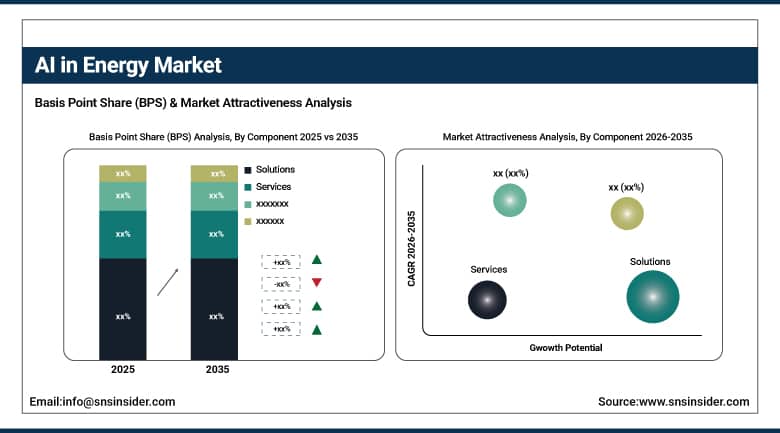
By Component, Solutions dominated with ~61% share in 2025; Services fastest growing (CAGR).
-
By End-user, Utilities dominated with ~34% share in 2025; Energy Generation fastest growing (CAGR).
-
By Application, Renewables Management dominated with ~23% share in 2025; Demand Forecasting fastest growing (CAGR).
-
By Deployment, Cloud dominated with ~61% share in 2025; Cloud fastest growing (CAGR).
By Component, Solutions dominate the AI in Energy Market, Services are expected to grow fastest
Solutions segment dominated the AI in Energy Market in 2025 due to extensive adoption of integrated AI platforms for grid optimization, predictive maintenance, asset performance management, and real-time analytics across utilities. These solutions deliver immediate efficiency gains, cost reduction, scalability, and reliability, making them preferred investments over fragmented tools globally.
Services segment is expected to grow at the fastest CAGR from 2026–2035 as energy companies increasingly seek consulting, integration, customization, training, and lifecycle management support. Rising implementation complexity, evolving regulations, continuous model tuning, and skills shortages push utilities toward long-term managed and professional AI service engagements across global energy operations.
By End-user, Utilities dominate the AI in Energy Market, Energy generation is expected to grow fastest
Utilities segment dominated the AI in Energy Market in 2025 because utilities widely deploy AI for grid monitoring, outage management, load balancing, asset optimization, and regulatory compliance. Large-scale infrastructure, centralized data availability, and critical reliability requirements accelerate AI investments across transmission and distribution networks to support stable power delivery systems.
Energy Generation segment is expected to grow at the fastest CAGR from 2026–2035 driven by rapid renewable capacity additions, hybrid power plants, and digitalized generation assets. AI adoption increases for generation forecasting, performance optimization, fuel efficiency improvement, emissions reduction, and predictive maintenance across diverse power technologies and complex operational environments.
By Application, Renewables management dominates the AI in Energy Market, Demand forecasting is expected to grow fastest
Renewables Management segment dominated the AI in Energy Market in 2025 due to rapid expansion of solar, wind, and energy storage projects worldwide. AI tools enable accurate output forecasting, curtailment reduction, asset health monitoring, and grid integration, making them essential for managing renewable variability and performance across modern power systems.
Demand Forecasting segment is expected to grow at the fastest CAGR from 2026–2035 as electrification, electric vehicle adoption, and decentralized energy resources increase consumption volatility. AI-driven forecasting supports dynamic pricing, demand response, infrastructure planning, and peak load management, helping providers maintain grid stability and efficiency under rapidly changing demand conditions.
By Deployment, Cloud dominates the AI in Energy Market and is also expected to grow fastest
Cloud segment dominated the AI in Energy Market in 2025 due to its ability to provide scalable, flexible, and cost-effective infrastructure for data storage, real-time analytics, and AI model deployment. Energy companies prefer cloud platforms for seamless integration, remote monitoring, and centralized management of large datasets. The segment is expected to grow at the fastest CAGR from 2026–2035 as adoption of advanced AI solutions, IoT connectivity, and digital energy management accelerates, enabling faster innovation and operational efficiency across utilities and energy operators.
AI in Energy Market Regional Analysis
North America AI in Energy Market Insights
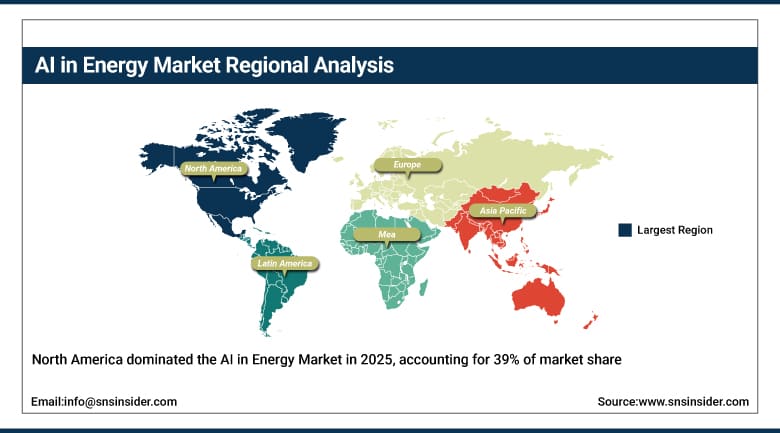
North America dominated the AI in Energy Market with the highest revenue share of about 39% in 2025 due to the presence of well-established energy infrastructure, advanced digitalization, and early adoption of AI technologies. Strong investments in smart grids, renewable integration, and AI-driven analytics by major utilities and tech companies, combined with supportive government policies and R&D initiatives, accelerated deployment, making North America the largest revenue contributor in the global AI in Energy Market.
Get Customized Report as per Your Business Requirement - Enquiry Now
Asia Pacific AI in Energy Market Insights
Asia Pacific is expected to grow at the fastest CAGR of about 15.22% from 2026–2035, driven by rapid urbanization, expanding energy demand, and increasing renewable energy installations. Rising government investments in smart grids, AI-enabled energy management, and digitalization initiatives, along with adoption by emerging utilities and industrial sectors, fuel market expansion. Growing focus on sustainability, energy efficiency, and grid modernization accelerates AI adoption across the region, making it the fastest-growing market globally.
Europe AI in Energy Market Insights
Europe in the AI in Energy Market is witnessing steady growth due to strong government support for clean energy, smart grid modernization, and energy efficiency initiatives. Widespread adoption of renewable energy, advanced digital infrastructure, and stringent regulatory frameworks drive utilities and energy companies to deploy AI for predictive maintenance, demand forecasting, and grid optimization. Investments in research, innovation, and AI-based energy management solutions further strengthen Europe’s position as a key contributor to the global AI in Energy Market.
Middle East & Africa and Latin America AI in Energy Market Insights
Middle East & Africa and Latin America in the AI in Energy Market are witnessing steady growth due to rising investments in smart grids, renewable energy projects, and digital energy management. Governments and utilities in both regions are adopting AI for predictive maintenance, demand forecasting, grid optimization, and operational efficiency. Expanding renewable capacity, sustainability initiatives, and the need for reliable, cost-effective energy systems further drive AI adoption across these emerging markets.
AI in Energy Market Competitive Landscape:
Schneider Electric
Schneider Electric is a global leader in energy management, automation, and digital solutions, serving utilities, industrial, commercial, and residential markets. Its AI-enabled EcoStruxure platform integrates software, IoT, and digital twin technologies to optimize energy efficiency, resiliency, and real-time operations. The company drives sustainable energy transformation, including smart grids, data centers, and industrial automation, by combining AI, cloud, and edge technologies for scalable, intelligent energy infrastructure worldwide.
-
At Innovation Summit North America 2025, Schneider Electric highlighted AI-powered EcoStruxure solutions to enhance grid resiliency, digital operations, and future-ready energy management.
-
Schneider Electric announced a $700M U.S. investment to expand AI-enabled energy infrastructure, grid digitization, and data center power solutions, supporting jobs and innovation.
IBM
IBM provides AI, cloud, and enterprise software solutions for energy and utilities, helping organizations leverage automation, analytics, and digital transformation. Its watsonx AI platform offers generative AI, governance, and workflow automation to optimize energy operations, asset management, and sustainability initiatives. IBM’s AI and process automation tools accelerate operational efficiency, predictive maintenance, and intelligent grid management, enabling energy companies to implement data-driven strategies for both traditional and renewable energy systems.
-
IBM study revealed 74% of energy and utility companies are adopting AI, highlighting its watsonx platform to accelerate automation and AI workflows.
Hitachi / Hitachi Energy
Hitachi Energy, part of Hitachi Group, specializes in energy infrastructure, digital grids, and automation solutions. The company integrates AI, data-driven analytics, and sustainable power technologies to optimize grid performance, data center efficiency, and renewable integration. Hitachi Energy leads in smart grid automation, energy management software, and next-generation power architectures, supporting utilities, industrial sectors, and AI-focused computing facilities with advanced 800 VDC architectures and AI-enhanced grid solutions globally.
-
Hitachi and OpenAI signed a strategic MoU to develop AI-driven data centers and grid-friendly energy infrastructure, enhancing sustainability and performance.
-
Hitachi announced 800-volt architecture for AI data centers, optimizing grid-to-rack power delivery and efficiency for large-scale AI workloads.
-
Hitachi Energy recognized as a global leader in grid automation, integrating AI solutions for advanced energy system management.
C3.ai
C3.ai is a leading enterprise AI software provider delivering AI and IoT solutions for industrial and energy sectors. Its AI applications optimize energy management, predictive maintenance, and operational efficiency for utilities, oil & gas, and manufacturing. C3.ai enables organizations to rapidly deploy AI-driven insights, accelerate sustainability initiatives, and integrate large-scale AI into complex industrial workflows, helping enterprises achieve real-time energy optimization, reduced operational costs, and accelerated digital transformation.
-
C3.ai reported record fiscal 2025 results, expanding partnerships with energy sector companies and accelerating AI applications in enterprise energy management.
AI in Energy Market Key Players
-
General Electric
-
Siemens Energy
-
ABB Ltd
-
Honeywell International
-
IBM
-
C3.ai
-
AutoGrid
-
SparkCognition
-
Uplight
-
DataRobot
-
Iberdrola
-
Tibber
-
Envision Digital
-
Hitachi Energy
-
SenseTime
-
Fujitsu
-
Origami Energy
-
ATOS SE
| Report Attributes | Details |
|---|---|
| Market Size in 2025 | USD 15.99 Billion |
| Market Size by 2035 | USD 297.36 Billion |
| CAGR | CAGR of 33.95% From 2026 to 2035 |
| Base Year | 2025 |
| Forecast Period | 2026-2035 |
| Historical Data | 2022-2024 |
| Report Scope & Coverage | Market Size, Segments Analysis, Competitive Landscape, Regional Analysis, DROC & SWOT Analysis, Forecast Outlook |
| Key Segments | • By Component (Solutions, Services) • By Application (Robotics, Renewables Management, Demand Forecasting, Safety and Security, Infrastructure, Others) • By End-user (Energy Transmission, Energy Generation, Energy Distribution, Utilities) • By Deployment (On-premises, Cloud) |
| Regional Analysis/Coverage | North America (US, Canada), Europe (Germany, UK, France, Italy, Spain, Russia, Poland, Rest of Europe), Asia Pacific (China, India, Japan, South Korea, Australia, ASEAN Countries, Rest of Asia Pacific), Middle East & Africa (UAE, Saudi Arabia, Qatar, South Africa, Rest of Middle East & Africa), Latin America (Brazil, Argentina, Mexico, Colombia, Rest of Latin America). |
| Company Profiles | General Electric, Siemens Energy, Schneider Electric, ABB Ltd, Honeywell International, IBM, C3.ai, AutoGrid, SparkCognition, Uplight, DataRobot, Iberdrola, Tibber, Samotics, Envision Digital, Hitachi Energy, SenseTime, Fujitsu, Origami Energy, ATOS SE |
Frequently Asked Questions
The AI in Energy Market is expected to grow at a CAGR of 33.95% from 2026 to 2035, driven by digitalization and AI adoption.
The AI in Energy Market was valued at USD 15.99 billion in 2025, reflecting rising adoption of smart grids, renewable integration, and energy management solutions.
Rapid adoption of smart grids, renewable energy integration, predictive maintenance, and advanced AI-based energy management solutions are key factors driving market growth.
The Solutions segment dominated the AI in Energy Market in 2025, while Services, Energy Generation, Demand Forecasting, and Cloud segments are expected to grow fastest.
North America dominated the AI in Energy Market in 2025 with about 39% revenue share due to advanced infrastructure, early AI adoption, and supportive policies.
