
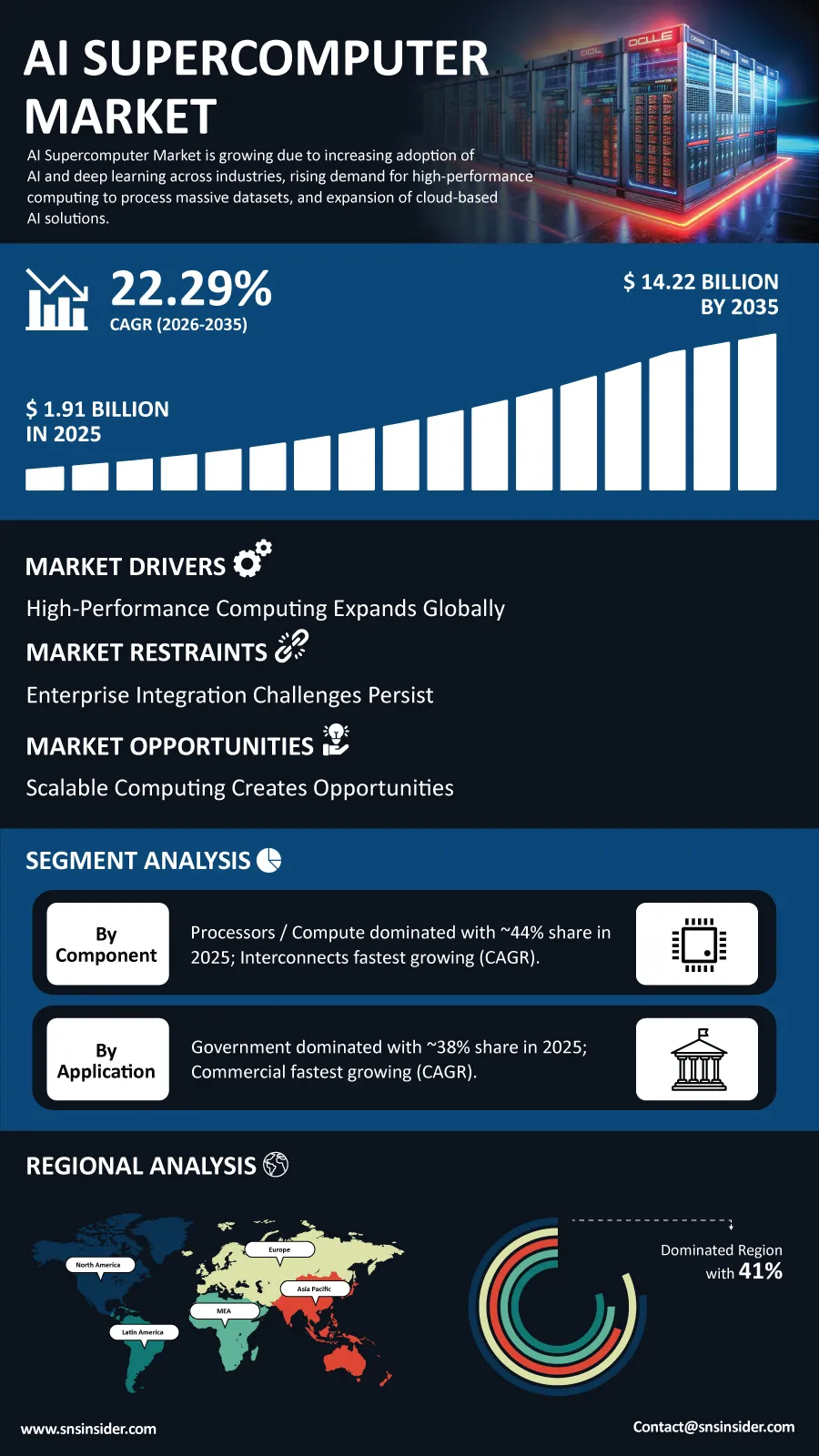
The global AI Supercomputer Market is projected to grow at incredible rate, as enterprises, research institutes and governments step-up investments in artificial intelligence infrastructure that can handle next generation computing workloads. “According to a recent study by SNS Insider, the global AI Supercomputer Market size valued at USD 1.91 billion in 2025, is anticipated to grow to USD 14.22 billion by 2035, registering a CAGR of 22.29% over the 2026–2035 forecast period.”
With the growth of generative AI, deep learning and large language models, the requirements for advanced computing systems to deal with massive amount of data at amazing speeds and efficiency are growing rapidly. AI supercomputers are helping organizations in healthcare, finance, defense, automotive and scientific research innovate faster by improving prediction abilities and reducing the time to train complex AI models.
The market is also changing thanks to an increase in cloud-based AI platforms, which allow businesses of all sizes to access high-performance computing. Organizations are continually advancing the core of their AI Infrastructure with ever more powerful GPU's, AI accelerators, high-speed networks, energy-efficient compute architectures to balance optimal operational performance and maximal scalability.
To Get Detailed Insights on the AI Supercomputer Market – Request a Sample Report
Expanding AI Infrastructure Investments Create Long-Term Growth Opportunities
Governments and tech companies are investing more cash into AI computing infrastructure than ever before to boost national competitiveness, accelerate scientific discovery, and fight back against our digital transformation. AI supercomputers for climate modeling, genomics, advanced manufacturing, cybersecurity and autonomous technologies are being deployed at scale unlocking opportunities for hardware manufacturers and cloud providers.
Cloud service providers are enhancing specialized environments for AI supercomputing that enterprises can tap into without making major capital investments. This transformation is empowering enterprises to expedite AI development, scale machine learning workloads and deploy sophisticated analytics applications faster across a multitude of industries.
Simultaneously, rapid innovation in communication- and computation fabrics – from high-bandwidth memory to sophisticated interconnects, and specialized AI chips – delivers significant advancements in computational performance, energy efficiency, and workload optimization. Such Growth is expected to facilitate wider adoption of AI Supercomputing Platforms across the forecast period.
Key Market Insights Highlight Shifting Demand Patterns
On the basis of component, Processors / Compute is expected to remain as the biggest segment in termsOf revenues globally by accounting for close to 44% revenues share in global Market opportunityin 2025 due to their vital role in enhancing performance of deep learning, neuralnetwork training and complex compute workloads. Through 2035, the Interconnects segment is anticipated to grow at the fastest rate as more organizations will need ultra-high-speed communication between computing nodes to help enable sizable-scale AI processing.
Based on application, the Government segment is expected to hold nearly 38% share of market revenue in 2025 with large scale investment being made in the field of defense modernization, scientific research, cybersecurity and national AI strategy. Based on Application, the Commercial segment is expected to witness fastest growth during the forecast period as businesses are ramping up adoption of generative AI, computer vision, predictive analytics, and intelligent automation across business operations.
From the view of end user, Government & Public Sector led the market with nearly 29% share in 2025 on account of continuous investments toward high-performance computing for public research, defense as well as large-scale data processing. AI supercomputers supporting drug discovery, genomics research, disease modeling and precision medicine initiatives are projected to drive the fastest growth for Healthcare & Life Sciences through 2035. A breakdown of the global AI Infrastructure market on the basis of deployment type shows Cloud to be the leading segment with nearly 61% revenue share in 2025 and forecast to continue as fastest-growing model as organizations favor scalable, flexible, and cost-efficient AI computing environment process.
Advanced Computing Technologies Accelerate Industry Transformation
New technology of AI supercomputing is upgrading fast, when manufacturers launching Next-Generation processors and AI accelerators along with high-performance networking solutions that allow trillions-parameter AI models. Progress in GPU architectures, memory bandwidth, parallelism and using intelligent workload management is accelerating the pace of AI training while lowering its operating complexity.
In addition, technology providers are tying AI supercomputers together with cloud-native software platforms, orchestration tools and automated resource management systems in order to increase scalability and computational efficiency. These innovations are enabling organizations to speed up research, shorten model development lifecycles, and make more efficient use of infrastructure as AI environments become more complex.
North America Held Approximately 41% of the AI Supercomputer Market Share in 2025; Asia Pacific Projected to Register the Fastest CAGR Through 2035
North America is projected to hold an estimated 41 percent of total market revenue in 2025, due to the presence of key AI technology companies, top-notch research institutions, advanced cloud infrastructure and significant public and private investment into artificial intelligence. The region continues to drive worldwide usag of AI supercomputing for commercial, government, and scientific applications.
Asia Pacific is anticipated to emerge as the fastest growing regional market during 2035, with increase in investments for AI research, ongoing digital transformation, development of semiconductor capabilities, and government policies encouraging high-performance computing in China, Japan, South Korea and India. Increasing enterprise deployment of AI technologies is expected to augment the regional demand.
Europe is likewise holding its ground with continued investments in supercomputing, health care innovation, industrial AI and collaborative research. In the meantime, with countries in Middle East & Africa has increased investments towards AI infrastructure and digital modernization initiatives to build capabilities towards smart cities and research.
Industry Participants Focus on Innovation and Next-Generation AI Computing Platforms
The competitive landscape is still quite fluid, with mega-vendors simultaneously investing in next-generation AI processors, cloud-native supercomputing platforms, high-speed networking technologies and energy-efficient computing architectures. Data scientists, such as those in the industry are being supported to meet rapid growth in demand for AI model training, scientific simulations and deployment at scale of AI throughout enterprises through strategic partnerships, product innovation and trillions of dollars worth of infrastructure investment taking place.
Key companies operating in the global AI Supercomputer Market include NVIDIA Corporation, IBM Corporation, Hewlett Packard Enterprise (HPE), Dell Inc., Fujitsu Limited, Lenovo, Atos SE, NEC Corporation, Penguin Solutions, INSPUR Co., Ltd., Intel Corporation, Advanced Micro Devices (AMD), Cerebras Systems, Huawei Technologies, Google LLC, Meta Platforms Inc., Amazon Web Services (AWS), Samsung Electronics, Oracle Corporation, and Micron Technology.
An SNS Insider analyst Sakshi Kale commented, “The rapid expansion of generative AI, scientific computing, and cloud-based AI services is fundamentally reshaping the global high-performance computing landscape. Organizations investing in scalable AI supercomputing infrastructure, advanced processor technologies, and intelligent computing platforms will be well positioned to capitalize on accelerating demand for next-generation artificial intelligence applications across industries.”
About the Author

Get in touch




