
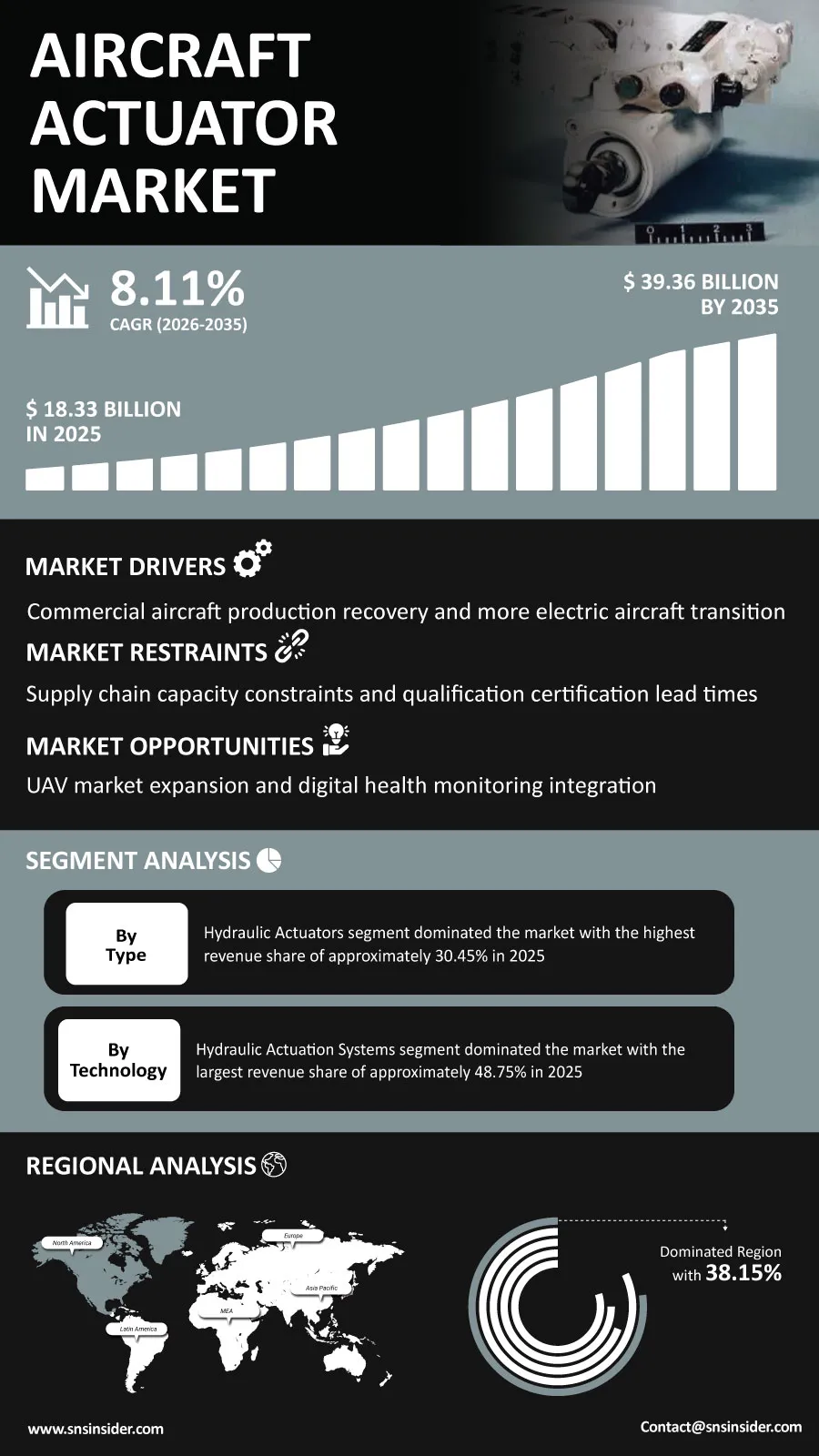
The global Aircraft Actuator Market is gaining momentum as aerospace manufacturers prioritize lighter, smarter, and more efficient flight-control architectures across commercial and military platforms. “According to a recent study by SNS Insider, the global Aircraft Actuator Market size valued at USD 18.33 Billion in 2025, is anticipated to grow to USD 39.36 Billion by 2035, registering a CAGR of 8.11% over the 2026–2035 forecast period.”
The resurgence of aircraft manufacturing, the growth in defense spending, and higher demand for unmanned aerial vehicles have created a good environment for the producers of actuators. On the other hand, aerospace engineering is slowly turning towards more electric systems that could potentially decrease dependency on centralized hydraulics.
Highly reliable actuators are required in modern aircraft in order to achieve control for moving parts on flight surfaces, landing gear, engine controls, and other parts. This wide range of applications allows the manufacture of actuators to be involved in multiple aspects.
To Get Detailed Insights on the Aircraft Actuator Market – Request a Sample Report
Aircraft Production Recovery and Electrification Open New Growth Opportunities
Aerospace companies are looking to ramp up their manufacturing capacities to accommodate the growing requirement from airliners for aircraft capable of carrying greater numbers of passengers and for replacements in their fleets. Increased delivery of narrow-body and wide-body planes is resulting in increased demand for actuation components that are utilized in the airframe and propulsion systems.
One area that is providing an added opportunity in the field is that of more electric aircraft. Electro-mechanical and electro-hydrostatic systems offer benefits of local actuation, less fluid dependency, and improved diagnostics. This is motivating aerospace companies to consider electric solutions for applications where weight and reliability are important factors.
Modernization of the defense sector is also driving growth in the market. Combat aircraft, military transport planes, advanced rotary-wing aircraft, and unmanned platforms need actuation components that are compact and capable of offering accurate movements in difficult operating environments.
Key Market Insights Highlight Technology and Platform Shifts
By type, hydraulic actuators accounted for 30.45% of market revenue in 2025, reflecting their extensive presence across existing aircraft architectures. Electro-hydrostatic actuators (EHA) are forecast to record the fastest growth, advancing at a 9.36% CAGR through 2035 as aerospace manufacturers pursue more-electric system designs.
Based on technology, in 2025, the hydraulic actuation system held a dominant market share of 48.75%. It is predicted that the electrical actuation system will witness rapid growth, with a CAGR of 8.57%, owing to their efficiency and connectivity with digital systems.
By application, flight control systems held a market share of 35.41% in 2025. The engine control systems segment is expected to be the fastest growth rate of 9.40% CAGR, driven by advancements in propulsion system and precise control technologies.
By platform, the commercial aircraft segment constituted 45.16% of market revenues in 2025. The military aircraft segment is forecast to register the highest CAGR of 7.57% owing to modernization of the defense fleets and introduction of new combat aircraft programs.
Smart Monitoring and Electric Architectures Accelerate Aerospace Transformation
Actuator design technology is advancing from simple mechanical actuation to more complex sensor-based and connectivity-focused systems. The use of sensors and monitoring systems will enable the detection of component problems before they become serious failures.
This technology is especially useful in aviation for the purposes of increasing fleet availability and reducing costs of maintenance. Digital actuators may provide data on the operation cycles, load factors, wearing process, and overall health of each part, making maintenance work more efficient.
The combination of electrification, lightweight engineering, and onboard diagnostics is expected to remain a defining technological direction for the industry through 2035.
North America Accounted for 38.15% Market Share in 2025; Asia Pacific Forecast to Expand at an 8.83% CAGR by 2035
The North American region dominated the regional landscape in 2025 with 38.15% of global revenues owing to its wide presence of aerospace industry players, sizeable commercial aircraft fleet, government defense procurements, and the presence of major players dealing in actuator technologies.
Asia-Pacific is expected to witness the highest growth among regional markets, growing at a CAGR of 8.83% during 2025-2035 owing to rising demand for air travel services, rising aircraft fleet size, government spending on defense, and development of aerospace industry in nations like China, Japan, South Korea, and Australia, among others.
Europe continues to remain a significant aerospace hub through its strong presence in commercial aircraft manufacturing and defense, whereas the Middle Eastern region will benefit from the rising number of aircraft fleets and investment in aviation infrastructure. Latin America will also grow at a stable pace due to the replacement of existing aircraft fleets.
Industry Participants Invest in Next-Generation Actuation Solutions Globally
Competition in the Aircraft Actuator Market is increasingly driven by technology innovation, production capability, reliability, and involvement in aerospace programs. Companies are building their product lines on technologies such as hydraulics, electro-mechanics, and electro-hydrostatics, with digital health management for future models.
Key companies operating in the global Aircraft Actuator Market include Moog Inc., Parker Hannifin Corporation, Collins Aerospace, Safran S.A., Honeywell International Inc., Woodward Inc., Liebherr-Aerospace, Eaton Corporation, Curtiss-Wright Corporation, Crane Aerospace & Electronics, Meggitt PLC, Triumph Group Inc., Ametek Inc., Sitec Aerospace GmbH, Arkwin Industries Inc., Electromech Technologies, Microtecnica S.r.l., Kyntronics Inc., Nook Industries Inc., and AeroControlex Group.
An SNS Insider analyst Santosh Bhul commented, “The aerospace industry's movement toward electrified architectures, combined with renewed aircraft production and defense modernization, is creating a strong long-term environment for actuator technologies. Suppliers capable of delivering lightweight, reliable, digitally monitored, and highly efficient systems will be well positioned to capture emerging opportunities across commercial, defense, and unmanned aviation.”
About the Author

Get in touch




