
The global Aircraft Cabin Interior Market is moving into a sustained modernization cycle as airlines seek to differentiate passenger experiences while improving aircraft efficiency. “According to a recent study by SNS Insider, the global Aircraft Cabin Interior Market size valued at USD 32.05 Billion in 2025, is anticipated to grow to USD 49.80 Billion by 2035, registering a CAGR of 4.51% over the 2026–2035 forecast period.”
Airlines are increasingly recognizing cabin interiors as commercial assets and aviation requirements. Seats, communications infrastructure, lighting, storage and galleys are now all being redesigned for greater comfort, increased space, reduced weight, and improved travel experience. The process of upgrading existing fleets has provided another avenue of revenue for cabin interior manufacturers apart from the manufacturing of new planes.
To Get Detailed Insights on the Aircraft Cabin Interior Market – Request a Sample Report
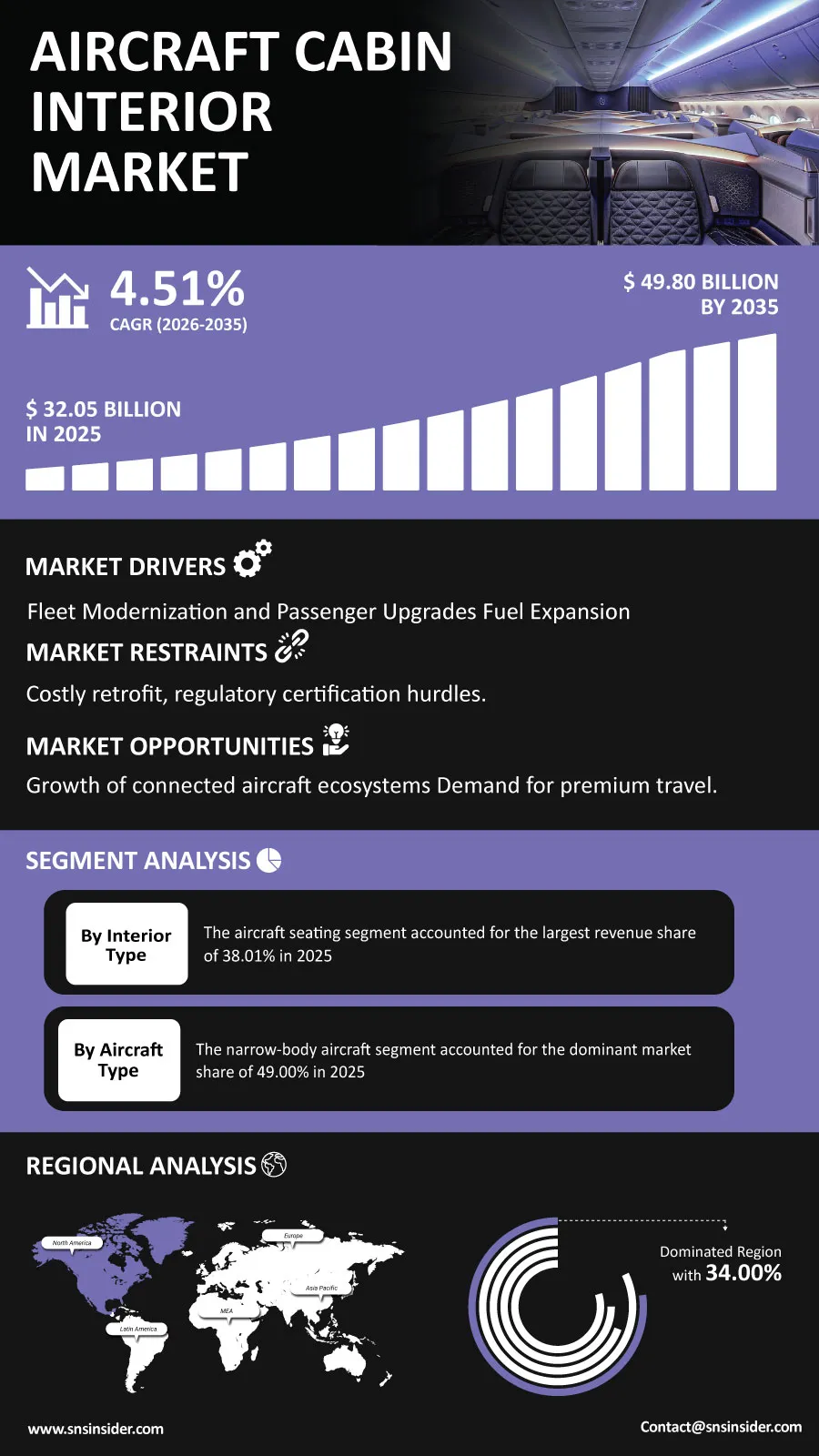
Fleet Modernization and Premium Travel Create New Market Opportunities
Airline fleet upgradation is still a very important reason for purchases of modern cabin equipment. There are still large backlogs for manufacturers of airplanes to deliver orders, and airlines should keep operating their existing aircraft by maintaining and upgrading them. This provides good chances for producers of retrofit-friendly products and solutions.
The expectations of passengers are also affecting procurement processes. Premium Economy and Business Class passengers demand spacious seats, individual lighting, connectivity on board and entertainment services. Simultaneously, low-cost carriers and narrow body aircraft operators are searching for cabin designs with higher capacity but not at the expense of passenger satisfaction.
Another promising area for research is connected cabin systems. Through digital platforms, it will be possible to control lighting, entertainment, environment, and passenger services, thereby giving the airline the ability to create a responsive cabin environment and collect useful data.
Key Market Insights Highlight Shifting Cabin Investment Priorities
By interior type, the share of the aircraft seating market was 38.01% of total revenues in 2025. Aircraft deliveries, replacements, and demands for lightweight seating will keep driving this market segment in the future. At the same time, IFEC is forecasted to be the fastest-growing market segment with 6.50% CAGR until 2035, as passengers require digital access to the internet.
Based on aircraft type, narrow body aircraft was at the forefront with a market share of 49.00%. The high use of narrow-body aircraft in domestic and regional operations has driven a need for seating enhancements and cabin fittings. The regional and business aircraft are predicted to have the highest CAGR of 5.07% owing to personalized cabin services and luxury.
By end user, commercial airlines accounted for 79.00% of the market share in 2025. Growth in fleet, traffic, and maintenance keeps the airlines as the major buyers in the market. The business aviation segment is expected to record the highest growth rate at a CAGR of 6.27% due to increasing preferences for luxury interiors and onboard connectivity.
Connected Cabin Technologies Accelerate Industry Transformation
Aircraft interiors are also becoming more technologically advanced, with digital cabins, intelligent lighting, fast Internet connectivity, and automated passenger service technologies becoming the future of the industry.
Another technology that becomes increasingly popular due to its potential in decreasing aircraft weight and increasing its efficiency is lightweight composite materials. Modular galleys, optimized seating, advanced lighting, and connected entertainment systems can help operators to bring their cabins into the future while dealing with the installation issues.
It is happening in parallel with promising demand outlooks in the aircraft industry. According to Boeing, 43,625 new commercial jetliners will be delivered during 2026 to 2045 period, most of them being single-aisle jets.
North America Accounted for 34% Market Share in 2025; Asia Pacific Forecast to Expand at a 6.94% CAGR by 2035
The North American region represented approximately 34.00% of the global market share revenue in 2025 due to extensive presence of airlines, well-established aerospace industry, and substantial retrofitting.
The Asia Pacific region is expected to be the fastest-growing region with a CAGR of 6.94% between 2026 and 2035. Increasing air travel, procurement of aircrafts, LCC fleets, and increasing demands from China, India, Japan, and Southeast Asian countries present immense opportunity for suppliers of cabin products.
Europe is a key market region due to the highly developed aerospace ecosystem and focus on energy-efficient and sustainable aircraft systems. At the same time, Middle Eastern airlines keep up their investments in premium cabins, and Latin American airlines continue their modernization efforts.
Industry Participants Focus on Lightweight, Connected and Premium Cabin Solutions to Compete in the Market Globally
The competitive landscape remains dynamic as suppliers work toward designing lighter, smarter seats and cabin configurations, as well as improved connectivity. The increasing trend among suppliers is the combination of traditional cabin interiors production methods with digital tools.
Key companies operating in the global Aircraft Cabin Interior Market include Safran SA, Collins Aerospace, Panasonic Avionics Corporation, Thales Group, Diehl Aviation, RECARO Aircraft Seating GmbH & Co. KG, Gogo Inc., JAMCO Corporation, ST Engineering Aerospace, Lufthansa Technik AG, Astronics Corporation, Honeywell International Inc., Geven S.p.A., Aviointeriors S.p.A., FACC AG, Airbus SE, Boeing Company, Acro Aircraft Seating Ltd., Haeco Group, and Cobham Aerospace Communications.
An SNS Insider analyst Santosh Bhul commented, “The next phase of aircraft cabin development will be shaped by the convergence of lightweight engineering, digital connectivity, premium passenger services, and fleet modernization. Suppliers capable of delivering certified, scalable, and technology-enabled cabin solutions will be positioned to capture opportunities created by both new aircraft deliveries and the growing global retrofit cycle.”
About the Author

Get in touch




