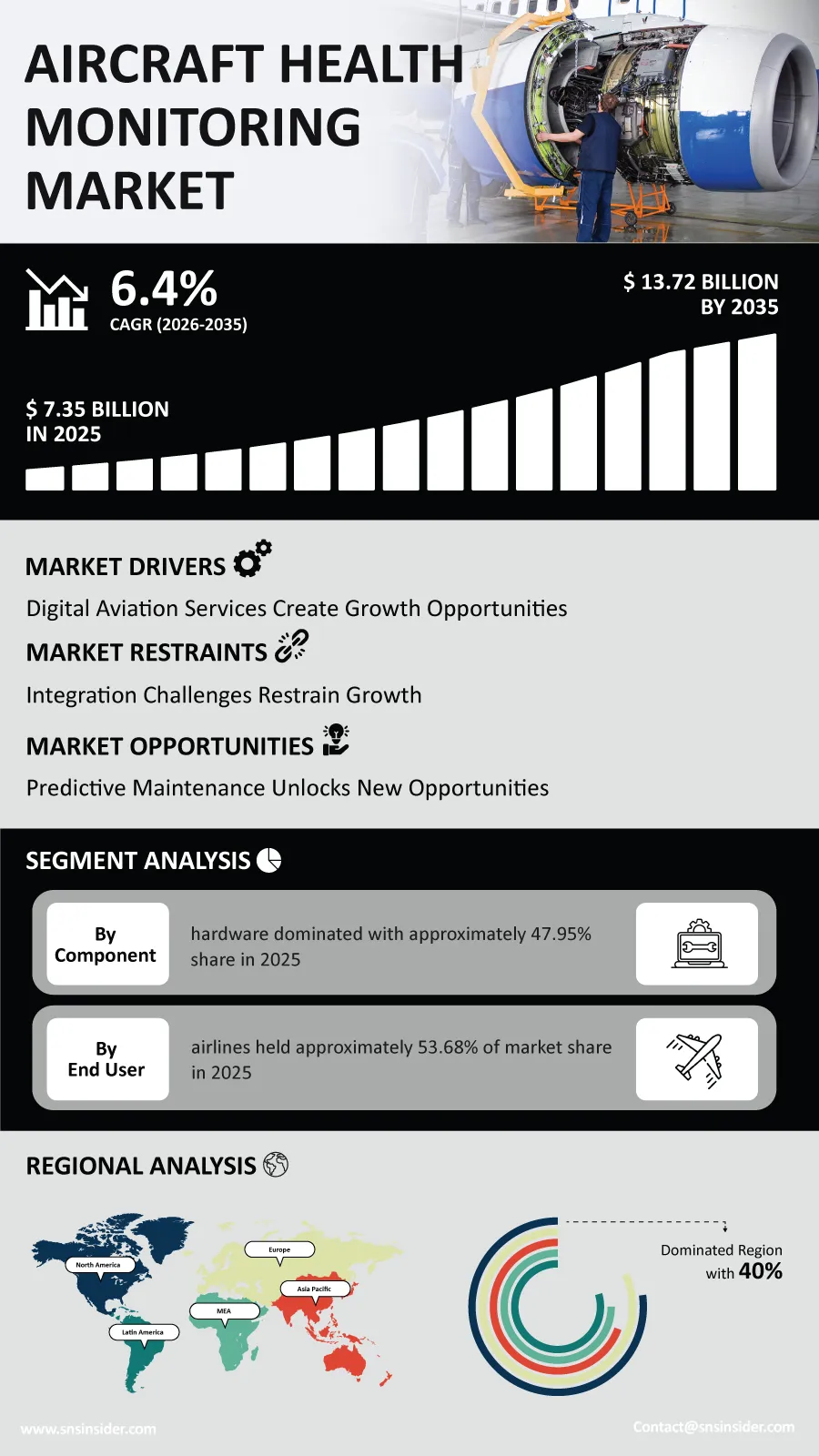
Aircraft Health Monitoring Market Details and Growth DriversOver the next ten years, a surge in investments aimed at improving fleet reliability through advanced predictive maintenance techniques is anticipated to drive steady growth of the global Aircraft Health Monitoring market. “According to a recent study by SNS Insider, the global Aircraft Health Monitoring Market size valued at USD 7.35 billion in 2025, is anticipated to grow to USD 13.72 billion by 2035, registering a CAGR of 86.4% over the 2026–2035 forecast period.”
As commercial aviation recovers and fleet utilization climbs, operators are focusing their attention on technologies that can identify what equipment may be an issue before it reaches the flight schedule. Real-time diagnostics through aircraft health monitoring solutions allow for better maintenance planning and extend the operational life of mission-critical aircraft systems, which are an integral part of digital aviation strategies.
Increasing digitalization across the airline network, alongside a rising implementation of connected aircraft technologies, is providing an impetus to demand for intelligent monitoring platforms that can utilize operational data to inform actionable maintenance intelligence.
To Get Detailed Insights on the Aircraft Health Monitoring Market – Request a Sample Report
Predictive Maintenance Technologies Create New Opportunities Across Aviation
Unknown to many in the general public, airlines around the world are updating maintenance operations (with a goal of improved operational efficiency and minimum/alternate unscheduled aircraft ground time). With latest technology support like AI, Cloud Analytics and built-in sensors, sophisticated monitoring setups are allowing maintenance teams to shift from reactive repairs towards condition-based assessments.
The shift is opening new paths for software providers, avionics OEMs and aircraft OEMs alike as digital maintenance ecosystems emerge during the aircraft lifecycle. Mechanics can also access aircraft performance data remotely from cloud-based monitoring platforms, enhancing fleet management for dispersed operations.
Increasing investments to establish commercial aviation infrastructure, fleet modernization programs and digital transformation initiatives are projected to make a positive contribution towards sustaining demand for aircraft health monitoring technologies across the forecast period.
Key Market Insights Reflect Evolving Industry Priorities
Of market components, hardware contributed 47.95% to total market revenue in 2025, bolstered by mass implementation of sensors, onboard monitoring technology and data acquisition systems across commercial aircraft fleets.
On the other hand, software is estimated to be the fastest growing segment with a CAGR of 8.18% until 2035 as airlines increasingly adopt AI driven analytics and cloud-based maintenance platforms.
Based on the installation type, the line-fit systems covered 61.88% of market revenue in 2025 owing to their integration during aircraft manufacturing and long-term operational advantages. But retrofit installations are anticipated to witness the fastest growth rate, due to the modernization of current airline fleets.
In 2025, airlines contributed 53.68% of total market revenue from the end-user side as carriers continued to invest in technologies enhancing fleet availability and maintenance performance. Predictive Maintenance Services will be increasingly integrated with aircraft support operations, allowing MRO providers to achieve the fastest growth.
Aircraft subsystems maintained the highest share of revenue contribution in the aeropropulsion monitoring market at 41.85% share in 2025, while advanced avionics have been continuously evolving alongside digital aircraft development to keep pace with rapidly evolving demands for monitoring solutions.
Digital Aviation Strategies Strengthen Long-Term Market Outlook
A wider shift across aviation towards connected aircraft ecosystems, factory automation and data-centric operational management is underway. They are highly valuable as they improve the scheduling of maintenance, optimized spare parts inventory and fleet performance.
Manufacturers are also taking health monitoring systems to the next level, bringing in advanced analytics, machine learning and predictive algorithms that allow for early detection of component degradation – before it leads to an operational failure. These innovations keep both compliance and operations on track while saving airlines among the prominent costs related to maintenance.
An increased proliferation of unmanned aerial vehicles, advanced air mobility platforms and next-generation commercial aircraft will spur greater demand for scalable monitoring technologies in the 2020s decade.
North America Accounted for 40% Market Share in 2025; Asia Pacific Forecast to Expand at the Fastest Pace Through 2035
North America is estimated to hold ~40% of the global Aircraft Health Monitoring Market share in 2025 due to its enormous commercial aircraft fleet, mature aerospace ecosystem, stringent aviation safety standards, and early adoption of digital maintenance technologies.
Asia Pacific is expected to continue the fast growing trend in relative market size as compared across regions mainly resulting from growth in airline fleets, demand for more capacity and rising passenger traffic coupled with increasing aircraft deliveries along high value investments on aviation infrastructure by emerging economies like China and India até 2035.
The demand for predictive maintenance is also likely to accelerate with the continued investment of airlines and governments into fleet expansion and aviation safety in both developed and developing aviation markets.
Industry Leaders Accelerate Innovation Across Digital Maintenance Solutions
The competition in the Aircraft Health Monitoring Market is adaptable as technology providers for aerospace increase investments in artificial intelligence, cloud computing, advanced sensing technologies and predictive analytics. Firms are notably forging strategic alliances and implementing complex digital maintenance platforms that are intended to enhance operational reliability and facilitate life-cycle support of fleets over the long term.
Key companies operating in the global Aircraft Health Monitoring Market include Honeywell International Inc., The Boeing Company (AnalytX), Airbus SE (Skywise), GE Aerospace (HealthAware), RTX Corporation, Safran S.A., Rolls-Royce Holdings plc, Lufthansa Technik AG, Curtiss-Wright Corporation, Meggitt PLC (Parker Hannifin), Teledyne Technologies Inc., FLYHT Aerospace Solutions Ltd., Collins Aerospace, Acellent Technologies Inc., Embraer S.A., Tech Mahindra Limited, MTU Aero Engines AG, Liebherr-Aerospace, Crane Aerospace & Electronics, and Ventura Aerospace Inc.
An SNS Insider analyst Santosh Bhul commented, "The aviation industry's continued focus on predictive maintenance, operational reliability, and digital fleet management is accelerating adoption of aircraft health monitoring technologies worldwide. Organizations investing in AI-driven analytics, connected aircraft platforms, and advanced diagnostic capabilities will be well positioned to support the next generation of safer and more efficient aviation operations."
About the Author

Get in touch