
AI in Animal Health Market is entering a period of rapid technological adoption as more and more veterinarians, livestock producers, and animal health firms are relying on the power of artificial intelligence to analyze clinical data, behavior patterns, imaging, and production-related information. This is going to create innovative applications in diagnostics, disease monitoring, reproduction, and precision livestock farming.
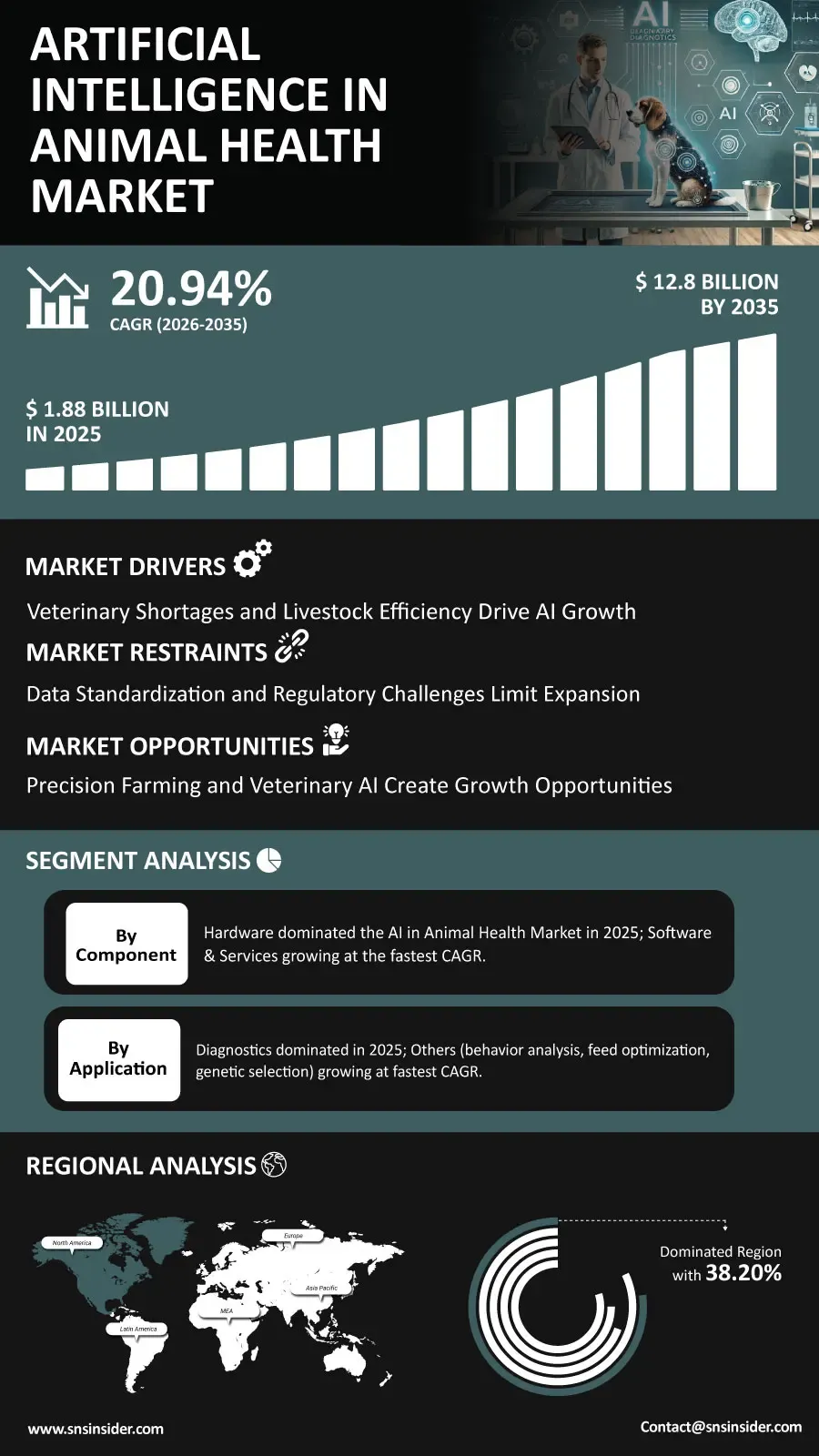
According to a recent study by SNS Insider, the global AI in Animal Health Market size valued at USD 1.88 billion in 2025, is anticipated to grow to USD 12.8 billion by 2035, registering a CAGR of 20.94% over the 2026–2035 forecast period. Growing constraints on veterinary resources, the requirement to enhance productivity in livestock, and increased accessibility of animal-tracking technologies are leading to more investments in artificial intelligence-based solutions.
To Get Detailed Insights on the Artificial Intelligence in Animal Health Market – Request a Sample Report
Veterinary Technology Moves Toward Continuous Monitoring
Animal health data collection and analysis are being transformed by AI applications. There is potential to create big data from wearable sensors, image processing software, camera surveillance, electronic databases, and intelligent farming machines in order to extract patterns related to disease, reproductive status, mobility, and changes in behavior.
In veterinary practice, AI-based image processing systems and clinical decision support systems can be used to determine priorities and abnormal findings for professional assessment. On farms, automatic monitoring can offer timely alerts about the health and productivity of animals.
Diagnostics Lead While Software Gains Momentum
Hardware was the biggest portion among component segments in 2025, owing to the high demand for sensors, imaging equipment, monitoring devices, and smart agriculture systems that supply the necessary data for AI-based solutions. Software & Services is estimated to experience the highest CAGR as vendors gradually transform unstructured data on animal health into actionable insights without need for changing hardware.
Diagnostics led the market among applications in 2025. The analysis of veterinary imaging, lab tests, and other clinical data using artificial intelligence technologies is a promising sector for the development of innovative technologies. Others, which include behavioral analysis, feeding optimization, genetic selection, and reproductive management, is estimated to grow at the fastest rate due to growing use of AI beyond standard diagnostics.
Companion Animals was the biggest share holder among animal types in 2025, while Production Animals is expected to be the fastest growing segment due to the need for higher efficiency, disease prevention, and herd management among livestock farmers.
Workforce Constraints Strengthen the Business Case
Lack of sufficient veterinary staff is contributing to increased needs for technology that can expand the capability of professionals. According to the American Veterinary Medical Association, there is a shortage of veterinarians in the United States and the shortage is anticipated to continue until 2030. AI solutions can help analyze data and conduct triaging while allowing professionals to make decisions.
This technology is also generating interest among livestock farmers who are looking for ways to improve their control over feed usage, reproduction, welfare, and diseases. Such applications may prove to be economically advantageous if automated surveillance helps detect issues early on.
North America Maintains Market Leadership
North America had the biggest regional share in 2025 owing to its well-developed infrastructure, considerable expenditure on pet healthcare, and active participation of animal health and diagnostic firms. The U.S. was responsible for around 88% of North American revenues.
The U.S. Artificial Intelligence in Animal Health Market size was estimated to be around USD 0.42 billion in 2025 and is projected to grow at a 20.94% CAGR from 2026 to 2035. Such companies as Zoetis, IDEXX Laboratories, and Elanco are working towards the emergence of technologically advanced animal health solutions.
Asia-Pacific is turning into one of the most important markets for the AI in Animal Health Industry. China made up about 42% of the region's revenues. Livestock industry and the introduction of digital agricultural technologies offer opportunities for monitoring and disease management via AI.
Europe is also growing due to the UK taking about 27% of regional revenues. Israel had about 40% of Middle East & Africa revenues, whereas Brazil provided around 50% of Latin American revenues thanks to its agricultural and livestock industries.
New Applications Expand the Opportunity
AI-assisted reproductive tracking, precision feeding, biosurveillance, and veterinary telemedicine have expanded the addressable market for the industry. Integrated systems can leverage data on animal behavior, environmental factors, production data, and clinical data in making informed decisions.
There is also the potential for aquaculture, especially when using automated systems to monitor the feeding habits, signs of disease, mortality, and parasites. With reduced costs of sensors and advances in computer vision technology, there could be wider use of AI among different species.
Technology Providers Intensify Competition
Recent industry activity reflects growing investment in AI-enabled animal health platforms. IDEXX Laboratories, Zoetis, Connecterra, and other technology providers are developing solutions spanning diagnostics, livestock monitoring, veterinary workflow support, and precision agriculture.
Leading companies in the global AI in Animal Health Market include Zoetis Inc., IDEXX Laboratories Inc., Elanco Animal Health Inc., Merck Animal Health (MSD), Boehringer Ingelheim Animal Health, Connecterra BV, Afimilk Ltd., SoundTalks NV, Cainthus Ltd., CattleEye Ltd., Allflex Livestock Intelligence (MSD), HerdDogg Inc., PathAI, Vet-AI Inc., Animana (IDEXX), DeLaval International AB, Lely Industries NV, SCR by Allflex, Smartbow GmbH (Zoetis), and VetMedData Ltd.
An SNS Insider analyst Parry Kardani commented, “Artificial intelligence is becoming an important layer within modern animal healthcare, connecting diagnostics, monitoring, and farm-management data. The strongest opportunities will emerge where AI delivers measurable improvements in clinical efficiency, animal welfare, disease prevention, or production economics while keeping veterinary expertise central to decision-making.”
About the Author

Get in touch




