The Petrochemical Packaging Market is on a steady growth path through 2035, as expanding production capacity and growing specialty chemical demand continue reshaping packaging requirements worldwide.
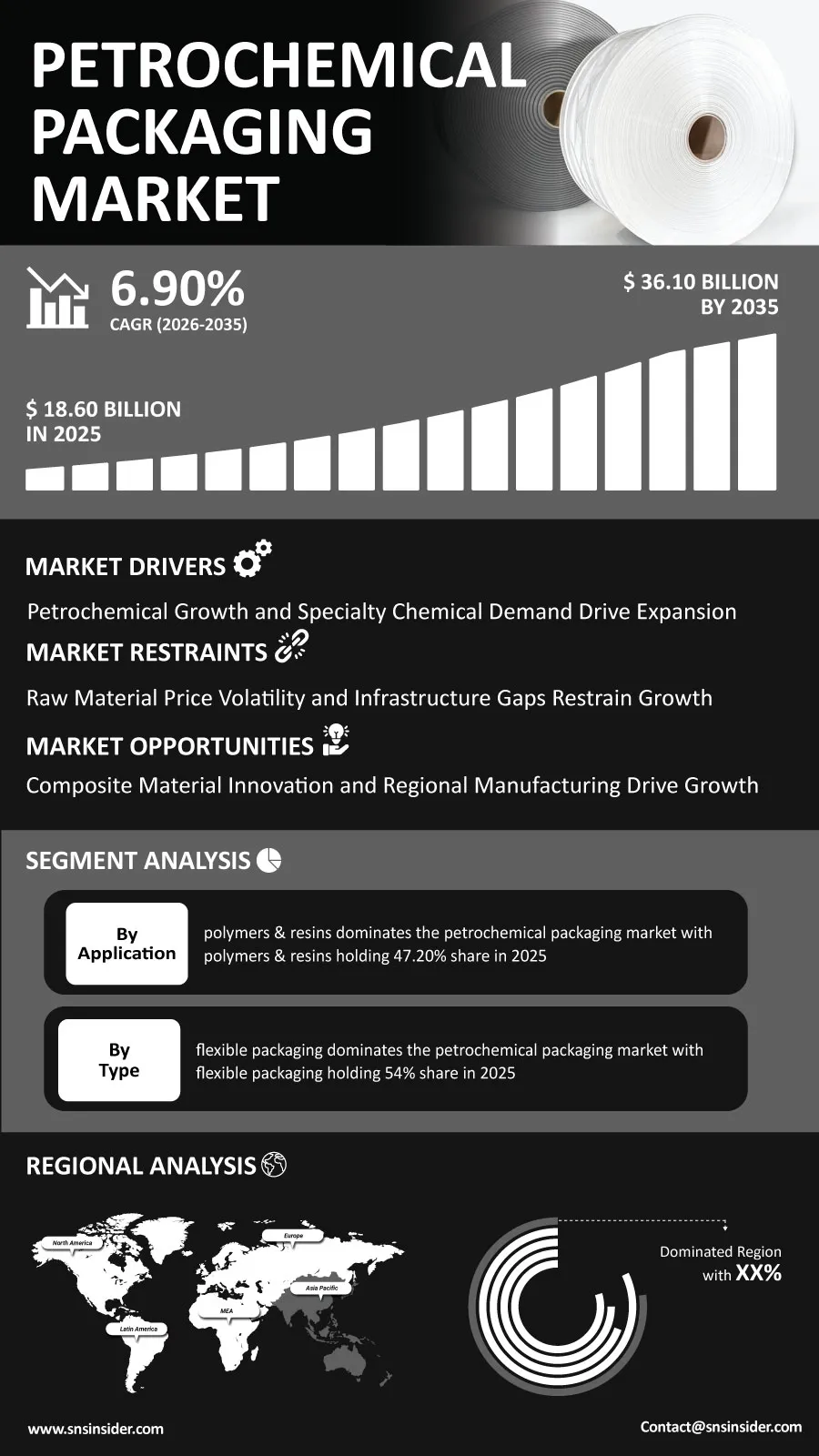
“According to a recent study by SNS Insider, the Petrochemical Packaging Market size valued at USD 18.60 billion in 2025, is anticipated to grow to USD 36.10 billion by 2035, registering a CAGR of 6.90% over the 2026-2035 forecast period.”
Petrochemicals are genuinely difficult cargo, often flammable, corrosive, or reactive in ways that demand packaging engineered specifically for that risk rather than adapted from more general industrial formats. That heightened bar has made petrochemical packaging a genuine proving ground for material and container design innovation across the chemical industry.
Specialty petrochemicals, more than any single new application, are reshaping demand within this market right now, as electronics and pharmaceutical producers increasingly require customized containment that bulk commodity packaging was never designed to provide.
To Get Detailed Insights on the Petrochemical Packaging Market – Request a Sample Report
Composite Materials Reshape Container Design Standards
Where single-material containers once dominated petrochemical packaging by default, composite designs combining plastic's chemical resistance with steel's structural durability are increasingly capturing manufacturer investment.
This shift is changing how packaging suppliers approach product development, since chemical compatibility and structural performance now both have to be engineered into a single container rather than achieved through material choice alone.
Companies that are early adopters of composite material manufacturing technology stand to gain the advantage of getting business from chemical companies in need of a superior product.
Key Market Findings Highlight High-Growth Segments
Polymers & Resins held the largest share of the Petrochemical Packaging Market in 2025, at 47.20%, reflecting the sheer scale and diversity of chemical manufacturing this packaging category serves.
Specialty petrochemicals is the fastest-growing application, expanding at a 7.20% CAGR, pulled forward by electronics and pharmaceutical industries requiring customized containment solutions.
By type, flexible packaging led with 54% share in 2025, while rigid packaging is growing fastest, at a 7.60% CAGR, as bulk chemical producers favor durable, reusable drums and IBCs.
Plastic remained the dominant material at 58% share, but composite materials are climbing fastest, at an 8.40% CAGR, as chemical producers seek hybrid chemical resistance and structural durability.
Certification Depth and Reconditioning Capability Anchor Competitive Positioning
Chemical producers are increasingly evaluating packaging suppliers on certification depth and reconditioning capability nearly as much as on unit price, particularly for higher-value specialty formulations.
Investment in automated production and closed-loop reconditioning infrastructure is becoming a genuine competitive differentiator among larger suppliers, while smaller regional players without that investment increasingly compete only on price.
This divide is expected to sharpen further as chemical producers consolidate their packaging sourcing with fewer, more capable suppliers.
Asia Pacific Leads as Middle East & Africa Grows Fastest
Asia Pacific holds the largest share of global market revenue, driven by the growing transportation of petrochemicals across China and India's massive manufacturing base. The Middle East & Africa region, meanwhile, is growing fastest, at a 7.20% CAGR, powered by expanding petrochemical production capacity and export activity across the Gulf states.
North America holds a steady, mature share as well, anchored by a well-established petrochemical industry and advanced logistics infrastructure concentrated along the U.S. Gulf Coast.
Leading Companies Drive Innovation and Competition
Competition in this market centers on certification capability, reconditioning infrastructure, and regional manufacturing scale nearly as much as on unit pricing, with major players investing in automated production to differentiate.
Some of the major companies that operate in the global petrochemical packaging market are Greif, Inc., Mauser Packaging Solutions, SCHÜTZ GmbH & Co. KGaA, Balmer Lawrie & Co. Ltd., Time Technoplast Ltd., TPL Plastech Ltd., Mondi Group, Amcor plc.
An SNS Insider Analyst Himanshu Sharma commented, “Petrochemical packaging has become a genuine proving ground for container innovation, and the suppliers capturing the fastest-growing parts of this market are the ones treating composite material design and reconditioning capability as competitive advantages rather than back-office logistics. As specialty chemical production keeps expanding globally, packaging suppliers with strong regional manufacturing and certification capability are best positioned to lead.”
About the Author

Get in touch