A device small enough to disappear inside a nursing bra has fundamentally changed what breastfeeding compatibility with a working life can look like. "According to a recent study by SNS Insider, the global Wearable Breast Pumps Market, valued at USD 600.19 million in 2025, is projected to reach USD 1,180.85 million by 2035, registering a CAGR of 7.00% across the 2026-2035 forecast period."
Wearable breast pumps fit discreetly inside a nursing bra, letting mothers pump hands-free while working, travelling, or caring for other children, a design that has fundamentally changed what breastfeeding compatibility with everyday life can look like since the category's commercial debut less than a decade ago. Since the wearable category's introduction, it has come to represent a majority of overall breast pump sales in the United States alone, reflecting just how decisively mothers have embraced hands-free pumping over tethered alternatives.
To Get Detailed Insights on the Wearable Breast Pumps Market – Request a Sample Report
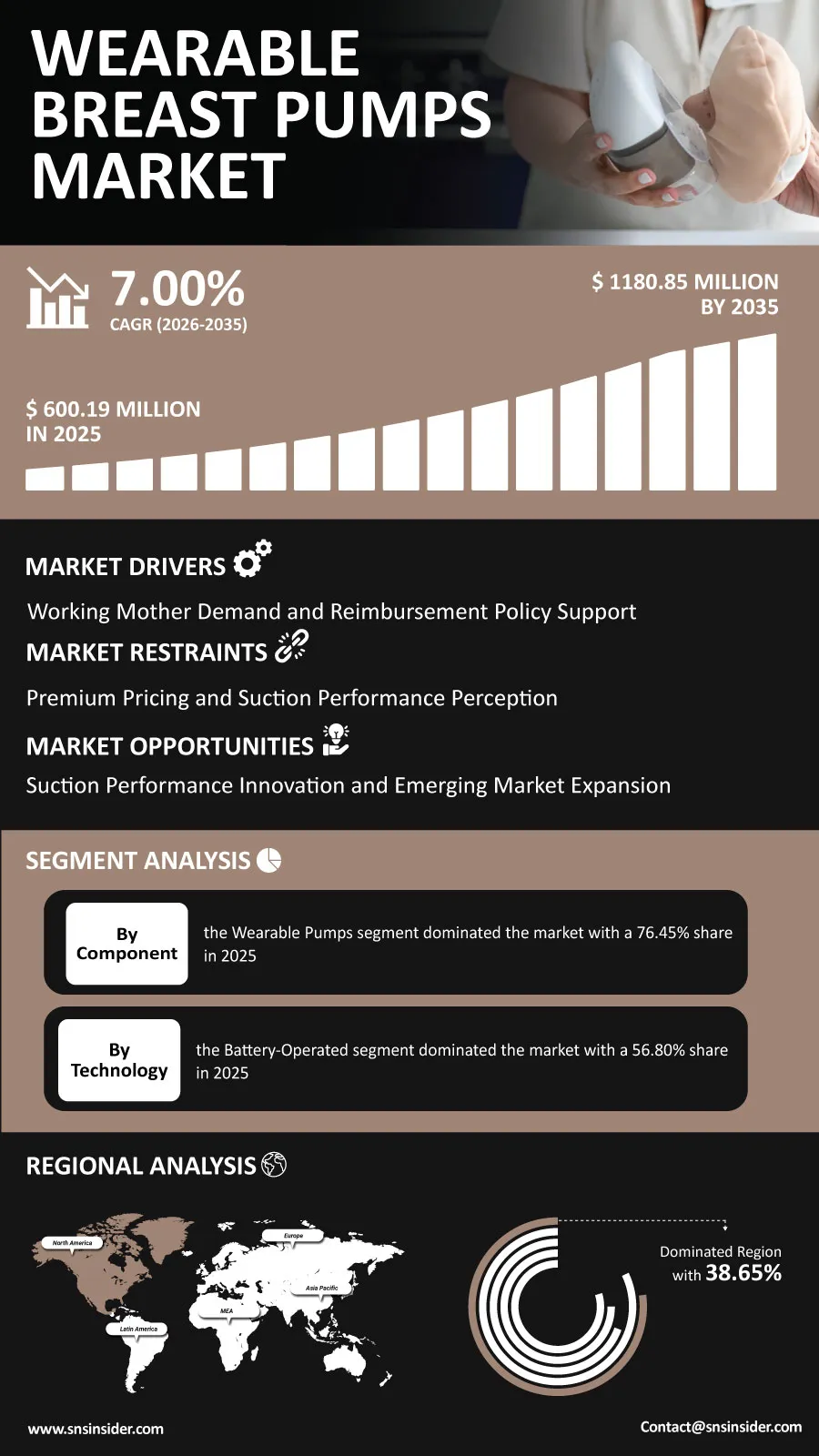
Working Mother Demand and Reimbursement Policy Support Fuel Growth
The increased involvement of women in workforces and their demand for efficient solutions to balance work and parenting continues to widen demand, as wearable pumps offer a genuinely practical way to maintain breastfeeding while managing professional responsibilities. Favourable reimbursement policies reinforce this trend, as expanding insurance coverage continues to lower the effective cost barrier for mothers who might otherwise default to lower-cost tethered alternatives.
Manufacturers are responding with continued innovation narrowing the performance gap between wearable convenience and hospital-grade suction power, and with expanding retail distribution partnerships that bring wearable pumps into major mass-market locations beyond specialty and direct-to-consumer channels alone.
Segment Findings Point to a Market in Transition
Wearable pumps led the market in 2025, reflecting the core device's role as every mother's primary purchase, while accessories are recording the fastest growth at an 8.65% CAGR as the installed base generates recurring replacement demand. Battery-operated devices hold the largest technology share, though smart and app-connected devices are growing fastest at 10.35% as session tracking features gain favour.
Automatic pumps dominate by product type and are also growing fastest at 7.65%, reflecting the category's core hands-free value proposition. Online pharmacies lead distribution and are also expanding fastest at 9.15% as e-commerce convenience wins share. Working mothers account for the largest end-user share, while hospitals and maternity clinics are growing fastest at 8.95% as postpartum lactation support programs incorporate wearable pump provision.
North America Leads, Asia Pacific Set to Grow Fastest
North America accounted for the largest share of global revenue in 2025, at 38.65%, supported by a large working-mother population and favourable insurance reimbursement policies. The United States represented the substantial majority of the regional market.
Asia Pacific is projected to expand at the fastest rate of any region through 2035, at a CAGR of approximately 9.75%, as China, Japan, and India continue expanding female workforce participation and disposable incomes. Europe remains a significant contributor, anchored by Germany's consumer health market, while Latin America and the Middle East and Africa continue building adoption at a more gradual pace.
Brand Consolidation and Retail Expansion Reshape Competitive Dynamics
Competition within this market increasingly centres on which brands can pair reliable core pumping performance with genuinely differentiated discretion and app-based convenience features, as leading femtech companies continue consolidating complementary product portfolios and expanding retail distribution beyond direct-to-consumer channels alone.
Some of the major companies operating in the global wearable breast pumps market include Willow Innovations, Inc., Elvie, Momcozy, Medela AG, Koninklijke Philips N.V., Lansinoh Laboratories, Inc., Spectra Baby USA, Hegen Pte. Ltd., BabyBuddha Products LLC, and Motif Medical.
Looking ahead, the pace of suction performance innovation, continued brand consolidation, and sustained working-mother workforce participation growth are likely to determine which brands gain the most share over the coming decade. Companies that combine proven pumping reliability with genuine convenience and discretion innovation are expected to be best placed to benefit from the market's sustained, workforce-participation-driven growth throughout the forecast period.
Design iteration speed continues to separate leading brands from slower-moving competitors in this category. Because wearable breast pump design must balance suction power, battery life, discretion, and comfort within genuinely tight physical constraints, brands that can iterate quickly based on direct mother feedback are consistently delivering meaningfully improved products year over year, while slower-moving competitors risk falling behind on the comfort and performance attributes that ultimately drive purchasing decisions in this fast-evolving category.
Clinical validation is becoming an increasingly important credibility signal for the category as a whole, particularly as insurance reimbursement continues to expand. Brands that can point to regulatory clearances and genuinely rigorous consumer testing data are finding this meaningfully strengthens their position with both healthcare providers, who increasingly recommend specific devices to new mothers, and insurers evaluating which products qualify for reimbursement coverage, a dynamic that continues to favour established, clinically validated brands over newer entrants without comparable evidence behind their performance claims.
Affordability innovation is also opening the category to a broader base of mothers who previously found premium electric wearables out of reach. Lower-priced manual wearable variants, offered at a fraction of premium electric pump pricing while still delivering genuinely comparable output according to recent consumer surveys, continue to demonstrate that the wearable category's appeal extends well beyond mothers who can afford the most expensive devices, a dynamic that is gradually reshaping how brands think about their addressable market beyond premium positioning alone.
An SNS Insider Analyst, Parry Kardani, commented, "This market continues to benefit from a genuine convergence of rising female workforce participation and continued product innovation narrowing the gap between wearable convenience and traditional pump performance. Brands that pair proven pumping reliability with genuine discretion and affordability innovation are best positioned to capture the next phase of demand, particularly across Asia Pacific's fast-growing female workforce participation and disposable income growth."
About the Author

Get in touch