The global Phospholipids & Lecithin Market is on a steady growth path through 2035, as pharmaceutical applications and clean-label reformulation continue reshaping demand for this versatile functional ingredient.
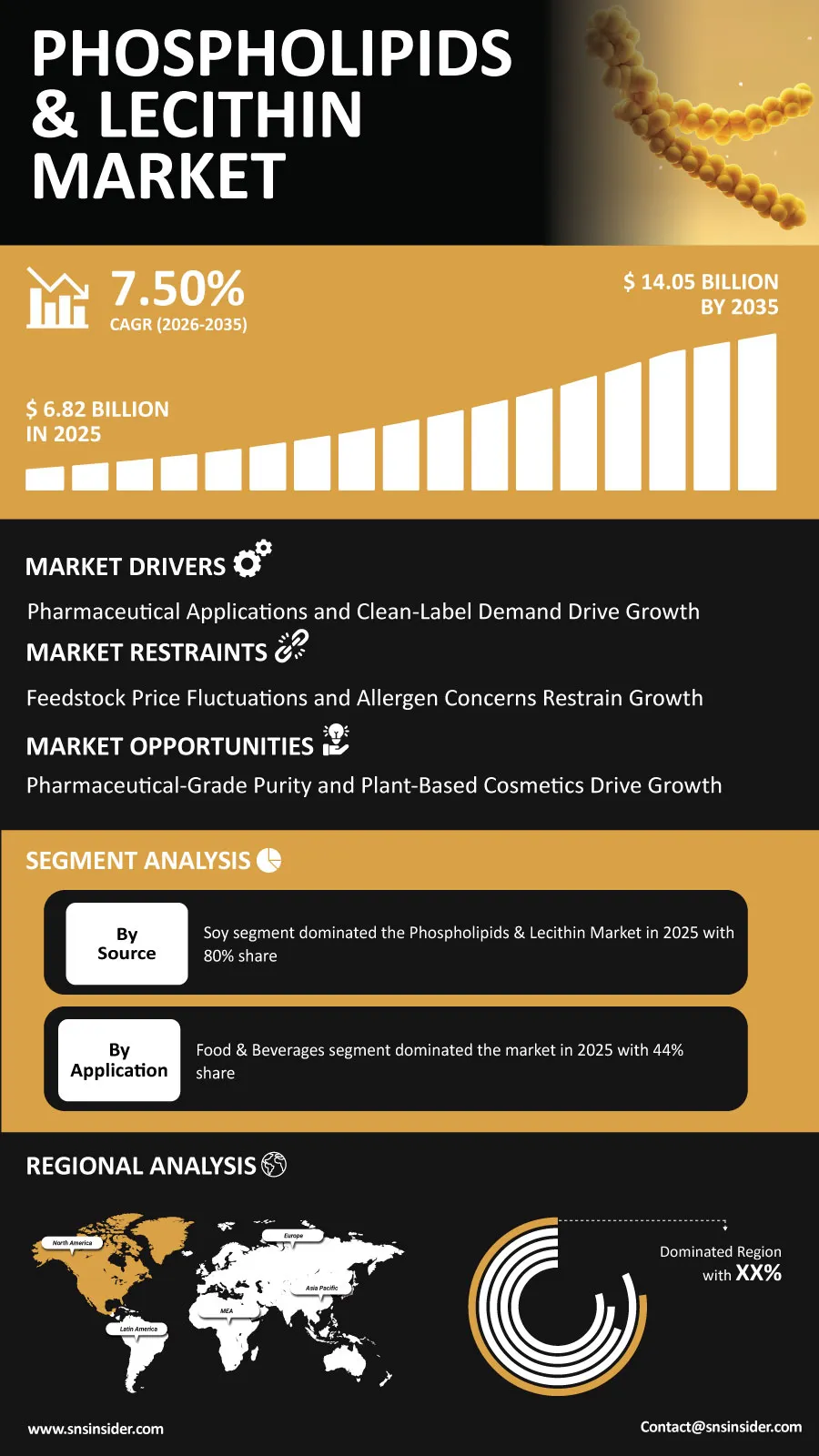
“According to a recent study by SNS Insider, the global Phospholipids & Lecithin Market size valued at USD 6.82 billion in 2025, is anticipated to grow to USD 14.05 billion by 2035, registering a CAGR of 7.50% over the 2026-2035 forecast period.”
Lecithin has quietly become one of the more versatile ingredients in the modern formulator's toolkit, recovered as a byproduct of vegetable oil refining but increasingly valued as a functional ingredient in its own right across food, pharmaceuticals, and cosmetics. That byproduct origin story keeps commodity lecithin cost-competitive even as demand pulls the category into genuinely new, higher-value applications.
Pharmaceutical-grade purity is where the most interesting growth is happening right now, as high-purity phosphatidylcholine fractions become essential components of liposomal drug delivery systems, a use case that barely existed for lecithin a generation ago and now commands meaningfully higher margins than commodity food-grade product.
To Get Detailed Insights on the Phospholipids & Lecithin Market – Request a Sample Report
Pharmaceutical-Grade Purity Reshapes Category Economics
Where lecithin was once judged almost entirely on emulsification performance for food applications, pharmaceutical-grade phospholipid fractions exceeding 99% purity are increasingly capturing manufacturer investment and attention.
This shift is creating a genuinely bifurcated market, high consolidation and pricing power at the pharmaceutical-grade tier, where GMP compliance and validated analytical capabilities create real barriers to entry, versus more fragmented competition at the commodity food-grade tier.
Manufacturers investing in purification and analytical capability are positioning themselves to capture this higher-margin pharmaceutical growth ahead of competitors still focused primarily on commodity lecithin production.
Key Market Findings Highlight High-Growth Segments
Soy had the maximum market share of 80% of the Phospholipids & Lecithin Market in 2025 due to the large production of soybeans and the by-product production mechanism that helps keep soy lecithin prices low.
Sunflower lecithin was the fastest-growing type, with a CAGR of 8.60%, driven by formulators who wish to have an allergy-free replacement for soy lecithin.
On the basis of application, Food & Beverages had the maximum share of 44% in 2025, whereas Cosmetics & Personal Care had the highest CAGR of 9.20% due to the unique properties of lecithin.
Emulsifiers were the leading application of lecithin in 2025, accounting for 41.20% of the total applications, whereas Stabilizers & Antioxidants had the highest CAGR of 8.40%.
Purity Standards and Vertical Integration Anchor Competitive Positioning
Purity criteria and transparency of the supply chain have been becoming almost equally important as prices in evaluations by consumers of pharmaceutical products and premium cosmetics.
The vertical integration approach in the chain from crushing to fractioning and formulations has already become the key competitive advantage strategy that allows controlling costs during feedstock cycles and providing supply chain transparency for regulated applications.
The gap will only widen further as the quality and traceability criteria of pharmaceutical and nutraceutical consumers become more stringent.
North America Leads as Asia Pacific Grows Fastest
North America holds the largest share of global market revenue, anchored by the region's massive soybean processing industry and rising demand for natural, functional ingredients. Asia Pacific, meanwhile, is growing fastest, propelled by technological advancements in extraction processes and expanding food, pharmaceutical, and cosmetics manufacturing across China, India, and Southeast Asia.
Europe holds a meaningful, mature share as well, shaped by strong regulatory support for lecithin as a food and feed ingredient and growing demand for non-GMO and organic variants.
Leading Companies Drive Innovation and Competition
Competition in this market centers on purification technology, pharmaceutical-grade quality documentation, and vertical integration capability nearly as much as on price, with significant partnership and capacity investment activity reshaping the competitive landscape.
Some of the major companies that operate in the global phospholipids and lecithin market are Archer Daniels Midland Company, Cargill, Incorporated, Bunge Global SA, Wilmar International Limited, Lipoid GmbH, American Lecithin Company, Sternchemie GmbH & Co. KG, Thew Arnott & Co. Ltd.
An SNS Insider Analyst Parry Kardani commented, “Lecithin has moved well past being a simple food emulsifier byproduct, the companies capturing the fastest-growing parts of this market are the ones investing in pharmaceutical-grade purification and vertical integration rather than competing on commodity lecithin pricing alone. As liposomal drug delivery and plant-based cosmetics applications keep expanding, manufacturers with strong purity documentation and supply chain transparency are best positioned to lead.”
About the Author

Get in touch