
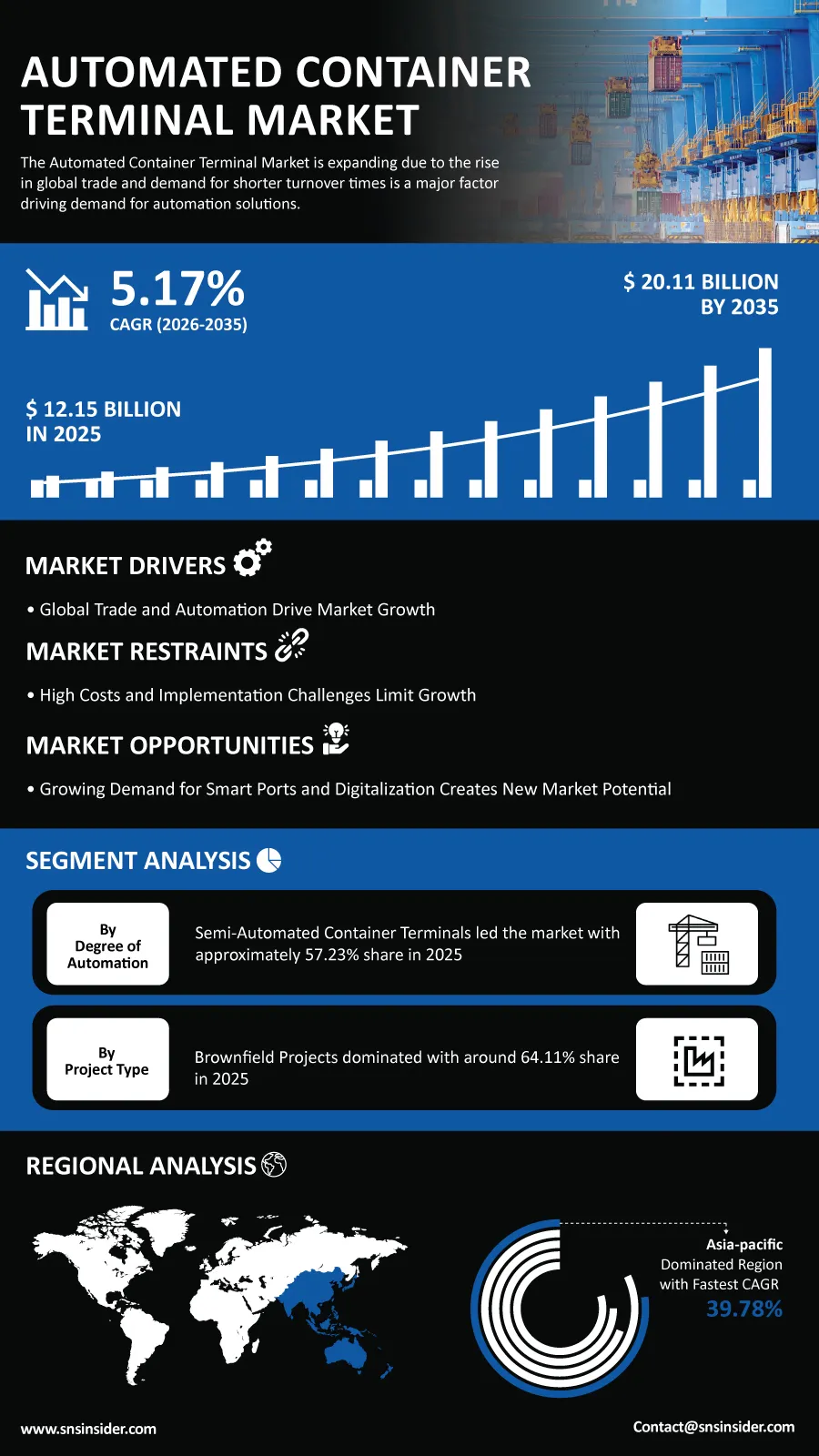
The global Automated Container Terminal Market is projected to witness steady expansion as ports accelerate investments in intelligent automation to manage rising cargo volumes and improve operational efficiency. According to a recent study by SNS Insider, the global Automated Container Terminal Market size valued at USD 12.15 billion in 2025, is anticipated to grow to USD 20.11 billion by 2035, registering a CAGR of 5.17% over the 2026–2035 forecast period.
With increased globalization and internationalization, there is a need for increased automation in ports to improve efficiencies in handling the cargo and improving turnaround times of vessels. Advances in technology have enabled terminals to handle cargo more efficiently, be safe, and utilize their resources effectively.
The recent developments in robotics, artificial intelligence, Internet of Things (IoT), and terminal operating systems have made it possible to revolutionize the way ports operate by making them more interconnected and reliant on data. There is an increasing trend of investing in automated terminal infrastructure because of the demand for efficient logistics services.
To Get Detailed Insights on the Automated Container Terminal Market – Request a Sample Report
Smart Port Development Creates Significant Growth Opportunities
Digital transformation is being embraced by port authorities to develop resilient logistics centers, which have sufficient capacity to sustain the future development in trade volume. Greenfield projects have incorporated complete automation during the planning process of developing their terminals, whereas brownfield projects are automating existing systems through the incorporation of smart machines and software.
Automated terminal operating systems with artificial intelligence capabilities, predictive analysis, and equipment tracking have been helpful in planning operations, optimizing yard activities, and reducing the number of rehandles. Initiatives aimed at sustainable development are driving ports to use efficient automated equipment with low carbon emissions and operational expenses.
Investments in emerging markets, together with expanding shipping lanes, are anticipated to offer numerous business opportunities for automation vendors during the projected period.
Key Market Insights Highlight Shifting Demand Patterns
By degree of automation, semi-automated container terminals accounted for approximately 57.23% of global market revenue in 2025 due to widespread modernization of existing port infrastructure. Fully automated container terminals are projected to register the fastest growth, expanding at a CAGR of 5.45% through 2035 as advanced robotics and AI technologies become increasingly integrated into new terminal developments.
Based on project type, brownfield projects contributed around 64.11% of market revenue in 2025, reflecting continued investments in upgrading operational ports. Greenfield projects are forecast to experience the fastest growth as governments and private operators develop next-generation smart ports designed around fully automated workflows.
By offering, equipment held around 49.31% of market revenue in 2025, driven by demand for automated cranes, guided vehicles, and cargo handling systems. Software is projected to emerge as the fastest-growing segment with a CAGR of 5.74% as terminals increasingly adopt intelligent management platforms, predictive analytics, and AI-enabled operational control systems.
Within solutions, hardware segment accounted for 43.22% of market revenue in 2025, while software is anticipated to witness the strongest growth through 2035, supported by expanding digitalization initiatives across global port operations.
Automation Technologies Enhance Port Productivity and Safety
Connected automation technologies are being used more often in terminals to enhance coordination of equipment, facilitate the management of containers, and increase safety for workers. Scheduling software, self-driving trucks, remotely controlled cranes, and data analysis technologies are helping ports to process cargo efficiently without causing any disruptions to the process.
At the same time, automated processes help companies achieve their sustainability objectives through greater energy efficiency, decreased downtime of equipment, and reduction of greenhouse gas emissions associated with cargo handling.
Asia Pacific Accounts for 39.78% Market Share; North America to Grow at 5.99% CAGR
It is estimated that Asia Pacific will contribute around 39.78% towards the global market revenues. This will be made possible due to increased global trade volume, huge investments in modern port infrastructures and use of automation technology. China will also continue to exert leadership within the region in relation to deployment of fully automated container terminals.
North America will record the fastest rate of growth among all regions and will grow at a compound annual growth rate of 5.99%. This will be as a result of ongoing efforts for modernization of ports within the region, increase in cargo volume as well as investments in robotic, AI and IoT infrastructure.
As governments and private operators prioritize resilient and efficient logistics infrastructure, demand for intelligent terminal automation solutions is expected to remain strong across global markets.
Industry Participants Focus on Intelligent Terminal Innovation
The competitive landscape continues to evolve as leading technology providers invest in integrated automation platforms, autonomous cargo handling equipment, digital terminal operating systems, and AI-powered analytics. Companies are strengthening strategic collaborations to accelerate deployment of intelligent port ecosystems while enhancing operational reliability and sustainability.
Key companies operating in the global Automated Container Terminal Market include Cargotec Corporation, Konecranes, Liebherr, ABB, Künz Aircraft Equipment, CLT, Camco Technologies, IDENTEC SOLUTIONS AG, ORBCOMM, TMEIC Port Technologies, PACECO CORP., TOTAL SOFT BANK LTD., INFORM SOFTWARE, Logstar ERP, Infyz, Tideworks, Loginno Logistic Innovation Ltd., World Crane Services FZE, Starcom Systems Ltd, and ZPMC.
An SNS Insider analyst Sushant Kadam commented, “The combination of expanding global trade, increasing port digitalization, and growing demand for operational efficiency is accelerating investments in automated container terminal technologies. Companies delivering intelligent automation, integrated software platforms, and sustainable port solutions will be well positioned to capitalize on future market opportunities.”
About the Author

Get in touch




