
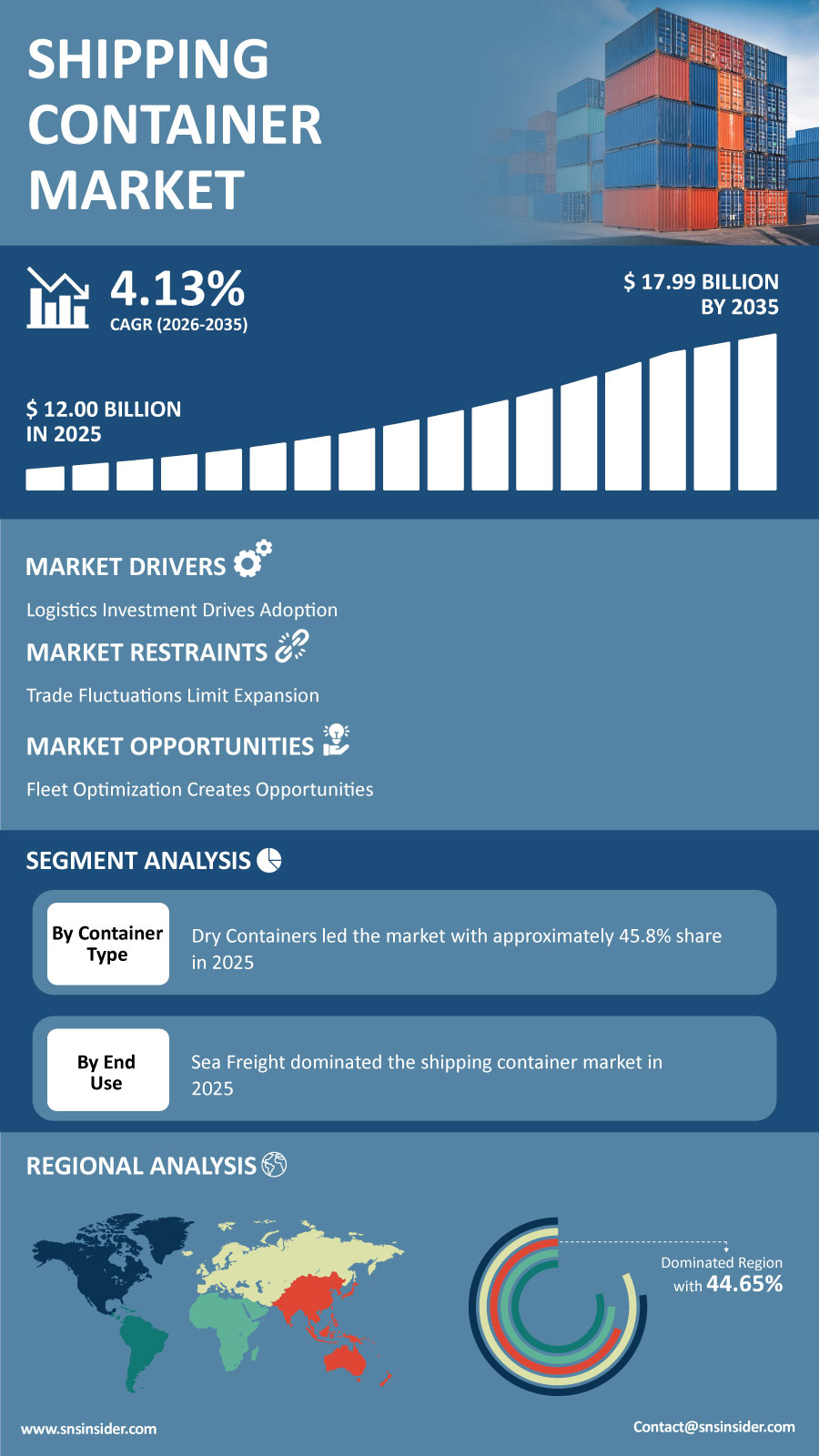
The global Shipping Container Market is expected to witness steady expansion over the coming years as international trade networks, logistics modernization, and demand for efficient cargo transportation continue shaping global supply chains. “According to a recent study by SNS Insider, the global Shipping Container Market size valued at USD 12.00 billion in 2025, is anticipated to grow to USD 17.99 billion by 2035, registering a CAGR of 4.13% over the 2026–2035 forecast period.”
As manufactured products, industrial supplies, foodstuffs, and consumer items continue to move more across international pathways, there is an increase in the need for standardized containers. The ship container continues to be a very significant aspect of multimodal transport owing to its flexibility in making possible the transfer of loads from ships to railways and roadways.
Rapid globalization and investments in logistics have spurred shipping firms and manufacturers of shipping containers to build larger fleets and become more efficient in operations. In the meantime, technology has enabled the revolution of the way that shipping containers are managed.
To Get Detailed Insights on the Shipping Container Market – Request a Sample Report
Smart Container Technologies Create New Growth Opportunities
The logistics sector globally is gradually embracing connected and technology-based operations and encouraging the use of smart container systems fitted with Internet of Things (IoT) monitoring devices. The technologies give users real-time information about the locations of the containers, the conditions of the cargo being carried, and maintenance needs for better efficiency and minimizing operation disruptions.
The rising demands for cold storage transportation have also been driving innovations in developing modern-day refrigerated containers. The growing transportation of pharmaceutical products and exportation of fresh foods and the increasing needs for cold chains across the globe have led to more reliable means of storage for cargo that can withstand transportation over large distances.
Additionally, the secondary market of shipping containers is becoming increasingly significant as companies are experimenting with new uses such as construction, storage, and temporary structures. This development not only increases the lifespan of shipping containers commercially but also brings more money for the owners of these shipping containers.
Key Market Insights Highlight Evolving Demand Patterns
Based on container type, dry containers accounted for the largest share of the global market in 2025, representing approximately 45.8% of revenue. Their dominance is attributed to widespread usage across general cargo transportation, including consumer goods, industrial products, and manufactured materials. Refrigerated containers are expected to experience the fastest growth, expanding at nearly 6.2% CAGR, supported by rising cold chain requirements.
By container size, 20-foot containers maintained a leading position in 2025 due to their versatility, compatibility with global logistics infrastructure, and extensive usage across multiple trade routes. Meanwhile, high cube containers are gaining momentum as businesses increasingly require additional cargo capacity for e-commerce and retail shipments.
By ownership model, leasing solutions dominated the market as shipping companies and logistics providers prefer flexible fleet management strategies that reduce upfront investment requirements. However, owned container fleets are also expanding as major carriers seek greater control over long-term transportation assets.
By end use, sea freight represented the largest application segment in 2025, supported by the continued importance of maritime transportation in global trade. Intermodal logistics is emerging as the fastest-growing application area as companies increasingly integrate rail and road transportation with maritime supply chains.
Logistics Efficiency and Supply Chain Visibility Remain Industry Priorities
Asset efficiency, minimizing transportation delays, and enhancing supply chain visibility have been some of the key concerns of shipping companies and logistics firms. The growing complexity of global transportation networks necessitates the implementation of container tracking technologies and automation of logistics to ensure efficient operations.
Port upgrading projects are facilitating the growth in the market due to their contribution towards increasing container handling capabilities and decreasing container turnaround times. Investments made in automatic ports, freight management software, and sustainable port activities are prompting companies to adopt new generation container solutions.
Industry development is also being driven by sustainability, with players looking into developing lightweight containers, energy-efficient refrigeration units, and sustainable manufacturing processes.
Asia Pacific Accounted for 44.65% Market Share in 2025; North America Forecast to Witness Strong Growth During the Forecast Period
The Asia Pacific held the biggest share of the Shipping Containers Market in 2025, accounting for about 44.65% of the overall revenue. This is attributed to the fact that the region has active manufacturing activities, vast exporting capabilities, huge shipping ports, and manufacturers of containers. China is one of the dominant regions due to its contribution towards manufacturing of containers and international trade.
The North America region will witness steady growth in the coming years due to investments in port infrastructure and intermodal transportation as well as increased need for cargo management solutions. The U.S. is still a key market owing to its huge import volume and logistics sector.
Europe will also see further developments owing to advanced port infrastructure, sustainable initiatives, and digitalization of containers management systems. The Latin America and Middle East & Africa are developing markets that present new avenues for development in the Shipping Containers Market.
Industry Participants Focus on Innovation and Fleet Optimization
The competitive landscape of the global Shipping Container Market remains dynamic, with manufacturers and logistics companies investing in digital technologies, sustainable designs, and improved operational capabilities. Companies are focusing on enhancing container durability, improving cargo security, and developing solutions that support modern supply chain requirements.
Key companies operating in the global Shipping Container Market include China International Marine Containers Co. Ltd. (CIMC), Maersk Container Industry A/S, Singamas Container Holdings Ltd., CXIC Group Containers Co., Ltd., Dong Fang International Container (Hong Kong) Co., Ltd., Triton International Limited, Textainer Group Holdings Ltd., Seaco Global Ltd., Hapag-Lloyd AG, Mediterranean Shipping Company (MSC), CMA CGM SA, Evergreen Marine Corporation, Ocean Network Express (ONE), ZIM Integrated Shipping Services, Sea Box Inc., CARU Containers B.V., Storstac Inc., China Eastern Containers Co., Ltd., BSL Containers Ltd., and W&K Container Inc.
An SNS Insider analyst Santosh Bhul commented, “Expansion of global trade networks, increasing adoption of smart container technologies, and modernization of logistics infrastructure are creating sustained growth opportunities in the shipping container industry. Companies that focus on digital visibility, sustainability, and flexible transportation solutions are expected to strengthen their market position in the evolving global supply chain ecosystem.”
About the Author

Get in touch




