
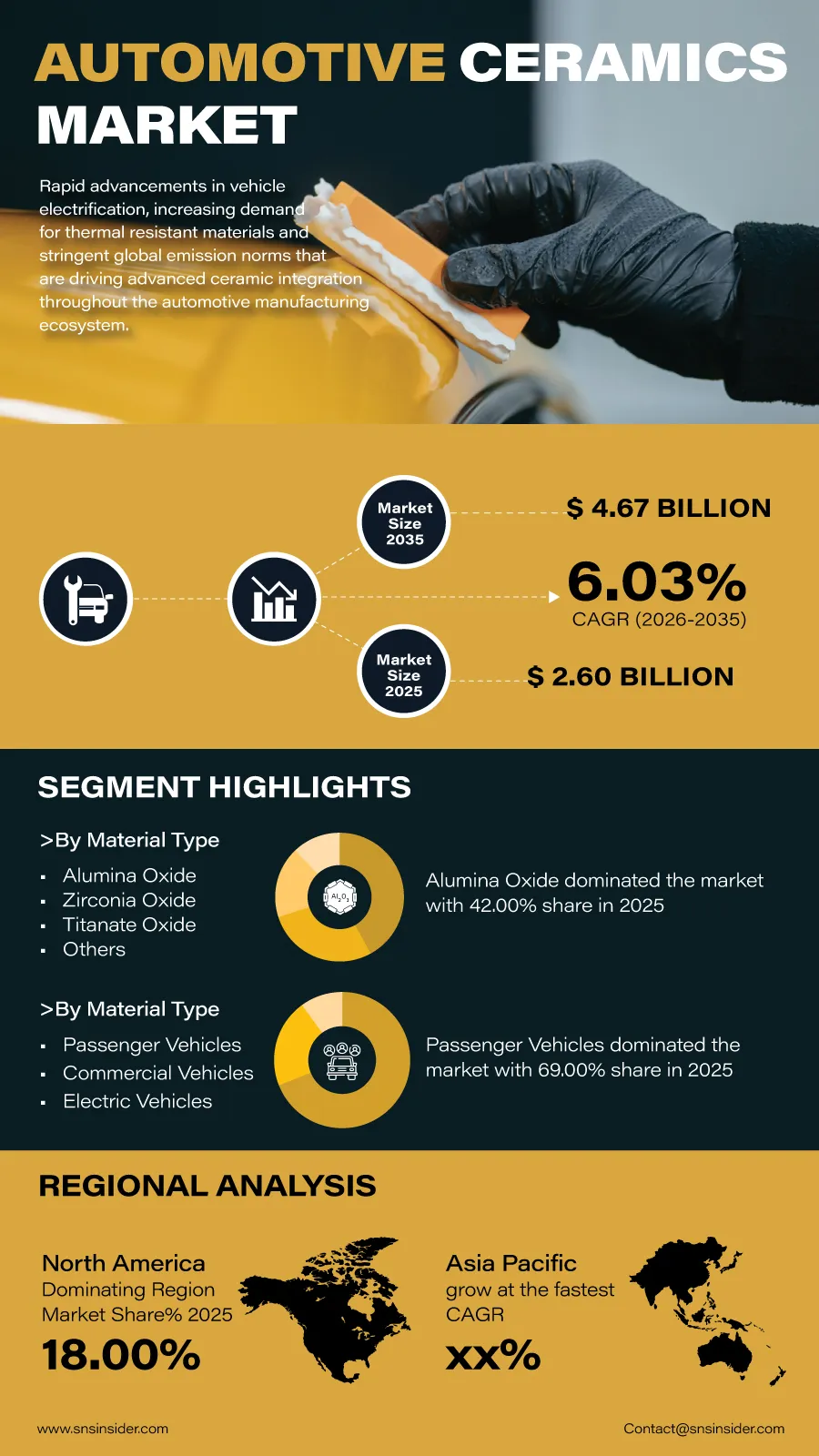
The global Automotive Ceramics Market is poised for steady expansion over the next decade as automakers accelerate investments in advanced materials that improve vehicle efficiency, durability, and safety. “According to a recent study by SNS Insider, the global Automotive Ceramics Market size valued at USD 2.60 billion in 2025, is anticipated to grow to USD 4.67 billion by 2035, registering a CAGR of 6.03% over the 2026–2035 forecast period.”
The increased use of electric vehicles, more stringent environmental laws, and constant technological improvements in car electronics are revolutionizing material selection for the global automotive industry. Automotive firms are now using ceramic parts in various vehicle subsystems due to their ability to withstand high temperatures and provide electrical insulation.
To Get Detailed Insights on the Automotive Ceramics Market – Request a Free Sample Report
The shift toward software defined cars and electric motors presents more avenues in which advanced ceramic technologies can thrive. Ceramics have become critical components in next generation vehicle design where car manufacturers aim at maximizing performance without sacrificing energy efficiency.
Vehicle Electrification Accelerates Demand for High-Performance Materials
Efforts toward lightweight construction, efficiency, and energy-efficient thermal control still represent key aims of automotive producers in the era of automotive innovations. High heat, corrosive, and mechanical resistance properties along with compact design make advanced ceramics a perfect solution for these aims.
Increased production of electric vehicles has become an additional reason to use ceramics in automotive insulation systems, power electronics, and sensors. Increased battery capacity and semiconductor quantity make the manufacturers more concerned about materials that ensure stable operation in tough conditions.
On the other hand, rising spending on state-of-the-art manufacturing techniques and new components is pushing suppliers to come up with ceramic-based products that will ensure improved productivity while meeting the changing regulatory requirements of clean transportation.
An Infographic Representation of the Global Automotive Ceramics Market
Key Market Insights Highlight Emerging Industry Trends
By material type, alumina oxide represented 42.00% of global market revenue in 2025, reflecting its widespread use in thermal insulation, emission-control systems, and high-temperature automotive components. Meanwhile, zirconia oxide is expected to record the fastest expansion through 2035, advancing at a CAGR of 7.02% as demand rises for advanced sensing technologies, thermal barrier applications, and electric vehicle components.
From a vehicle perspective, passenger vehicles accounted for 69.00% of market revenue in 2025 due to sustained global vehicle production and broad integration of ceramic materials across conventional and hybrid platforms. However, electric vehicles are projected to register the strongest growth, with a CAGR of 8.68%, driven by expanding battery manufacturing and increasingly sophisticated power electronics.
Based on application, exhaust systems generated 40.00% of total market revenue in 2025, supported by continued implementation of emission-control technologies worldwide. At the same time, automotive electronics are anticipated to emerge as the fastest-growing application segment, progressing at a CAGR of 9.73% as vehicles incorporate greater semiconductor content, intelligent sensors, and connected mobility technologies.
Innovation in Thermal Management Strengthens Market Outlook
Automotive suppliers continue investing in advanced ceramic engineering to address evolving performance requirements across modern vehicle architectures. New product development efforts increasingly focus on improving heat dissipation, electrical insulation, structural integrity, and component longevity.
As electric vehicles become more sophisticated, thermal management has become a strategic priority throughout the automotive supply chain. Ceramic materials are supporting safer battery operation, protecting sensitive electronic components, and enabling more compact designs for future mobility platforms.
Growing collaboration between material manufacturers, automotive OEMs, and electronics suppliers is also accelerating commercialization of innovative ceramic technologies capable of supporting autonomous driving systems, intelligent braking, and next-generation powertrain architectures.
Asia Pacific Maintains Market Leadership While Global Investments Expand
The Asia Pacific region held the largest market share for the Automotive Ceramics Market in 2025 and will continue to be the leading regional market growing at the fastest pace during the forecast period. The presence of high automobile manufacturing capabilities in China, Japan, South Korea, and India along with growth in electric vehicle manufacturing supported by various industrial policies is boosting the demand for ceramics in the region.
In North America, there is constant growth in the market owing to increasing investments in electric vehicle manufacturing, semiconductor manufacturing, and automotive technology development. Automotive manufacturers in North America are building production capabilities domestically for future mobility plans.
Europe also remains an important contributor to global market growth, supported by ambitious carbon reduction targets, increasing electric vehicle adoption, and continuous innovation in automotive engineering. Meanwhile, emerging economies across Latin America and the Middle East & Africa are gradually expanding opportunities through modernization of automotive manufacturing and growing emphasis on fuel-efficient transportation.
Industry Participants Intensify Focus on Advanced Material Innovation
Competition across the Automotive Ceramics Market continues to evolve as manufacturers prioritize research, manufacturing efficiency, and application-specific product development. Companies are investing in next-generation ceramic substrates, semiconductor packaging technologies, thermal insulation solutions, and lightweight structural materials to address changing automotive requirements.
Key companies operating in the Automotive Ceramics Market include Kyocera Corporation, CeramTec GmbH, Corning Incorporated, Saint-Gobain, NGK Insulators Ltd., CoorsTek Inc., Morgan Advanced Materials plc, Ibiden Co., Ltd., Murata Manufacturing Co., Ltd., 3M Company, Elan Technology, Rauschert GmbH, Ferrotec Holdings Corporation, Ceradyne Inc., Dyson Technical Ceramics, Superior Technical Ceramics, Maruwa Co., Ltd., Blasch Precision Ceramics Inc., McDanel Advanced Ceramic Technologies, and International Syalons Ltd.
An SNS Insider analyst Himanshu Sharma commented, "The automotive industry's transition toward electrification, intelligent electronics, and higher efficiency standards continues to expand the role of advanced ceramics across multiple vehicle systems. Companies investing in material innovation, scalable manufacturing, and next-generation thermal management technologies are expected to strengthen their competitive position as demand for high-performance automotive components continues to grow."
About the Author

Get in touch




