
Electronic Components Market Report Scope & Overview:
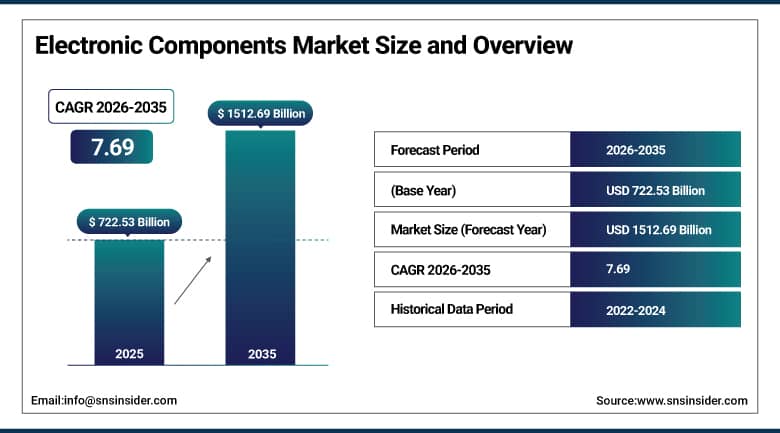
The Electronic Components Market was valued at USD 722.53 billion in 2025 and is expected to reach USD 1512.69 billion by 2035, growing at a CAGR of 7.69% from 2026–2035.
The electronic components market is witnessing strong growth in the global market owing to increasing demand for advanced consumer electronics and automotive systems. Rising adoption of semiconductors, sensors, and integrated circuits is enhancing device performance. Expanding electric vehicle production and 5G infrastructure is supporting market expansion. Manufacturers are focusing on miniaturized, energy-efficient, and high-performance components. Growing demand for IoT devices and AI-enabled hardware is driving innovation. Increasing investments in semiconductor manufacturing and supply chain expansion are further accelerating market adoption.
According to the World Semiconductor Trade Statistics 2025 and the U.S. Semiconductor Industry Association manufacturing indicators, global semiconductor shipments continue to exceed trillions of units annually, with Asia accounting for over 75% of fabrication capacity concentration.
As per the OECD Digital Economy Outlook 2025, more than 95% of electronic devices rely on semiconductor-based components, while advanced node adoption below 10nm represents over 20% of leading-edge production capacity. The International Telecommunication Union reports that global 5G coverage now reaches over 60% of the world population, significantly increasing demand for integrated electronic components across communication infrastructure and consumer devices.
To Get More Information On Electronic Components Market - Request Free Sample Report
Electronic Components Market Trends:
-
Increasing adoption of advanced semiconductors driven by AI computing, 5G infrastructure, and high-performance electronic device applications globally.
-
Expansion of semiconductor fabrication facilities across Asia Pacific North America and Europe strengthening supply chain resilience and production capacity.
-
Growing integration of electric vehicle electronics increasing demand for power management systems battery control units and advanced sensors.
-
Rapid rise of IoT enabled devices across industrial consumer and healthcare sectors driving need for microcontrollers and connectivity chips.
-
Rising government incentives and policies supporting domestic chip manufacturing and encouraging localization of semiconductor supply chains globally.
-
Continuous technological advancements in miniaturized electronics improving efficiency performance and enabling next generation smart connected systems worldwide.
U.S. Electronic Components Market Outlook:
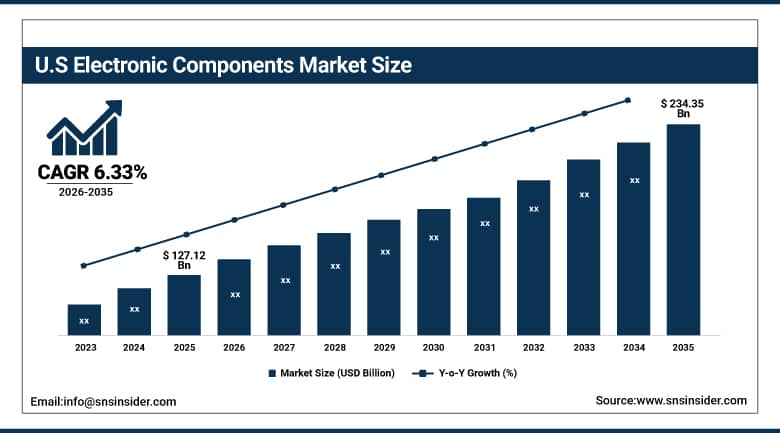
The U.S. Electronic Components Market was valued at USD 127.12 billion in 2025 and is expected to reach around USD 234.35 billion by 2035, growing at a CAGR of 6.33% from 2026–2035.
The U.S. electronic components market is growing steadily owing to rising demand for advanced semiconductor and electronic systems. Increasing adoption of active components is improving computing and device performance. Expansion of automotive electronics and EV manufacturing is supporting market growth across regions. Strong demand for PCBs and sensors is reducing system-level complexity requirements. Growing investments in aerospace and defense electronics are accelerating market development. Advancements in chip design and manufacturing technologies are further driving adoption nationwide.
As per the U.S. Census Bureau 2025 Manufacturing and Trade Indicators as well as U.S. International Trade Commission’s electronics supply chain studies, semiconductors and electronics parts constitute a substantial proportion of total high-tech manufacturing output produced by the U.S., with ICs contributing more than 40% to total electronics-manufacturing shipments.
As per the U.S. Department of Commerce CHIPS Program Office 2025 implementation updates, over 80 semiconductor fabrication and advanced packaging projects have been initiated or expanded under federal incentives, targeting increased domestic production capacity.
Electronic Components Market Segment Analysis:
-
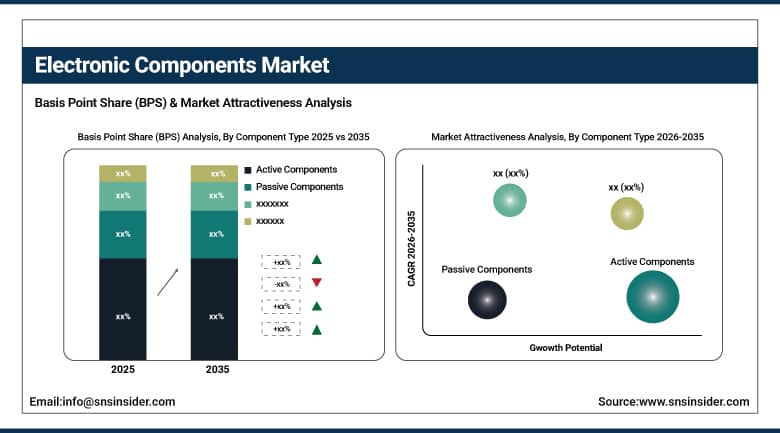
By Component Type, active components dominated the market with 47.20% share in 2025 and it is also the fastest growing segment with a CAGR of 8.48%.
-
By Material Type, semiconductor dominated the market with 44.60% share in 2025 and it is also the fastest growing segment with a CAGR of 8.60%.
-
By Application, consumer electronics dominated the market with 35.80% share in 2025; while automotive electronics are the fastest growing segment with CAGR of 12.95% during 2026 to 2035.
-
By Distribution Channel, authorized distributors dominated the market with 40.50% share in 2025; while online sales channels are the fastest growing segment with CAGR of 15.77% during 2026 to 2035.
By Component Type, active components segment dominates the electronic components market and is also the fastest growing segment
Active Components segment captured the leading position in the electronic components market with the dominated market share in terms of revenues in 2025. The reason behind such a high share can be attributed to the extensive usage of semiconductors, integrated circuits, microprocessors, and power devices by various industries. With the growing demand for high-speed computing, smartphone, electric vehicle, and industrial automation, there is an increasing deployment of these components as they are vital in modern electronic systems.
Active Components segment is estimated to witness the fastest CAGR during 2026–2035 owing to increasing adoption of AI chips, IoT devices, and semiconductor technologies. Growing demand for energy-efficient and compact electronic systems has fueled the advancements in this regard. Growing deployments of 5G infrastructure, autonomous vehicles, and smart electronics have increased the demand. Continuous advancements in chip design and manufacturing technologies have enabled performance enhancement and robust market expansion.
By Material Type, semiconductor segment dominates the electronic components market and is also the fastest growing segment
The Semiconductor Segment held the dominated revenue share in the electronic components market in 2025. This can be attributed to the vital importance of semiconductors in enabling all modern-day electronic devices ranging from consumer electronics to automobiles, telecommunications, and industrial electronic equipment. The increased demand for Integrated Circuits (ICs), Microprocessors, and Memory Chips is contributing towards its dominant position in the global market.
The Semiconductor Segment will have the fastest-growing CAGR between 2026-2035. This will be driven by the increasing usage of Artificial Intelligence (AI), Internet of Things (IoT), Electric Vehicles (EVs), and 5G infrastructure around the world. Increasing chip content per device, coupled with the fast-paced digital transformation in various industries, will drive the demand further. Advances in chip manufacturing techniques will drive the growth further.
By Application, consumer electronics dominated the electronic components market, while automotive electronics are the fastest growing segment.
Consumer Electronics segment captured the dominated revenue share in the electronic components market in 2025. The growing demand for smartphones, laptops, tablets, wearables, and home appliances globally is the primary factor behind this leading position. Growth in digitalization and innovations in products will drive the consumption of electronic components. Adoption of advanced semiconductors, sensors, and printed circuit boards (PCBs) in consumer electronics is driving the market leadership position.
Automotive Electronics segment is projected to witness the highest CAGR in terms of revenue during the forecast period 2026-2035. The rapidly changing nature of the automobile industry with respect to its electrification, growing adoption of electric cars, and increasing demands for advanced driver assistance systems are some of the major factors propelling this segment. Expansion of technology in the field of connected car technology, infotainment systems, and battery management system is boosting component usage.
By Distribution Channel, authorized distributors dominated the electronic components market, while online sales channels are the fastest growing segment.
Authorized Distributors segment dominated the electronic components market with the highest revenue share in 2025. This dominance is mainly due to strong supply chain reliability and assured product authenticity provided by distributors. They offer technical support, inventory management, and consistent availability for manufacturers. Large OEMs prefer authorized channels to reduce procurement risks. Strong relationships with global component suppliers further strengthen their market position and ensure stable and efficient distribution networks worldwide.
Online Sales Channels segment is expected to grow at the fastest CAGR from 2026–2035 due to increasing digital procurement adoption across industries. Growing preference for faster sourcing and price transparency is driving online platforms. SMEs and startups prefer these channels for convenience and lower procurement costs. Expansion of e-commerce distribution networks for electronic components is boosting accessibility. Improved logistics, real-time inventory tracking, and wider global reach are further accelerating online sales channel adoption globally.
Regional Analysis:
|
Region |
Major Country |
Share within Region, 2025(%) |
|---|---|---|
|
North America |
United States |
72.40% |
|
Europe |
Germany |
27.10% |
|
Asia Pacific |
China |
43.80% |
|
Middle East & Africa |
UAE |
18.20% |
|
Latin America |
Brazil |
48.30% |
Asia Pacific Electronic Components Market Insights.
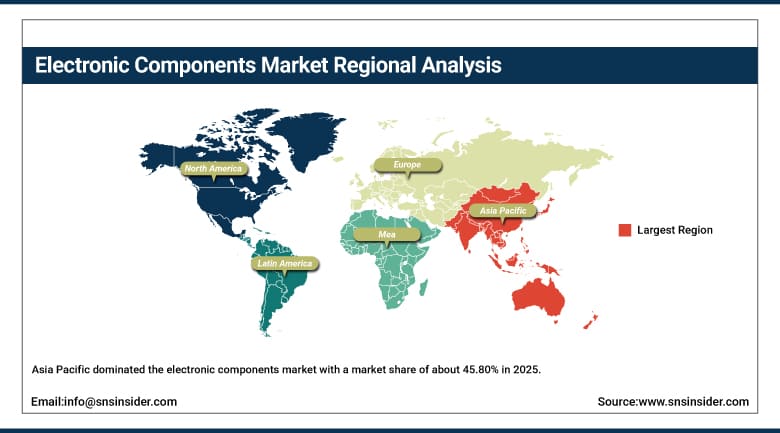
Asia Pacific dominated the electronic components market with a market share of about 45.80% in 2025 and is also positioned to register the fastest CAGR of about 8.55% during 2026–2035. Rapid industrialization and large-scale electronics manufacturing are driving strong demand across China, Japan, South Korea, India, and Southeast Asia. Expanding consumer electronics production and EV adoption are boosting market growth. Rising semiconductor fabrication investments are further accelerating regional expansion.
As per the United Nations Industrial Development Organization & International Telecommunication Union ICT Development Index 2025 report, Asia Pacific region is responsible for over 60% of global electronics manufacturing volume, while China, South Korea, Japan, and Taiwan hold dominance over the manufacture of semiconductors and components. As per the International Energy Agency Digital Economy & Electrification reports, electronics have contributed to more than 35% of total electricity consumed by industries in advanced Asian countries.
Get Customized Report as Per Your Business Requirement - Enquiry Now
North America Electronic Components Market Insights.
North America electronic components market is experiencing steady growth in 2025 owing to rising demand for advanced semiconductor and computing systems. The region benefits from strong presence of leading chip designers and electronic manufacturers. Increasing adoption of automotive electronics and defense applications is driving demand. Expansion of data centers and 5G infrastructure is supporting market growth. Strong R&D investments in next generation semiconductor technologies are further accelerating market development across the region.
According to the U.S. Census Bureau and Semiconductor Industry Association 2025 supply chain metrics, the U.S. produces only 10% of the world’s semiconductors, with the advanced-node semiconductors coming from less than 5% of global fabrication plants. According to the U.S. Bureau of Economic Analysis and Commerce Department CHIPS Program Office updates, more than 70% of the supply chain components required to produce electronics in North America are imported.
Europe Electronic Components Market Insights.
Europe electronic components market is characterized by steady growth in 2025 owing to strict industrial standards and strong automotive electronics demand. Key countries include Germany, France, United Kingdom, and Italy. Rising adoption of electric vehicles is driving semiconductor and PCB demand. Increasing focus on industrial automation and smart manufacturing is boosting component consumption. Expansion of renewable energy and telecommunications infrastructure is further supporting market growth across the region.
According to the European Commission’s 2025 Digital Decade report and Eurostat industrial production indicators, over 75% of EU enterprises use at least a basic level of digital intensity, supporting strong demand for electronic components across industrial automation and ICT systems. As per the European Semiconductor Industry Association (ESIA) policy tracking aligned with EU Chips Act implementation, Europe targets a 20% share of global semiconductor production capacity by 2030.
Middle East & Africa and Latin America Electronic Components Market Insights.
The Middle East & Africa along with Latin America regions are experiencing steady growth due to increasing electronics adoption and infrastructure development. Key contributing countries include Brazil, Mexico, UAE, Saudi Arabia, and South Africa. Rising demand for consumer electronics and telecom equipment is driving market expansion. Growing investments in smart cities and digital transformation are supporting component demand. Expanding industrial automation and renewable energy systems are further boosting market growth.
According to the ITU ICT Development Index and World Bank Digital Economy studies, internet penetration in Latin America is more than 78%, Middle East at an average of 70% and Africa at about 43%.
As per the IEA 2025 electrification statistics, electricity access in Africa stood at about 91%, compared to 87% a decade back, and has thus helped fuel the usage of electronic parts in power, telecommunication, and consumer goods industries. In addition, smartphone penetration rate in Latin America, according to GSMA mobility data, is greater than 75%, and 65% in some regions of the Middle East.
Market Dynamics:
Growth Drivers: Rapid expansion of semiconductor and chip manufacturing ecosystems across major global economies
The construction of semiconductor factories in Asia-Pacific, North America, and Europe has been improving the availability of supply. Incentives from the government have been promoting the manufacturing of chips within the country. Demand for AI processors, high-performance computing, and 5G technology is contributing to an increase in capacity. Advanced node technologies and processes are being prioritized. Efforts aimed at localization of supply chain are also helping to enhance the resilience of the manufacturing process.
According to the World Semiconductor Trade Statistics 2025 forecast and U.S. Semiconductor Industry Association, the annual global shipment of semiconductors continues to be above 1 trillion units each year, and Asia-Pacific alone contributes over 70% of the total semiconductor manufacturing capacity worldwide. According to the International Trade Administration and OECD semiconductor policy tracker, more than 50 nations already have national semiconductor strategies by 2025, and investments in fabrication facilities have been largely limited to the United States, Taiwan, South Korea, and China.
Restraints: High complexity and rapid technological obsolescence increasing product development and lifecycle challenges
With rapid innovations in the field of electronics, the lifecycle of products is reducing, and the complexity of designing is rising. The organizations have to constantly spend on R&D for staying ahead of others. The inclusion of sophisticated features like AI-IoT and 5G adds to the engineering efforts. Frequent upgradation of products causes more development costs and quick obsolescence of already developed components. The compatibility problem in the systems raises more designing problems.
Opportunities:Expanding adoption of electric vehicles smart infrastructure and IoT technologies worldwide
The increasing use of electric cars and smart cities, as well as the Internet of Things systems, will result in new avenues for electronic parts needs. Electric cars need modern power electronics, battery management systems, and sensors. The implementation of smart infrastructure will lead to increased demand for connected devices and control systems. The development of the Internet of Things in various industries will stimulate the demand for microcontrollers and communication chips.
As per the IEA Global EV Outlook 2025, there was a penetration of over 20% of electric vehicles in the world’s automobile sales, which created a great demand for semiconductors and passive electronic components per unit car. In terms of the ITU 2025 ICT Indicators, the number of IoT devices globally surpassed 15 billion, and the growth of M2M connections was above 10% per annum.
Recent Developments:
-
2026: Intel Corporation no verified publicly announced 2026 semiconductor developments available in reliable public disclosures as of current records.
-
2025: Taiwan Semiconductor Manufacturing Company (TSMC) advanced Arizona fab expansion supporting 2nm and 3nm capacity scaling for AI chips.
-
2025: Samsung Electronics expanded HBM3E memory production to meet AI accelerator demand from global hyperscale data centers.
-
2024: Qualcomm launched Snapdragon X Elite processors enabling AI PC ecosystem expansion and Arm-based Windows performance improvements globally.
Electronic Components Market Key Players are:
-
Intel Corporation
-
Samsung Electronics
-
Taiwan Semiconductor Manufacturing Company (TSMC)
-
Qualcomm
-
Broadcom Inc.
-
Texas Instruments
-
Analog Devices
-
STMicroelectronics
-
Infineon Technologies
-
NXP Semiconductors
-
Micron Technology
-
SK hynix
-
Sony Group Corporation
-
Murata Manufacturing
-
TDK Corporation
-
Panasonic Holdings Corporation
-
onsemi
-
Renesas Electronics Corporation
-
Vishay Intertechnology
-
TE Connectivity
Electronic Components Market Report Scope:
| Report Attributes | Details |
|---|---|
| Market Size in 2025 | USD 722.53 Billion |
| Market Size by 2035 | USD 1512.69 Billion |
| CAGR | CAGR of 7.69% From 2026 to 2035 |
| Base Year | 2025 |
| Forecast Period | 2026-2035 |
| Historical Data | 2022-2024 |
| Report Scope & Coverage | Market Size, Segments Analysis, Competitive Landscape, Regional Analysis, DROC & SWOT Analysis, Forecast Outlook |
| Key Segments | • By Component Type (Active Components, Passive Components, Electromechanical Components, Printed Circuit Boards (PCBs), Others) • By Material Type (Semiconductor, Ceramic, Metal, Polymer, Composite) • By Application (Consumer Electronics, Automotive Electronics, Industrial Electronics, Telecommunication Equipment, Healthcare Devices, Aerospace & Defense Systems) • By Distribution Channel (Direct Sales, Authorized Distributors, Independent Distributors, Online Sales Channels, System Integrators) |
| Regional Analysis/Coverage | North America (US, Canada), Europe (Germany, UK, France, Italy, Spain, Russia, Poland, Rest of Europe), Asia Pacific (China, India, Japan, South Korea, Australia, ASEAN Countries, Rest of Asia Pacific), Middle East & Africa (UAE, Saudi Arabia, Qatar, South Africa, Rest of Middle East & Africa), Latin America (Brazil, Argentina, Mexico, Colombia, Rest of Latin America). |
| Company Profiles | Intel Corporation, Samsung Electronics, Taiwan Semiconductor Manufacturing Company (TSMC), Qualcomm, Broadcom Inc., Texas Instruments, Analog Devices, STMicroelectronics, Infineon Technologies, NXP Semiconductors, Micron Technology, SK hynix, Sony Group Corporation, Murata Manufacturing, TDK Corporation, Panasonic Holdings Corporation, onsemi, Renesas Electronics Corporation, Vishay Intertechnology, TE Connectivity |
Frequently Asked Questions
Major growth factors include rising consumer and automotive electronics demand EV expansion 5G infrastructure IoT adoption AI hardware semiconductor innovation and global chip manufacturing capacity growth.
The active components dominated in 2025 due to widespread semiconductor use in smartphones EVs computing systems industrial automation and electronics applications.
Asia Pacific dominated the electronic components market in 2025 due to strong manufacturing base semiconductor capacity and electronics demand growth.
The electronic components market is expected to grow at a CAGR of 7.69% from 2026 to 2035.
The electronic components market was valued at USD 722.53 billion in 2025.
