
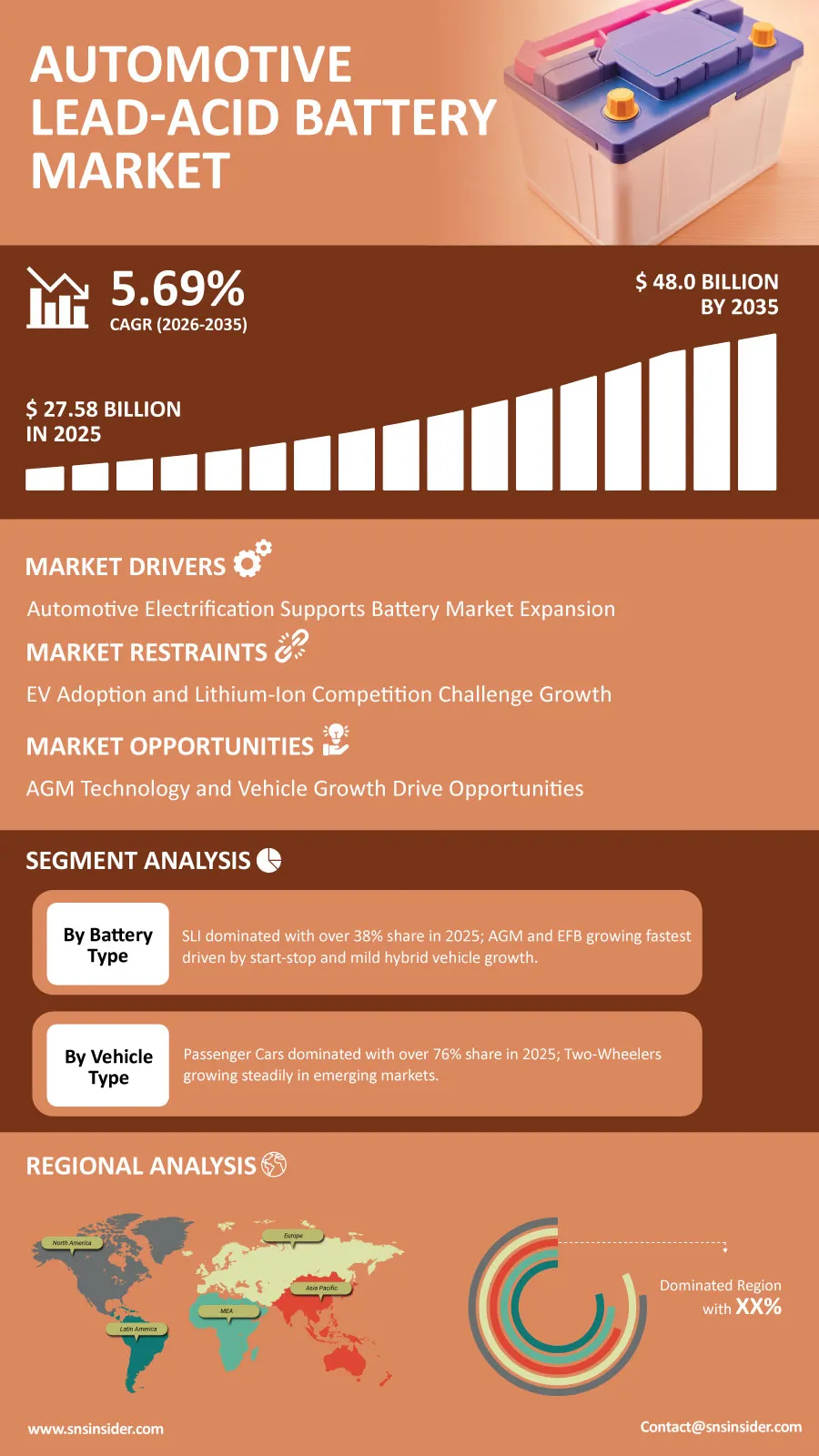
The global Automotive Lead-Acid Battery Market is expected to maintain steady growth as vehicle ownership continues to expand and replacement battery demand remains resilient across developed and emerging economies. “According to a recent study by SNS Insider, the global Automotive Lead-Acid Battery Market size valued at USD 27.58 billion in 2025, is anticipated to grow to USD 48.0 billion by 2035, registering a CAGR of 5.69% over the 2026–2035 forecast period.”
Despite the rapid evolution of electric mobility, lead-acid batteries continue to play a critical role in the automotive ecosystem by powering ignition systems, supporting vehicle electronics, and enabling dependable engine starting performance. Their affordability, mature manufacturing ecosystem, and highly established recycling network continue to reinforce their importance across passenger cars, commercial vehicles, and two-wheelers.
The market is also benefiting from growing automotive aftermarket activity, increasing fleet maintenance requirements, and broader adoption of start-stop vehicle technologies. Manufacturers are introducing advanced battery designs capable of delivering improved durability, faster charging performance, and enhanced operating efficiency, allowing lead-acid batteries to remain competitive in modern vehicle platforms.
To Get Detailed Insights on This Market – Request a Sample Report
Expanding Vehicle Fleet and Recycling Infrastructure Create Long-Term Growth Opportunities
Global vehicle parc expansion continues to generate recurring demand for replacement batteries, creating a stable revenue stream for battery manufacturers and aftermarket distributors. Aging vehicle fleets in several major automotive markets are increasing replacement cycles, while rising commercial transportation activity further strengthens battery consumption.
Growing investments in battery recycling facilities are also supporting long-term industry sustainability. Efficient recovery of lead and other battery materials reduces production costs while strengthening raw material availability. At the same time, improvements in battery management technologies and enhanced battery monitoring systems are helping vehicle owners optimize battery life and schedule timely replacements.
Increasing penetration of start-stop vehicles is creating additional opportunities for premium battery technologies that deliver superior cycling performance under demanding operating conditions.
Key Market Insights Highlight Changing Battery Demand
Based on battery type, Starting, Lighting and Ignition (SLI) batteries accounted for more than 38% of global market revenue in 2025 due to their widespread use in conventional internal combustion engine vehicles. Absorbent Glass Mat (AGM) and Enhanced Flooded Batteries (EFB) are projected to witness the strongest growth through 2035 as automakers continue integrating start-stop systems into new vehicle platforms.
By vehicle type, Passenger Cars represented over 76% of total market demand in 2025, supported by the large global fleet of privately owned vehicles requiring regular battery replacement. Meanwhile, the Two-Wheeler segment is expected to record steady expansion as urban mobility and motorcycle ownership continue increasing across emerging economies.
The growing replacement market, combined with advances in premium battery technologies, is encouraging manufacturers to diversify product portfolios that address both original equipment manufacturers and aftermarket customers.
Advanced Battery Technologies Support Industry Transformation
Battery manufacturers are investing heavily in research focused on improving energy efficiency, charging acceptance, and operational durability. Carbon-enhanced electrodes, improved grid designs, and optimized electrolyte formulations are extending battery lifespan while supporting higher electrical loads generated by today's connected vehicles.
Integration of battery monitoring systems with vehicle electronics is further transforming maintenance practices by enabling predictive diagnostics and proactive battery replacement. These digital capabilities help reduce unexpected vehicle downtime while improving overall ownership experience.
Ongoing innovation is also helping lead-acid batteries remain an important component of hybrid and start-stop vehicle architectures where dependable low-voltage power remains essential.
Asia Pacific Dominated the Automotive Lead-Acid Battery Market in 2025; North America Forecast to Register the Fastest Growth Through 2035
Asia Pacific accounted for the largest share of global revenue in 2025, supported by extensive automotive manufacturing capacity, a rapidly expanding vehicle population, and strong replacement battery demand across China, India, Japan, South Korea, and Southeast Asia. Continued industrialization and rising vehicle ownership are expected to sustain regional leadership throughout the forecast period.
North America is anticipated to register the fastest growth through 2035, driven by strong aftermarket distribution networks, an aging vehicle fleet, and increasing adoption of premium AGM batteries in passenger and commercial vehicles. Europe also remains an important market as advanced automotive manufacturing, established recycling infrastructure, and broad implementation of start-stop technologies continue supporting steady demand.
Latin America and the Middle East & Africa are experiencing consistent expansion as improving transportation infrastructure, commercial fleet growth, and rising vehicle ownership contribute to higher battery replacement volumes.
Industry Participants Focus on Innovation, Sustainability, and Aftermarket Expansion
Competition across the global automotive lead-acid battery industry continues to intensify as manufacturers strengthen production capabilities, improve recycling efficiency, and expand advanced battery offerings. Companies are investing in premium battery technologies, manufacturing modernization, and strategic partnerships to support growing demand from both vehicle manufacturers and the global replacement market.
Key companies operating in the global Automotive Lead-Acid Battery Market include Clarios International Inc., Exide Technologies, GS Yuasa Corporation, EnerSys Inc., East Penn Manufacturing Co. Inc., C&D Technologies Inc., Amara Raja Energy & Mobility Ltd., Exide Industries Ltd., Chaowei Power Holdings Ltd., Camel Group Co. Ltd., Tianneng Power International Ltd., Fiamm Energy Technology SpA, Furukawa Battery Co. Ltd., CSB Energy Technology Co. Ltd., PT. Century Batteries Indonesia, Tai Mao Battery Co. Ltd., Koyo Battery Co. Ltd., Robert Bosch GmbH, Continental AG, and ACDelco.
An SNS Insider analyst Santosh Bhul commented, "Automotive lead-acid batteries continue to demonstrate long-term relevance through their affordability, established recycling ecosystem, and dependable performance across conventional and start-stop vehicles. As manufacturers introduce more advanced battery technologies and strengthen circular supply chains, the industry is well positioned to capitalize on sustained replacement demand and expanding global vehicle ownership over the coming decade."
About the Author

Get in touch




