
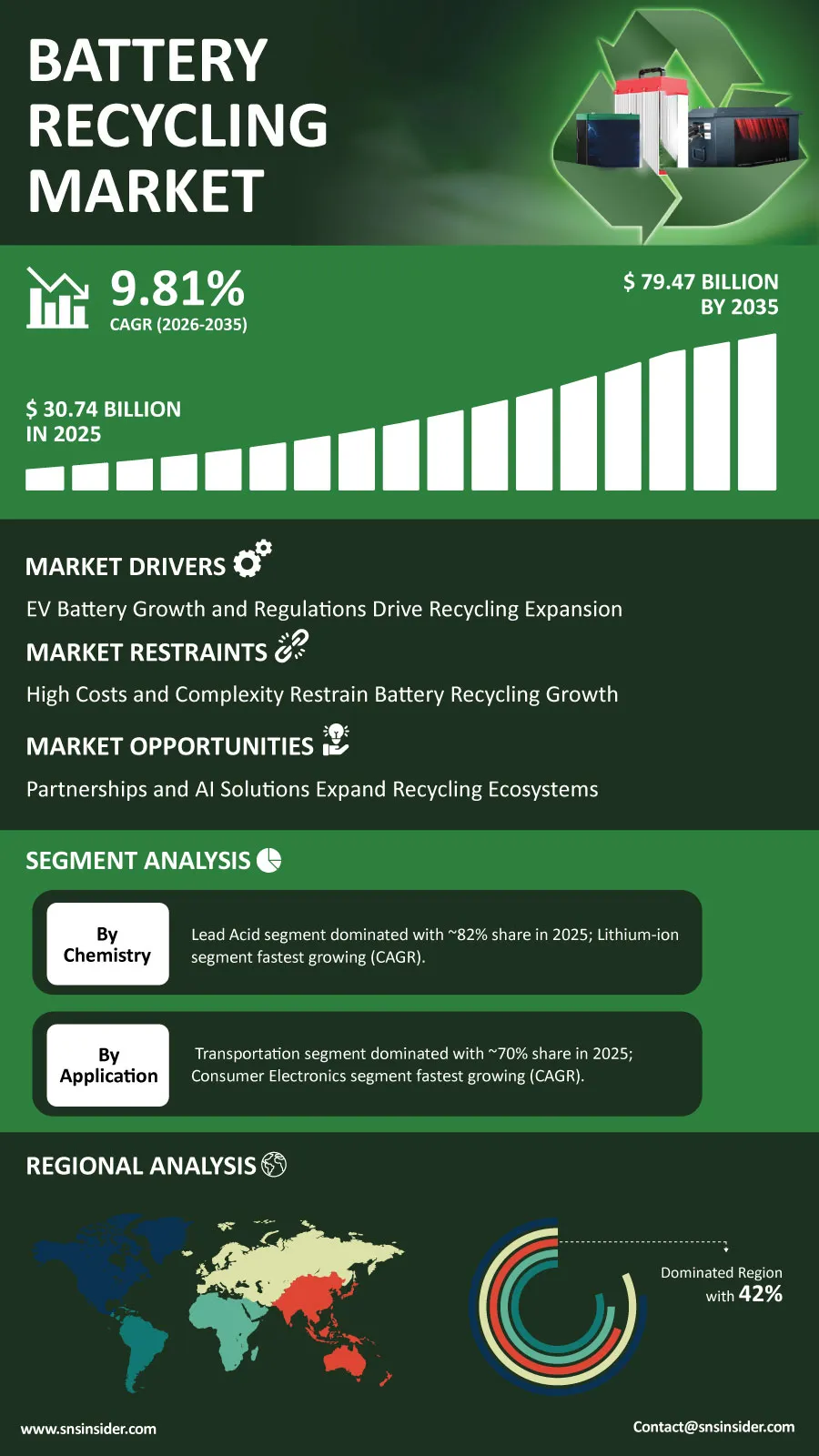
The global Battery Recycling Market is witnessing rapid expansion as governments, battery manufacturers, and automotive companies strengthen investments in sustainable resource recovery and circular supply chains. “According to a recent study by SNS Insider, the global Battery Recycling Market size valued at USD 30.74 billion in 2025, is anticipated to grow to USD 79.47 billion by 2035, registering a CAGR of 9.81% over the 2026–2035 forecast period.”
The move toward more sustainable and green forms of transport, energy storage, and consumer goods is generating an ever-growing need for the raw materials needed for batteries. In view of the millions of batteries that are nearing the end of their useful lives, recycling is emerging as a key method for obtaining the essential materials in an environmentally friendly way. It enables industry players to increase their recycling capacities so as to obtain reusable materials for battery production.
Increased environmental consciousness, positive government regulations, and business sustainability efforts are leading to the implementation of more efficient battery collection and recycling processes in both developed and developing countries. Ongoing advancements in materials extraction technology are helping to make these processes more efficient and profitable.
To Get Detailed Insights on the Battery Recycling Market – Request a Sample Report
Circular Economy Initiatives Create Long-Term Growth Opportunities
There is a rapid move towards circular manufacturing practices in the battery industry to ensure efficient use of resources and recovery of materials. Collaboration between automobile makers, battery makers and recyclers will help create closed-loop manufacturing processes where batteries are used as sources of valuable metals such as lithium, nickel, cobalt, lead and others.
Electric vehicles are gaining more popularity around the world, which means that more batteries will soon become obsolete and enter the recycling process. This trend provides favorable conditions for recyclers along with incentives to invest in automation, digital tracking systems, and advanced methods of materials separation.
The market is also benefiting from increasing public and private funding for sustainable manufacturing initiatives designed to strengthen domestic critical mineral supplies and reduce reliance on imported raw materials.
Key Market Insights Highlight Shifting Industry Demand
By chemistry, Lead Acid batteries represented approximately 82% of global market revenue in 2025, supported by well-established collection networks and mature recycling infrastructure. Lithium-ion batteries are expected to record the fastest expansion through 2035 as electric vehicles and energy storage deployments continue increasing globally.
Based on application, the Transportation segment accounted for nearly 70% of market revenue in 2025 owing to rising vehicle battery replacement volumes and expanding electric mobility. Consumer Electronics is anticipated to deliver the fastest growth during the forecast period as smartphones, laptops, wearable devices, and portable electronics generate increasing quantities of recyclable batteries.
By material, Metals contributed approximately 62% of total market revenue in 2025 due to the strong commercial value of recovered lithium, cobalt, nickel, and lead. Meanwhile, the Electrolyte segment is projected to expand rapidly as technological advancements improve extraction and purification capabilities.
Advanced Recycling Technologies Accelerate Industry Transformation
The use of technology in the field of battery recycling is continually evolving, with innovations in automation of sorting, separation and chemical recycling of materials. Recycling plants now commonly utilize robotics, AI and other digital solutions to streamline their operations while cutting down on processing expenses.
Moreover, manufacturers have been developing new types of recycling technology that enable high-quality extraction of materials for batteries with reduced environmental footprint. These developments not only help increase material efficiency but also assist battery manufacturers to achieve their sustainability goals and ensure reliable sources of strategic minerals.
As battery production expands globally, advanced recycling technologies are expected to play an increasingly important role in reducing waste generation, supporting domestic manufacturing ecosystems, and strengthening critical mineral availability.
Asia Pacific Accounted for More Than 42% Market Share in 2025; North America Forecast to Expand at the Fastest CAGR by 2035
More than 42% of the world Battery Recycling Market was generated from Asia Pacific due to its extensive battery manufacturing industry, electric vehicle manufacturing, and growing battery recycling facilities. Further investments into sustainable manufacturing and favorable regulations have helped sustain this market’s dominance in terms of battery recycling and resource reuse.
The North American market is poised to become the fastest-growing regional market until 2035 due to rising investments into local battery manufacturing, EV manufacturing, and recycling facilities. Increased public investments, industrial collaborations, and capacity expansion are contributing to the growing regional potential, which will ensure supply chain security in the long run.
Another important regional player in terms of global Battery Recycling Market growth is Europe. It will be fueled by growing sustainability regulations and recycled content requirements that would promote more advanced battery recovery methods. At the same time, Latin America and MEA regions are setting up their formal battery recycling infrastructure due to the growing demand for batteries in various sectors.
Industry Participants Expand Capacity Through Innovation and Strategic Partnerships
Competition across the Battery Recycling Market continues to intensify as leading companies expand processing capacity, strengthen material recovery capabilities, and establish strategic collaborations across the battery value chain. Investments in automation, hydrometallurgical processing, digital traceability, and closed-loop recycling systems are enabling companies to improve operational efficiency while meeting rising global demand for recycled battery materials.
Key companies operating in the global Battery Recycling Market include Li-Cycle Holdings Corp., Redwood Materials, Inc., Umicore SA, GEM Co., Ltd., Brunp Recycling Technology Co., Ltd., Retriev Technologies Inc., Battery Resources LLC, Accurec Recycling GmbH, International Metals Reclamation Co. (INMETCO), Glencore plc, Ecobat Technologies Ltd., Stena Recycling AB, Northvolt AB (Revolt Division), Envirostream Australia Pty. Ltd., Aqua Metals Inc., Toxco Inc., Sumitomo Metal Mining Co., Ltd., TES-AMM Pte. Ltd., Engitec Technologies SpA, and Veolia Environment SA.
An SNS Insider analyst Santosh Bhul commented, “Growing electric vehicle adoption, expanding renewable energy deployment, and increasing emphasis on critical mineral security are reshaping the global battery recycling landscape. Companies investing in advanced recovery technologies, scalable recycling infrastructure, and collaborative circular economy models will be well positioned to capitalize on sustained long-term market opportunities.”
About the Author

Get in touch




