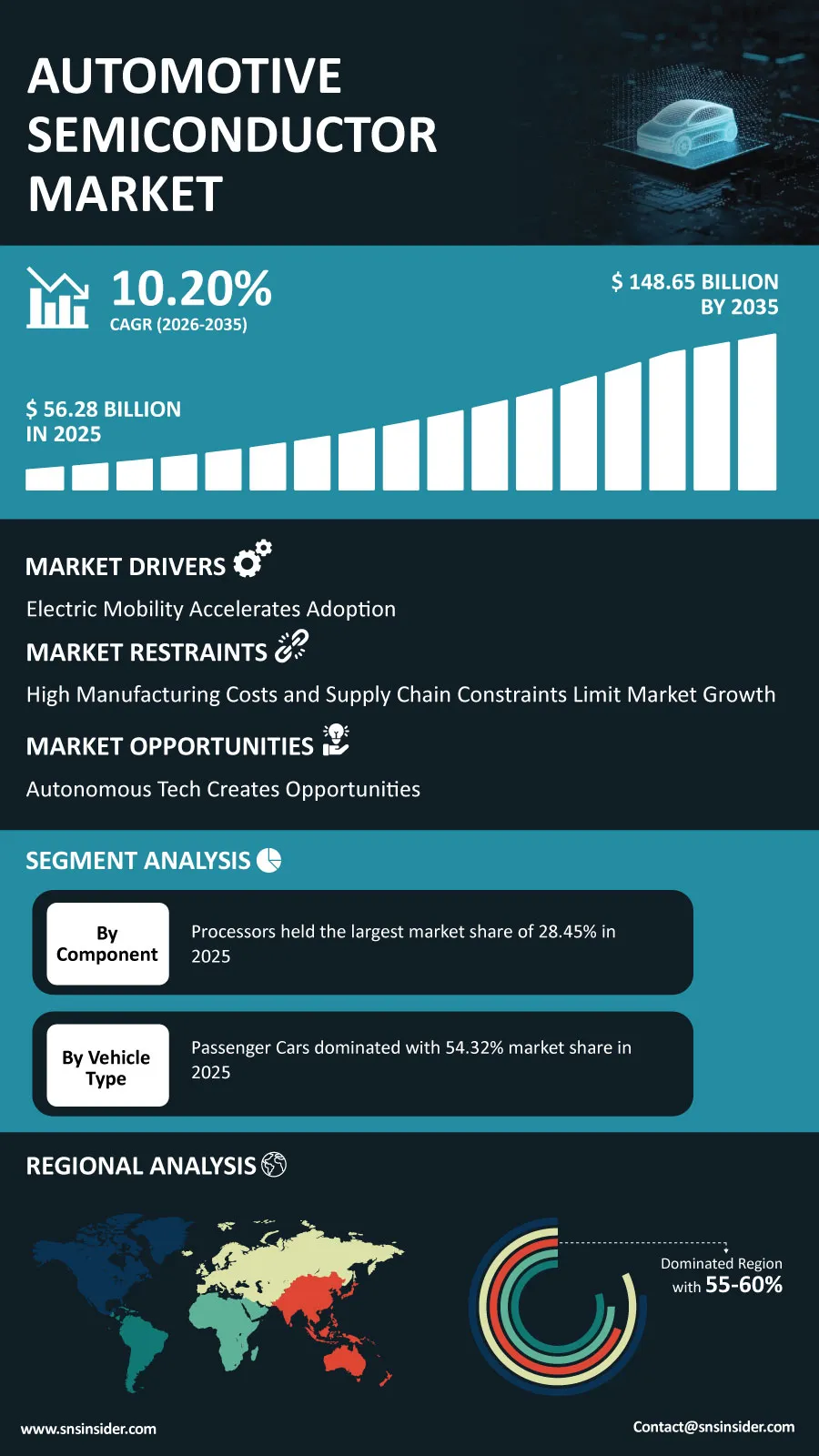
The global automotive sector is entering a new era of digital transformation, resulting in long-lasting demand for cutting-edge semiconductor technologies that power electrification, advanced safety systems as well as connected mobility. “According to a recent study by SNS Insider, the global Automotive Semiconductor Market size valued at USD 56.28 billion in 2025, is anticipated to grow to USD 148.65 billion by 2035, registering a CAGR of 10.20% over the 2026–2035 forecast period.”
Modern vehicles are turning to be software defined platforms with profile enabling advanced electronic architectures. The integration of intelligent computing, high-speed connectivity and advanced power management technologies within the automobile continues to increase semiconductor content per vehicle across passenger and commercial transportation segments.
This feeds strong demand in the market due to the rapid growth of electric mobility. They must have power devices, microcontrollers, memory solutions, sensors and processors that can operate reliably while maximizing energy efficiency to last all day on battery power. At the same time, increasing consumer preference for further safety and infotainment, as well as autonomous driving features, is pushing manufacturers to adopt more sophisticated semiconductor solutions across all vehicle platforms.
To Get Detailed Insights on the Automotive Semiconductor Market – Request a Sample Report
Intelligent Mobility and Vehicle Electrification Create New Growth Opportunities
To that end, governments across the globe are still backing vehicle electrification via tight emissions regulations, incentive programs and investments in charging infrastructure. These initiatives are accelerating the deployment of electric and hybrid vehicles by automobile manufacturers in the mid-term, giving rise to long-term opportunities for semiconductor suppliers.
The addressable market is further expanding by the increasing adoption of vehicle-to-everything (V2X) communication, artificial intelligence, and predictive maintenance technologies. Novel Semiconductor Capabilities: Sophisticated semiconductor parts allow for real-time information processing, seamless network and knowledge-driven mobility improvements that enable manufacturers to construct safer and more efficient transportation ecosystems.
Simultaneously, advancements in manufacturing processes and chip architectures are allowing companies to provide better computing performance at lower power consumption, opening the door to new markets within both premium and mass-market vehicle segments.
Key Market Insights Highlight Changing Industry Priorities
By component, processors held the largest revenue share of 28.45% of the global market size in 2025, driven by growing adoption across advanced driver assistance systems, infotainment platforms and autonomous driving technologies. At the same time, the sensors segment is likely to experience the strongest growth up until 2035 due to automated safety and environmental monitoring functionalities becoming integrated in vehicles.
Based on vehicle type, in 2025 according to consumption volume and the growing integration of electronic systems in passenger vehicles, passenger cars accounted for 54.32% of total market revenue. As global electrification strategies gain momentum, electric and hybrid electric vehicles (EV/HEV) are expected to be the fastest-growing vehicle type throughout the forecast period.
By fuel type, gasoline-powered vehicles and trucks accounted for the largest share of 2025 market, with EV and hybrid platforms expected to show the highest growth rate through the next decade. Powertrain systems accounted for 31.76% of market revenue by application in 2025 and Safety & ADAS applications are expected to provide the strongest future growth
Semiconductor Innovation Accelerates Automotive Transformation
Heavy investments are made by technology providers into next-generation automotive chips designed to enhance processing speed, functional safety, cybersecurity and energy efficiency. With this high performance computing (HPC) platforms, AI-enabled processors, advanced sensing technologies and power management solutions become core foundational building blocks for what future vehicle architectures would look like.
Additionally, Manufacturers are entering into strategic collaborations with automotive OEMs to further reinforce supply resilience at a faster pace of innovation. Additional investments in semiconductor fabs, onshore production capabilities and advanced packaging technology will likely enhance long-term supply stability and underpin higher global vehicle production.
These advances in technology are making it possible to have smart cars that can offer advanced driver assistance, over-the-air software upgrades, predictive diagnostics and eventual autonomous driving abilities.
Asia Pacific Accounted for Nearly 55–60% Market Share in 2025; North America Forecast to Witness Strong Growth Through 2035
By 2025, Asia Pacific is predicted to remain on the top with a share of nearly 55–60% of worldwide market earnings. These factors include both existing automobile manufacturing on a large scale along with new semiconductor production capacity, growing electric vehicle adoption, and industrial policies from the largest economies in Asia, including China, Japan, South Korea and India.
North America is still the fastest growing market due to local investments in semiconductor production and advanced automotive technologies, as well as software-defined vehicles and electric mobility initiatives. Ongoing advancements in autonomous driving platforms as well as connected vehicle ecosystems could promote future regional development.
Europe is also a significant driver as OECD member countries continue to impose strict emissions legislation, vehicle safety standards, and electrification programs, stimulating demand for more sophisticated semiconductor technology throughout the automotive value chain.
Industry Leaders Intensify Investments in Next-Generation Automotive Chips
The competitive landscape of the global Automotive Semiconductor Market has been shaped by investing in product innovation, manufacturing expansion, strategic alliances and R&D for high-performance automotive electronics. Players are catering to the changing customer requirements across electric, connected, and autonomous vehicles by enabling AI processors, next-generation memory technologies, power semiconductors and intelligent sensing platforms.
Key companies operating in the global Automotive Semiconductor Market include Analog Devices Inc., Infineon Technologies AG, NXP Semiconductors N.V., Renesas Electronics Corp., Robert Bosch GmbH, ROHM Co. Ltd., STMicroelectronics N.V., Toshiba Corp., Texas Instruments Inc., ON Semiconductor, Qualcomm Technologies Inc., Micron Technology Inc., Intel Corporation, AMD (Xilinx), Marvell Technology Inc., Cadence Design Systems Inc., Keysight Technologies Inc., Arm Ltd., GlobalFoundries Inc., and Microchip Technology Inc.
An SNS Insider analyst Santosh Bhul commented, "The convergence of vehicle electrification, intelligent safety technologies, and connected mobility is fundamentally reshaping semiconductor demand across the automotive industry. Organizations investing in advanced chip architectures, AI-enabled computing platforms, and resilient manufacturing capabilities are expected to secure long-term competitive advantages as next-generation mobility continues to evolve."
About the Author

Get in touch