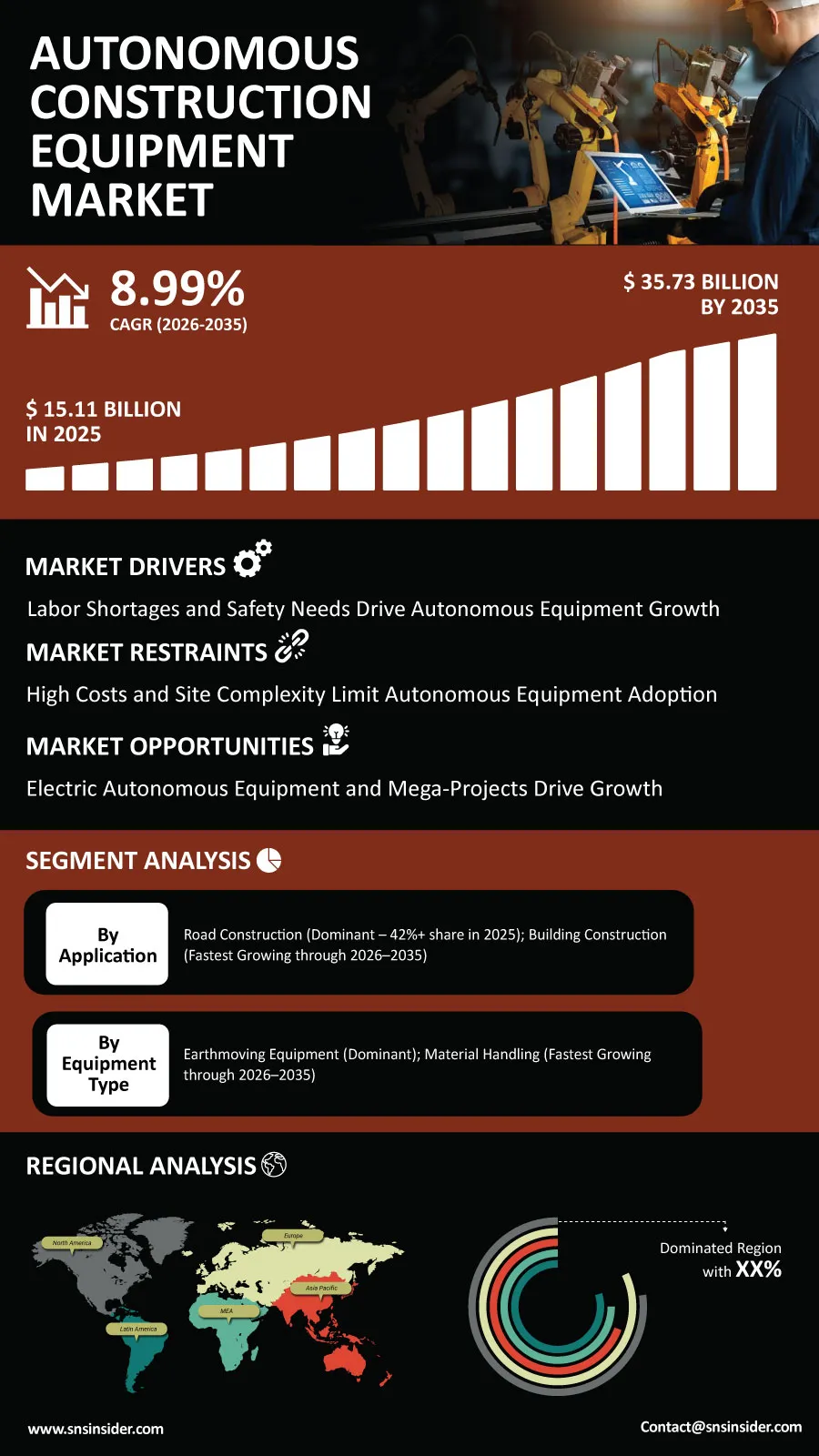
The global Autonomous Construction Equipment Market is entering a new era of digital transformation as contractors, infrastructure developers, and equipment manufacturers increasingly embrace intelligent machinery to improve project efficiency. “According to a recent study by SNS Insider, the global Autonomous Construction Equipment Market size valued at USD 15.11 billion in 2025, is anticipated to grow to USD 35.73 billion by 2035, registering a CAGR of 8.99% over the 2026–2035 forecast period.”
Fast pace of urbanization, rising infrastructure development plans, and an increasing scarcity of skilled construction workers are fueling investments in self-driving machines globally. Innovative technologies like artificial intelligence, computer vision, precision GPS, LiDAR, and telematics are allowing heavy machines to complete their assigned tasks effectively and consistently.
Construction firms are increasingly focusing on digitized site management as well for minimizing operation costs, maximizing safety of workers, and fleet optimization. As the government is allocating more resources towards transportation, energy, and infrastructure development projects, self-driving construction machines have emerged as a key resource in both developed and developing nations.
To Get Detailed Insights on This Market – Request a Sample Reportn
Intelligent Construction Technologies Unlock Long-Term Growth Opportunities
The increasing adoption of automation has turned out to be the key part of construction strategies. The use of intelligent machines that can perform excavations, grading, paving, and material handling with little involvement from the operator allows for minimizing downtime and optimizing the project schedule.
With further advances in electric drive trains, fleet management systems that work through the cloud, and predictive maintenance technologies, there are more and more possibilities for equipment providers. Thanks to these technological advances, construction companies can make their machines more efficient and save fuel.
Investment into smart cities, transportation routes, industrial plants, and renewable energy facilities will provide even more impetus to the demand for construction automation in the coming decade.
Key Market Insights Highlight Changing Equipment Demand
Based on autonomy level, Semi-Autonomous Equipment accounted for more than 62% of global market revenue in 2025, supported by broad commercial deployment and practical integration into existing construction workflows. Fully Autonomous Equipment is expected to register the fastest expansion through 2035 as AI capabilities and sensor technologies continue advancing.
By application, Road Construction represented over 42% of market revenue in 2025 due to widespread adoption of automated grading, paving, and material movement. Building Construction is projected to experience the highest growth during the forecast period as urban development projects increasingly adopt intelligent machinery.
Among equipment types, Earthmoving Equipment maintained market leadership in 2025, while Material Handling Equipment is anticipated to record the fastest growth as automated logistics become increasingly important on large construction sites.
Based on power source, Diesel-powered Equipment currently dominates global deployment, whereas Electric Autonomous Equipment is forecast to expand at the fastest pace as sustainability regulations and zero-emission construction initiatives gain momentum.
AI and Connected Machinery Transform Construction Operations
There are also many new developments in the field of construction as companies equip their heavy equipment with such innovative technologies as machine learning, digital mapping, real-time analytics, and autonomous navigation. Thanks to these technologies, machinery becomes more precise and decreases variability during its operation.
Fleet management solutions, predictive diagnostics, and remote machinery control contribute to the optimization of maintenance operations and increasing the availability of equipment. In combination with innovations in electric vehicles and intelligent automation, this technology revolution changes the standards of productivity for the entire construction industry on a worldwide scale.
In the future, as digital construction ecosystems become more advanced, the use of autonomous equipment will be one of the key factors in achieving this goal.
North America Accounted for the Largest Market Share in 2025; Asia Pacific Forecast to Expand at the Fastest CAGR by 2035
North America continued dominating the global Autonomous Construction Equipment Market in 2025 due to high levels of infrastructure investments, technological advancements, and availability of equipment manufacturers in the region. High investments in transportation, along with shortage of labor, are expected to continue driving the need for intelligent construction equipment in North America.
The Asia Pacific is forecasted to be the fastest-growing region through 2035 due to rapid urbanization, expansion of industries, and investments in infrastructure in countries such as China, India, Japan, and Southeast Asian countries. Initiatives in building smart cities, investment in high-speed transportation systems, and construction automation are creating market opportunities in the region.
Europe is continuously adopting more autonomous equipment owing to sustainable construction practices and digitization of infrastructure in the region, whereas the Middle East, Africa, and Latin America regions are showing increasing adoption owing to megaprojects, mining, and urbanization efforts.
Industry Participants Accelerate Innovation Through Smart Equipment Development
Competition across the autonomous construction equipment industry remains highly dynamic as manufacturers invest in artificial intelligence, electrification, advanced sensing technologies, and connected fleet management solutions. Strategic collaborations, product innovation, and continuous investment in automation platforms are enabling companies to deliver higher productivity while addressing evolving customer requirements across construction, mining, and infrastructure applications.
Key companies operating in the global Autonomous Construction Equipment Market include Caterpillar Inc., Bobcat Company, CNH Industrial America LLC, Komatsu Ltd., AB Volvo, Hitachi Construction Machinery Co., Ltd., Sany Group, Royal Truck & Equipment, TOPCON CORPORATION, Built Robotics, Deere & Company, Doosan Infracore, Trimble Inc., Leica Geosystems AG, Hyundai Construction Equipment Co., Ltd., Komatsu Mining Corp., JCB, Liebherr Group, XCMG Group, and Cognex Corporation.
An SNS Insider analyst Santosh Bhul commented, “Growing digitalization of construction operations, combined with advances in artificial intelligence, connected equipment, and autonomous control systems, is creating long-term opportunities across the global construction ecosystem. Companies investing in intelligent machinery, sustainable equipment platforms, and next-generation automation technologies are expected to strengthen their competitive position as infrastructure development accelerates worldwide.”
About the Author

Get in touch