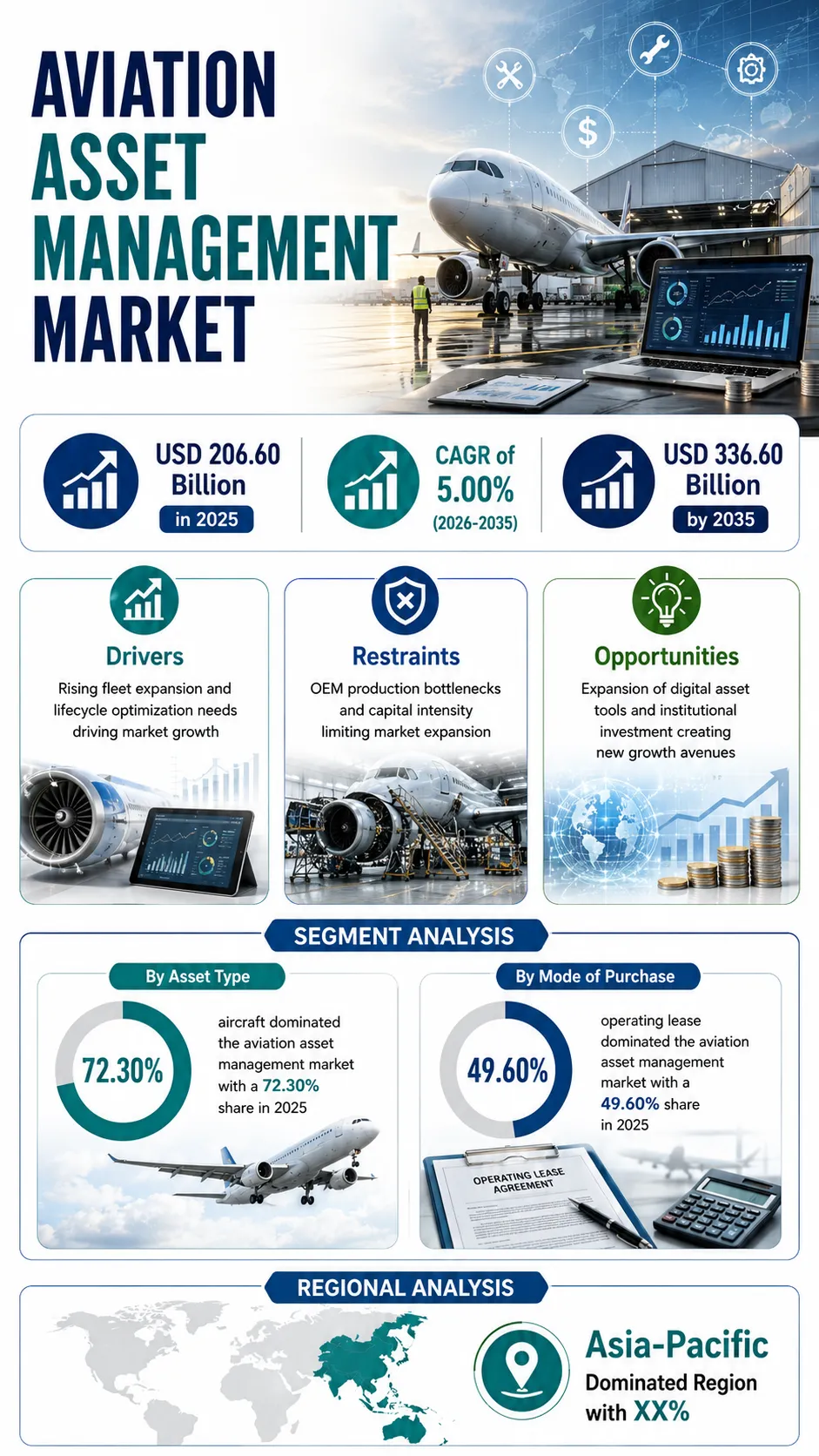
The global Aviation Asset Management Market is set for steady expansion as fleet optimization needs and structured leasing models continue to reshape aircraft ownership strategies worldwide. “According to a recent study by SNS Insider, the global Aviation Asset Management Market size valued at USD 206.60 billion in 2025, is anticipated to grow to USD 336.60 billion by 2035, registering a CAGR of 5.00% over the 2026–2035 forecast period.”
There have been notable changes within aircraft lifecycle management technology over time, due to which many airlines and lessors who aim at improving asset value can take advantage of this trend. This includes the need for more sophisticated financial structuring and digital fleet planning tools that will provide operators with the ability to optimize utilization and residual value across increasingly complex ownership arrangements. This applies in situations where aviation asset management supports aircraft, engine, and component lifecycle optimization. Airlines and lessors are constantly working hard to ensure that their asset management strategies perform better than before in order to meet various financial and operational efficiency requirements.
To Get Detailed Insights on the Aviation Asset Management Market – Request a Sample Report
Structured Leasing Models Create New Demand
The aviation asset management market has evolved from basic aircraft ownership tracking to increasingly sophisticated, financially structured lifecycle optimization services. The growing investment in digital fleet planning tools, predictive maintenance analytics, and institutional-grade portfolio management across service providers of all sizes has required the development of more comprehensive asset management platforms.
New financial structuring and technology tools can increase asset utilization efficiency, improve residual value realization, and allow for expansion into increasingly sophisticated leasing and remarketing arrangements. This gives airlines and lessors the possibility to optimize aircraft and engine portfolios while maintaining regulatory compliance and maximizing long-term returns.
Aircraft lessors, MRO providers, and technology companies are increasingly cooperating thanks to the growing interest in developing future solutions for sophisticated, data-driven aviation asset lifecycle management.
Key Market Findings Highlight High-Growth Segments
The aircraft segment dominated all categories in the aviation asset management market share with a market revenue share of 72.30% in 2025 due to its status as the largest single capital investment within airline and lessor portfolios. The fastest growing category is expected to be engines which will grow at a CAGR of 7.40% through 2035, owing to growing complexity of engine leasing and maintenance-by-the-hour arrangements.
By mode of purchase, operating leases held the largest share of total market revenue at 49.60% in 2025 due to their flexibility and balance sheet advantages. Sale and leaseback arrangements will see the fastest growth in revenue generation at a CAGR of 8.60%, driven by airlines increasingly unlocking aircraft asset liquidity.
Based on service type, leasing services generated a share of 44.60% of market revenue in 2025 thanks to the global airline industry's widespread reliance on leased aircraft. On the other hand, financial and portfolio management will be the segment recording the fastest revenue growth at a CAGR of 6.75%, supported by growing institutional investor demand for professional oversight.
Distributive end-user trends are changing as well. Airlines accounted for a 46.80% revenue share in 2025 owing to their direct responsibility for fleet composition and maintenance decisions. But leasing companies will turn out to be the fastest-growing end-user category through 2035, on the back of growing airline adoption of asset-light business models.
Asset Optimization, Digital Tools, and Financial Structuring Gain Importance
In this regard, airlines and lessors have been looking at asset management strategies that would deliver more consistent residual value while requiring less capital intensity and offering greater financial flexibility.
Innovation in digital fleet planning software, predictive maintenance analytics, and structured financing arrangements has been making it possible for companies to come up with services that can operate effectively across increasingly complex global fleet portfolios. In addition to that, increasing emphasis on institutional-grade portfolio management is also making it possible for asset managers to find solutions that meet evolving investor and regulatory expectations. Such trends are likely to become even more prominent in the future.
Asia Pacific Emerges as the Largest Market Amid Rising Fleet Expansion
The Asia Pacific region represented the largest share of regional market revenue in 2025, owing to rapidly expanding commercial aviation fleets, rising air passenger traffic, and growing aircraft leasing activity across the region's major economies. On the other hand, North America is expected to be the fastest-growing market during the forecast period through 2035, propelled by a strong focus on sustainability influencing investment strategies and substantial institutional investor participation in aviation asset management vehicles.
Leading Companies Drive Innovation and Competition
The environment continues to stay very dynamic since players continue innovating on digital fleet tools and structured financing as well as forming partnerships in order to enhance their position in the industry. Some of the major companies that operate in the global aviation asset management market are AerCap Holdings, Avolon Aerospace Leasing, Air Lease Corporation, BOC Aviation, GE Capital Aviation Services, SMBC Aviation Capital, Boeing Global Services, Airbus Group, Aircastle, and Nordic Aviation Capital.
An SNS Insider analyst Santosh Bhul commented, "The growing complexity of global fleet ownership structures is creating sustained demand for sophisticated, data-driven aviation asset management services. Companies that successfully combine financial structuring expertise, digital fleet tools, and institutional-grade portfolio management will be best positioned to capitalize on emerging opportunities across airline, leasing company, and MRO applications."
About the Author

Get in touch