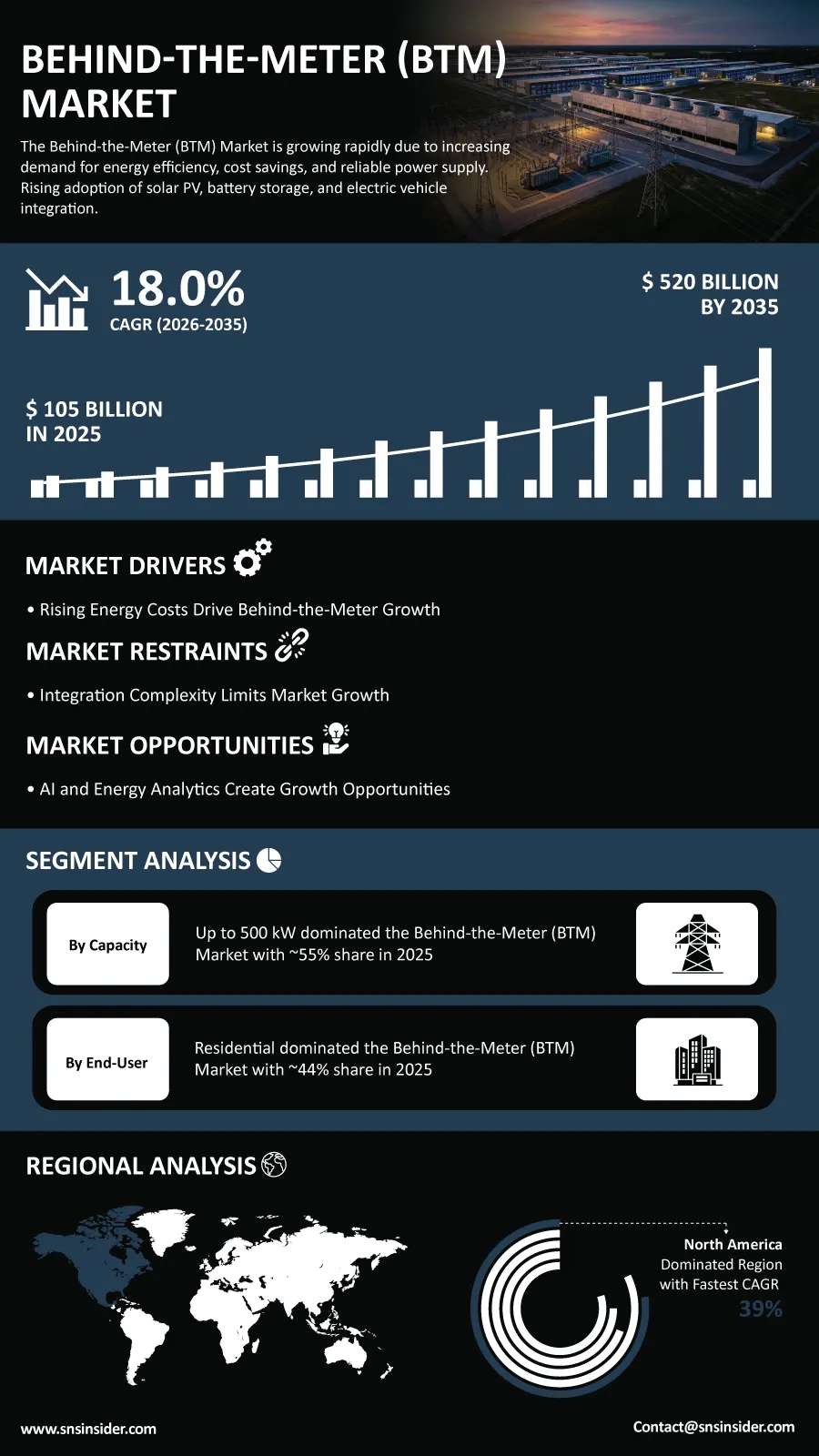
The global energy landscape is rapidly shifting toward decentralized electricity generation as organizations and consumers seek greater control over energy costs, sustainability, and grid reliability. Behind-the-Meter (BTM) technologies have emerged as a critical solution for improving energy resilience by combining on-site renewable generation, intelligent storage systems, and advanced digital energy management. “According to a recent study by SNS Insider, the global Behind-the-Meter Market size valued at USD 105 billion in 2025, is anticipated to grow to USD 520 billion by 2035, registering a CAGR of 18% over the 2026–2035 forecast period.”
The mounting need to cut down on carbon emissions and update old power generation systems is motivating government entities, power utility firms, and corporations to spend vast amounts of money on energy resources that are decentralized. Corporations are increasingly using behind-the-meter energy resources to save costs on energy, ensure continuity of operations, and minimize reliance on traditional utility grids.
To Get Detailed Insights on the Behind-the-Meter Market – Request a Sample Report
Energy Independence and Grid Modernization Create Strong Market Opportunities
Rising electricity costs and worries about power grids have been spurring a growing demand for energy production on-site. Behind-the-meter systems are being deployed by commercial properties, industrial operations, healthcare centers, and households in order to ensure better access to energy and reduce exposure to rising tariffs.
Meanwhile, the widespread development of electric vehicle charging stations is creating more opportunities. Solar panels and batteries can be used for charging electric cars while keeping power consumption during peak hours down. In addition to that, governmental support schemes, net-metering regulations, and decarbonization plans by companies are fueling investments in distributed energy systems.
Artificial intelligence, cloud-based analytics, and advanced energy management software are also transforming system performance by enabling predictive maintenance, automated load balancing, and real-time optimization. These digital capabilities are allowing end users to maximize renewable energy utilization while participating in demand response programs that generate additional financial value.
Key Market Insights Highlight Changing Investment Priorities
Based on capacity, systems up to 500 kW accounted for nearly 55% of total market revenue in 2025, reflecting widespread deployment across residential properties and small commercial facilities where affordable decentralized energy solutions remain a priority. Meanwhile, installations above 500 kW are expected to witness the fastest expansion through 2035 as industrial users invest in larger energy systems capable of supporting high electricity demand.
By end user, the residential segment represented approximately 44% of market revenue during 2025, driven by increasing rooftop solar adoption, supportive government incentives, and growing consumer awareness regarding energy independence. The commercial segment is forecast to experience the highest growth rate throughout the forecast period as businesses seek to reduce operating costs while meeting ambitious environmental sustainability targets.
Technology trends also continue reshaping investment decisions. Solar photovoltaic (PV) systems generated nearly 40% of market revenue in 2025 due to declining installation costs, technology maturity, and broad global adoption. However, Battery Energy Storage Systems (BESS) are expected to record the strongest future growth as organizations increasingly prioritize grid resilience, renewable integration, and intelligent energy optimization.
Similarly, lithium-ion batteries remain the preferred storage technology because of their high efficiency, longer operational lifespan, declining costs, and compatibility with distributed renewable energy systems. Growing investment in battery manufacturing and continuous improvements in storage performance are expected to further strengthen long-term market expansion.
Advanced Digital Energy Technologies Accelerate Industry Transformation
The aspect of innovation will play a key role in the development of the BTM Market as service providers continue to introduce artificial intelligence, cloud technology, and intelligent automation to enhance the performance of distributed energy systems. Today's energy management software allows for the real-time tracking of electricity production, battery performance, and consumption, helping users make decisions that help optimize performance and save on costs.
Through the use of smart sensors, prediction tools, and IoT, companies will be able to automate their energy consumption, while also ensuring that they benefit from increased reliability of assets. The use of demand response technologies will offer customers an additional source of income as they will help stabilize the power grid during peak hours of demand.
North America Accounted for 39% Market Share in 2025; Asia Pacific Forecast to Expand at a 45.73% CAGR by 2035
North America held around 39% of the global market revenue in 2025, owing to robust renewable energy infrastructure, supportive regulations, and substantial investments in distributed energy sources. The region will benefit from the extensive use of solar PV systems, energy storage technology, and corporate sustainability programs that foster decentralization of power generation. The development of electricity infrastructure and growing usage of energy management solutions are estimated to maintain market leadership during the forecast period.
The most rapid market growth is expected to be recorded in Asia Pacific during the 2035 forecast period, at a CAGR of 45.73%. The fast pace of industrialization, growing electricity demand, increasing investments into renewable energy facilities, and the presence of supportive government initiatives fuel the large-scale adoption of behind-the-meter solutions in residential, commercial, and industrial applications. Increasing investments into solar energy, battery storage, and smart grids make the region an important contributor to the growth of the global market.
Another region with a high market share is Europe, as governments continue setting renewable energy targets and encouraging distributed energy adoption via supportive policies. Growing investments into energy storage systems, corporate decarbonization measures, and smart energy infrastructure make the market environment conducive for behind-the-meter solutions. Latin America and the Middle East & Africa are developing as promising markets because of growing electricity demand and renewable energy investments, along with increasing awareness of energy security.
Industry Participants Accelerate Innovation in Distributed Energy Solutions
Competition within the global Behind-the-Meter Market continues to intensify as leading companies expand investments in digital energy management, advanced battery storage, intelligent software platforms, and renewable energy integration. Strategic partnerships with utilities, technology providers, and commercial enterprises are helping market participants strengthen product portfolios while supporting the growing transition toward decentralized electricity systems.
Manufacturers are also prioritizing scalable energy storage solutions, AI-enabled optimization platforms, and integrated solar-plus-storage offerings capable of delivering higher operational efficiency and improved grid flexibility. Continuous innovation in battery technologies and cloud-based energy analytics is expected to remain a key competitive differentiator throughout the coming decade.
Key companies operating in the global Behind-the-Meter (BTM) Market include Schneider Electric SE, Siemens AG, ABB Ltd., Eaton Corporation plc, Tesla Inc., Enphase Energy Inc., SolarEdge Technologies Inc., Generac Holdings Inc., Panasonic Corporation, LG Energy Solution Ltd., Honeywell International Inc., Johnson Controls International plc, GE Vernova, Hitachi Energy Ltd., SMA Solar Technology AG, Sungrow Power Supply Co., Ltd., NEC Corporation, Toshiba Energy Systems & Solutions Corporation, and Delta Electronics, Inc.
An SNS Insider analyst Santosh Bhul commented, "The rapid expansion of distributed energy resources, digital energy management platforms, and advanced battery technologies is fundamentally reshaping global electricity infrastructure. Organizations investing in intelligent behind-the-meter solutions that combine renewable generation, energy storage, and AI-driven optimization will be well positioned to benefit from the accelerating transition toward resilient, decentralized, and low-carbon energy systems."
About the Author

Get in touch