
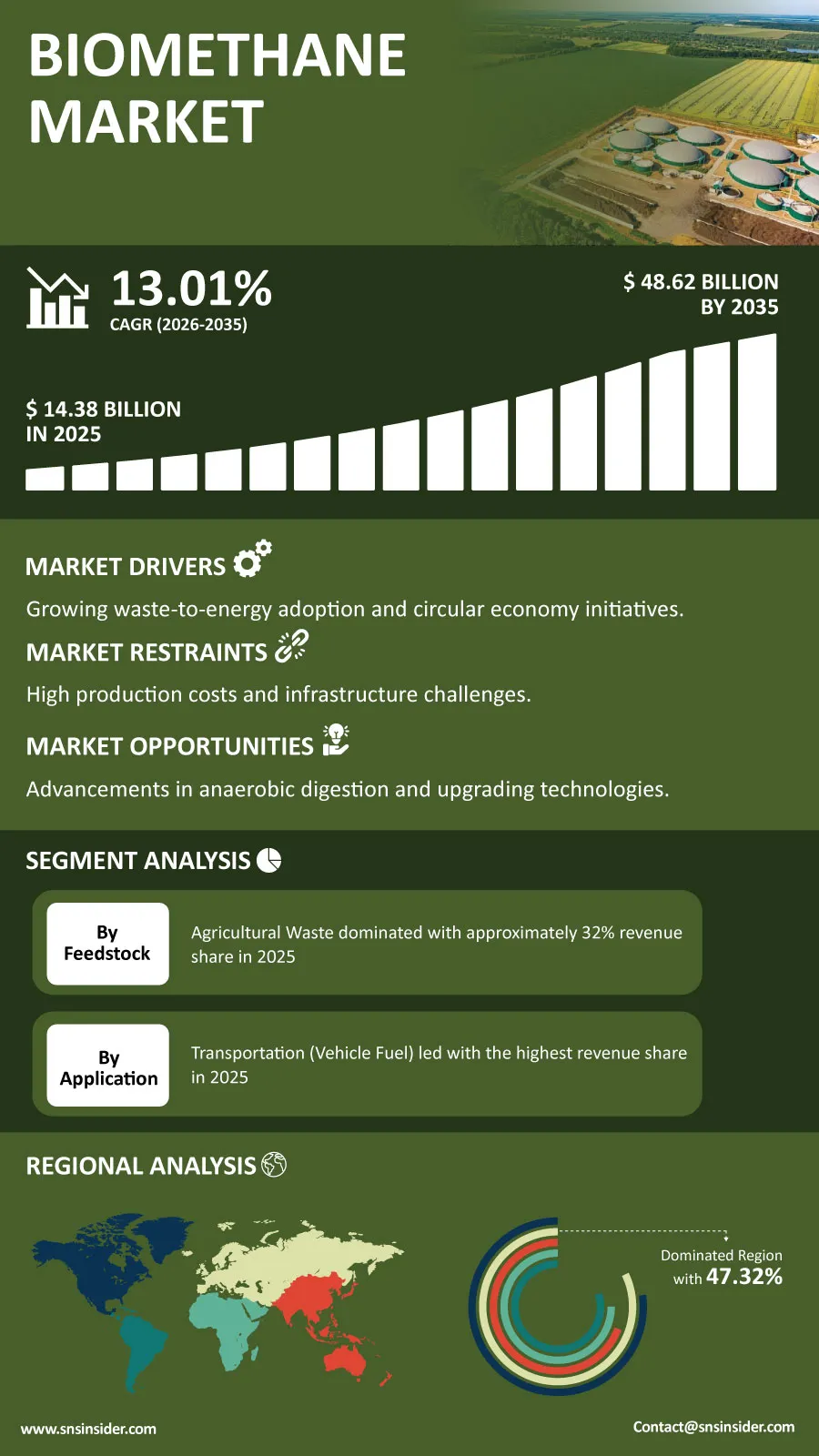
The world Biomethane Market is poised to experience accelerated growth due to the increasing preference for renewable gas as a means of lowering carbon emissions by using existing natural gas networks. “According to a recent study by SNS Insider, the global Biomethane Market size valued at USD 14.38 Billion in 2025, is anticipated to grow to USD 48.62 Billion by 2035, registering a CAGR of 13.01% over the 2026–2035 forecast period.”
Increasing importance of energy security, sustainable waste disposal, and circular economy approaches is greatly boosting the market outlook globally. Biomethane, which is derived through upgrading biogas obtained from agricultural wastes, municipal organic wastes, sewage sludge, and food processing industry wastes, is becoming increasingly accepted as a feasible renewable source of gas compared to natural gas. The compatibility of biomethane with existing gas pipeline infrastructure makes its fast adoption easier in domestic, commercial, transport, and industrial sectors.
With increasing adoption of ambitious climate change policies and renewable energy targets in various countries, the investments in anaerobic digestion plants, gas upgrading technology, and renewable gas delivery networks will see a considerable boost in the next ten years.
To Get Detailed Insights on the Biomethane Market – Request a Sample Report
Renewable Energy Policies and Circular Economy Investments Unlock Long-Term Opportunities
Supportive government policies that favor the development of renewable gas at the expense of fossil fuel are being implemented in many countries with significant economies. Incentives, renewable fuel mandates, low carbon fuel standards, and carbon reduction programs are driving utilities and private organizations to develop more projects that would produce biomethane.
Growing demand from the heavy duty transport sector for low carbon fuels that help reduce carbon emissions but do not require the complete overhaul of fleets is another driver of increased biomethane production. Growing use of bio-LNG and renewable compressed natural gas has created huge potential for biomethane producers.
Technological innovations in anaerobic digestion, gas cleaning, membrane separation, and pressure swing adsorption have further improved the efficiency of biomethane production and made projects economically feasible.
Key Market Insights Highlight Shifting Demand Patterns
Based on the feedstock, Agricultural Waste represented about 32% of the total market revenue in 2025 because of the high availability and steady availability of feedstock in agriculture operations all over the world. Sewage Sludge is likely to witness the fastest growth up to 2035 owing to the construction of new wastewater treatment and energy recovery facilities.
Based on the production technology, Anaerobic Digestion was responsible for about 78% of total market revenue in 2025 due to its commercial feasibility and popularity. Gasification is expected to grow at the fastest pace up to 2035 due to the increased usage of gasification technologies in industry.
Based on the application type, Transportation (Vehicle Fuel) dominated in 2025 due to the growing need for biofuel in commercial and logistics vehicles. Injection into the Natural Gas Grid is expected to be the fastest-growing CAGR application up to 2035.
Advanced Renewable Gas Technologies Accelerate Industry Transformation
Innovations in the technology behind biogas production continue to optimize processes and enhance its market feasibility. The modern systems for biogas production that use reactor optimization, pre-treatment of feedstock and effective process monitoring yield more methane and reduce the cost of production.
There is also an effort being made to develop better gas upgrading systems that can produce high-quality pipeline biogas in an energy efficient manner. Digital monitoring and predictive maintenance technologies are playing their role in enhancing the efficiency of production.
Europe Held 47.32% Biomethane Market Share in 2025; North America to Record Fastest Growth Through 2035
The Europe region accounted for around 47.32% of total global market revenue in 2025 owing to high renewable gas goals, well-established biomethane facilities, and favorable regulations. Various countries such as Germany, France, Denmark, and Netherlands are increasingly investing in grid injection systems along with renewable gas manufacturing.
The North American region is predicted to dominate among all regional markets in terms of CAGR over the forecast period. High economic incentives from renewable fuel policies, growing corporate purchase of renewable natural gas, and rising investments in agricultural waste, and landfill gas systems are contributing to the regional market growth.
On the other hand, the Asia Pacific region is gaining momentum in the form of a new market owing to abundant agricultural feedstock, developing urban waste facilities, and clean energy policies in China and India.
Industry Participants Focus on Innovation and Renewable Gas Expansion
Competition is increasing among players in the international biomethane industry as players increase their production capacity, develop stronger networks for sourcing feedstocks, and adopt new generation technology for gas upgrading. Collaboration among utility companies, transport firms, municipalities, and industries helps in securing long-term supply contracts while deploying renewable gas at scale.
Key companies operating in the global Biomethane Market include Engie S.A., Air Liquide S.A., Gasum Oy, EnviTec Biogas AG, Future Biogas Ltd., Waga Energy S.A., PlanET Biogas Group GmbH, Clean Energy Fuels Corp., Bright Biomethane B.V., Xebec Adsorption Inc., Veolia Environnement S.A., Greenlane Renewables Inc., Archaea Energy (bp), Hitachi Zosen Inova AG, Axiom Energy Group, Pentair plc, Verbio Vereinigte BioEnergie AG, TotalEnergies SE, Nature Energy Biogas A/S (Shell), and Biogest GmbH.
An SNS Insider analyst Himanshu Sharma commented, "Growing policy support for renewable gases, expanding waste-to-energy investments, and increasing demand for low-carbon transportation fuels are reshaping the global biomethane industry. Organizations investing in advanced upgrading technologies, sustainable feedstock management, and integrated renewable gas infrastructure are expected to capture substantial long-term growth opportunities as energy systems continue transitioning toward net-zero emissions."
About the Author

Get in touch




