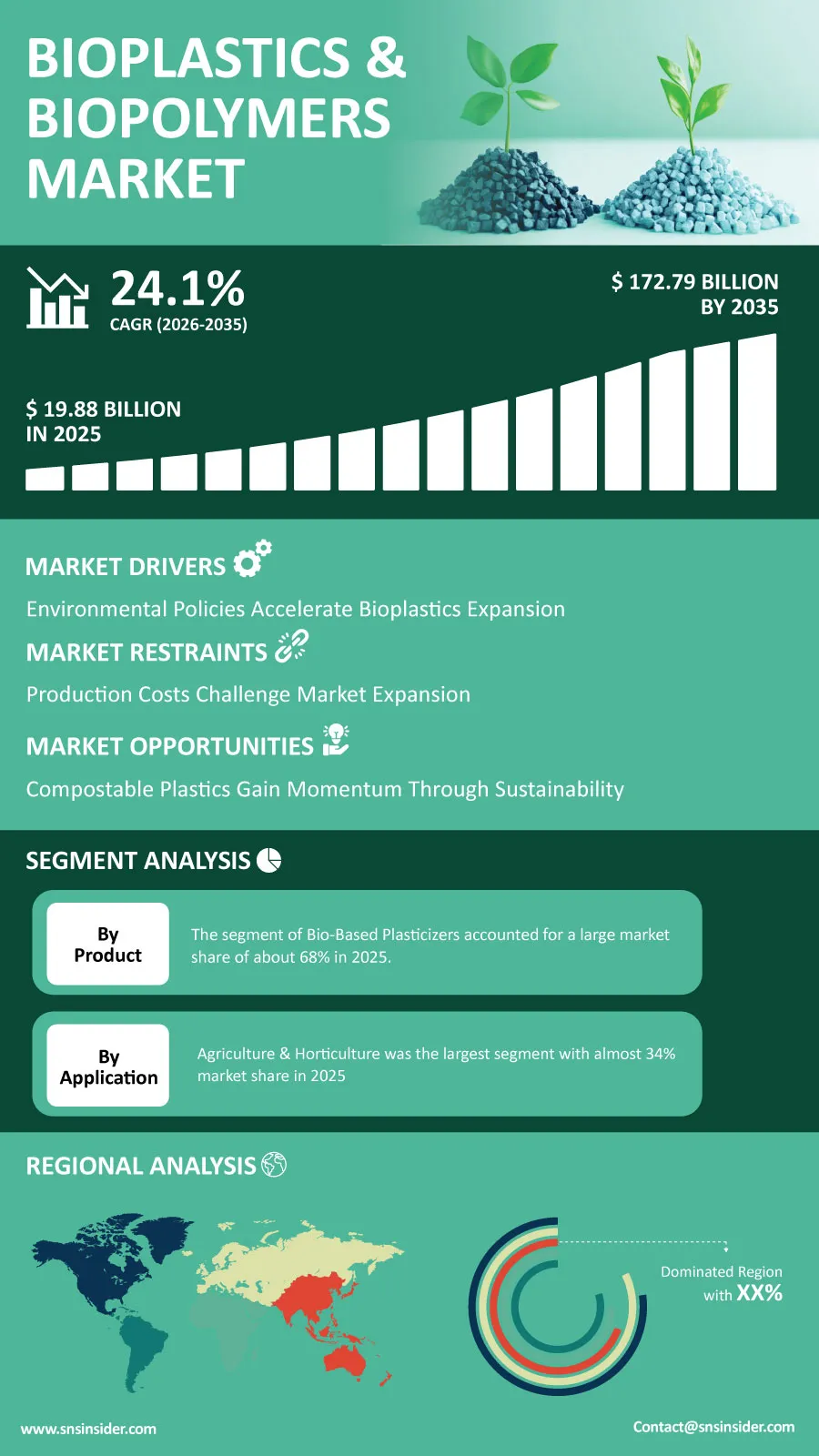
The global Bioplastics & Biopolymers Market is witnessing unprecedented momentum as industries transition toward renewable materials and circular economy practices. “According to a recent study by SNS Insider, the global Bioplastics & Biopolymers Market size valued at USD 19.88 Billion in 2025, is anticipated to grow to USD 172.79 Billion by 2035, registering a CAGR of 24.1% over the 2026–2035 forecast period.”
Growing environmental concerns, tighter regulations on plastic waste, and corporate commitments toward carbon neutrality are accelerating the replacement of petroleum-based plastics with bio-based alternatives. Manufacturers across packaging, agriculture, automotive, healthcare, and consumer goods industries are increasingly adopting biodegradable and renewable polymer solutions to reduce environmental impact while meeting evolving sustainability targets.
Continuous technological improvements in fermentation, bio-refining, and polymer engineering are also enhancing product performance, enabling wider commercial adoption across high-growth industrial applications.
To Get Detailed Insights on the Bioplastics & Biopolymers Market – Request a Sample Report
Circular Economy Initiatives and Sustainable Packaging Create Long-Term Growth Opportunities
Governments and multinational companies are investing heavily in circular economy programs designed to reduce plastic waste and improve resource efficiency. This transition is generating significant demand for compostable packaging materials, renewable feedstocks, and bio-based polymers capable of supporting environmentally responsible manufacturing.
Rapid expansion of e-commerce, food delivery services, and sustainable retail packaging has further strengthened demand for biodegradable plastics. At the same time, agricultural applications such as mulch films, plant containers, and seed coatings continue to expand as farmers seek environmentally friendly alternatives that improve operational efficiency while reducing plastic waste.
Healthcare represents another emerging opportunity, with biocompatible polymers finding increasing use in medical implants, surgical sutures, drug-delivery systems, and advanced biomedical devices. Ongoing investment in biotechnology and material science is expected to unlock additional high-value applications over the coming decade.
Key Market Insights Highlight Evolving Industry Demand
Based on product, Bio-Based Plasticizers accounted for approximately 68% of total market revenue in 2025, supported by rising demand for sustainable materials across packaging, agriculture, and consumer products. Their renewable composition and reduced environmental footprint continue to strengthen market adoption globally.
By application, Agriculture & Horticulture represented nearly 34% of the market in 2025 as biodegradable mulch films, greenhouse coverings, and planting materials gained wider acceptance within sustainable farming practices. Growing government support for environmentally friendly agricultural inputs is expected to sustain long-term segment expansion.
Increasing commercialization of high-performance bio-based polymers such as PLA, PHA, and bio-based polyethylene is also broadening opportunities across automotive, healthcare, textile, and industrial manufacturing sectors where lightweight, renewable materials are becoming strategic priorities.
Advanced Bio-Manufacturing Technologies Accelerate Market Transformation
Innovation remains central to the evolution of the bioplastics industry. Companies are investing in next-generation fermentation technologies, synthetic biology, and advanced bio-refining processes that improve production efficiency while lowering manufacturing costs.
Research into high-performance bio-based polymers is enabling improved thermal stability, mechanical strength, and processing characteristics, making these materials suitable for more demanding industrial applications. Simultaneously, investments in industrial composting infrastructure and closed-loop recycling systems are supporting broader commercialization while reinforcing global sustainability objectives.
Europe Dominates Global Biopolymer Market, Asia Pacific & North America Drive Growth to 2035
Europe continues to maintain a leadership position through stringent environmental regulations, comprehensive circular economy strategies, and restrictions on single-use plastics. Countries including Germany remain at the forefront of sustainable polymer innovation supported by advanced chemical manufacturing capabilities and strong policy frameworks.
Asia Pacific is emerging as one of the fastest-expanding regional markets, driven by abundant agricultural feedstocks, expanding manufacturing capacity, and rising demand for sustainable packaging across China and other developing economies. Government initiatives promoting plastic waste reduction and renewable materials continue to stimulate regional investment.
North America is experiencing robust market expansion as corporations accelerate ESG initiatives and increase investment in bio-based materials for packaging, healthcare, automotive, and consumer goods. Strong research capabilities and commercialization efforts are supporting continued technological advancement throughout the region.
Industry Participants Focus on Innovation and Sustainable Material Development
Competition across the global bioplastics and biopolymers market continues to intensify as manufacturers expand production capacity, strengthen research capabilities, and introduce advanced renewable polymer solutions. Strategic investments in sustainable feedstocks, circular manufacturing technologies, and high-performance biodegradable materials are helping companies address growing demand from multiple end-use industries while supporting global decarbonization objectives.
Key companies operating in the global Bioplastics & Biopolymers Market include NatureWorks LLC, Braskem S.A., BASF SE, TotalEnergies Corbion, Novamont S.p.A., DuPont de Nemours Inc., Arkema S.A., Mitsubishi Chemical Group Corporation, Eastman Chemical Company, Toray Industries Inc., Evonik Industries AG, Solvay S.A., Danimer Scientific Inc., Avantium N.V., Biome Bioplastics Limited, FKuR Kunststoff GmbH, Plantic Technologies Limited, Futerro S.A., CJ CheilJedang Corporation, and Saudi Basic Industries Corporation (SABIC).
An SNS Insider analyst Himanshu Sharma commented, "Global sustainability commitments, expanding circular economy initiatives, and continuous innovation in renewable polymer technologies are reshaping the future of plastics manufacturing. Companies investing in scalable bio-based production, advanced material performance, and environmentally responsible solutions are expected to gain a significant competitive advantage as industries accelerate their transition toward sustainable materials."
About the Author

Get in touch