
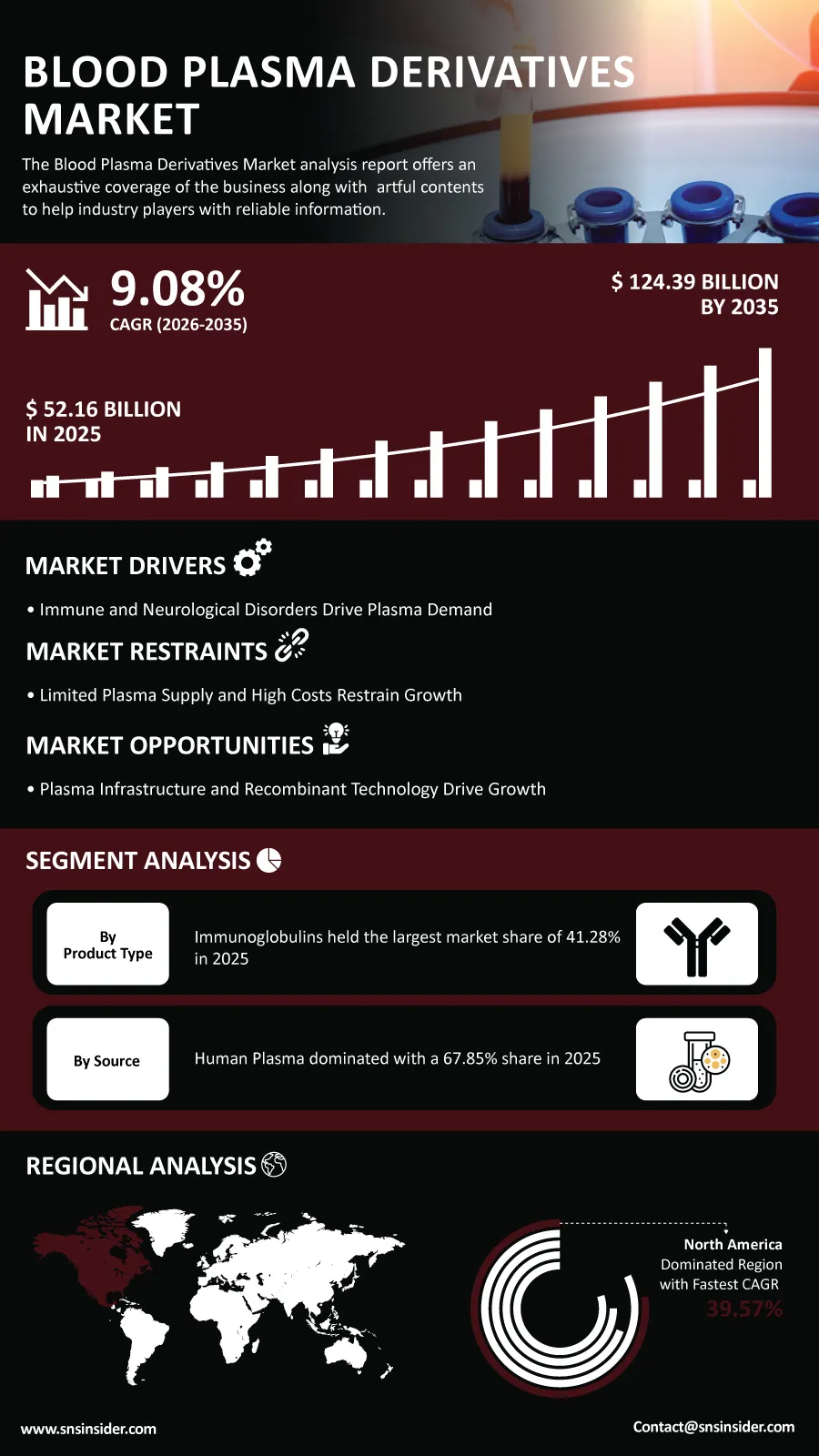
The global Blood Plasma Derivatives Market is projected to experience significant growth over the next decade as healthcare providers increasingly adopt plasma-derived therapies for the treatment of complex immune, neurological, hematological, and rare disorders. “According to a recent study by SNS Insider, the global Blood Plasma Derivatives Market size valued at USD 52.16 billion in 2025, is anticipated to grow to USD 124.39 billion by 2035, registering a CAGR of 9.08% over the 2026–2035 forecast period.”
Increasing usage of plasma-based products in various medical fields along with ongoing investments in biopharmaceuticals and plasma collection infrastructure are adding to the industry’s future potential. Healthcare organizations in different parts of the world are increasing the accessibility of specialty pharmaceuticals that can manage serious health issues and improve patient outcomes using biological medications.
With rising demand for specialty products, companies are working on building their production capacities, collaborating with research firms, and utilizing latest technologies.
To Get Detailed Insights on the Blood Plasma Derivatives Market – Request a Sample Report
Innovation and Manufacturing Expansion Strengthen Industry Outlook
Innovation and improvement in the fields of plasma fractionation techniques, automation, and recombinant technology are transforming the future landscape of plasma therapeutics. Manufacturers are upgrading their manufacturing plants and enhancing their products' quality, efficiency, and scalability in line with rising demand on the global front.
The increase in the number of plasma collection centers, improved cold-chain logistics, and increased investments in biologics production is contributing toward market growth. Partnerships between biotechnology firms, healthcare providers, and research institutes have also been fueling innovation in the field while expanding the choice of treatment options.
Growing emphasis on patient safety, manufacturing quality, and supply chain resilience is expected to remain a key priority across the industry throughout the forecast period.
Key Market Findings Highlight Emerging Opportunities
Among product categories, immunoglobulins accounted for 41.28% of global market revenue in 2025, reflecting their extensive use across a wide range of immune-related therapeutic applications.
Meanwhile, fibrinogen concentrate is projected to register the fastest growth through 2035, expanding at a CAGR of 10.74%, supported by increasing utilization in trauma care, surgical procedures, and bleeding management.
From a sourcing perspective, human plasma represented 67.85% of total market revenue in 2025, maintaining its leadership through established clinical use and robust therapeutic effectiveness. At the same time, recombinant technologies are expected to witness the fastest expansion, advancing at a CAGR of 11.29%, reflecting increasing industry focus on scalable production and enhanced product safety.
By therapeutic application, immunology accounted for 38.62% of market revenue in 2025, while neurology is expected to emerge as the fastest-growing application segment, recording a CAGR of 9.97% through 2035, driven by expanding therapeutic use in neurological disorders.
Among end users, hospitals and clinics held 54.43% of global market revenue in 2025, whereas research institutes are projected to grow at the fastest CAGR of 8.86%, supported by increasing clinical research activity and scientific collaborations.
Increasing Investment in Specialty Therapeutics Drives Future Demand
In the ongoing evolution towards tailored and disease-specific healthcare solutions, providers continue to broaden access to sophisticated biologic drugs. The growing interest in specialty drugs, rare diseases, and advanced biologic medications opens new possibilities for the development of the plasma therapeutics market.
The sector is also experiencing increased research funding, improved diagnostics, and cooperation between academia and biotech companies. Such activities are expected to spur innovation in the field and increase applications for plasma-based medicines.
North America Led with 39.57% Market Share in 2025, While Asia Pacific to Expand at 10.89% CAGR Through 2035
North America was responsible for 39.57% of market revenue in 2025 due to the presence of high-end healthcare facilities, established plasma collections channels, favorable reimbursement policies, and sustained spending on biologic drugs. North America is considered one of the key leaders for plasma collection, products development, and marketing.
On the other hand, Asia Pacific is expected to become one of the fastest growing regional markets at a CAGR of 10.89% till 2035. Increasing healthcare investments, growing facilities for plasma collection, growing production of biologic drugs, and increasing availability of specialty drugs are creating many opportunities in this region.
Leading Companies Continue to Expand Global Capabilities
Competition within the blood plasma derivatives market remains highly dynamic as manufacturers continue investing in production capacity, technological innovation, research partnerships, and geographic expansion to strengthen their global presence.
Key companies operating in the global blood plasma derivatives market include CSL Limited, Takeda Pharmaceutical Company, Grifols, Baxter International, Octapharma, Kedrion, LFB Group, Biotest, ADMA Biologics, and SK Plasma.
An SNS Insider analyst Parry Kardani commented, "The blood plasma derivatives market is entering a new phase of expansion driven by increasing demand for specialty biologics, advancements in plasma processing technologies, and broader adoption of plasma-derived therapies across multiple therapeutic areas. Companies investing in manufacturing innovation and global supply capabilities are expected to remain well-positioned for long-term growth."
About the Author

Get in touch




